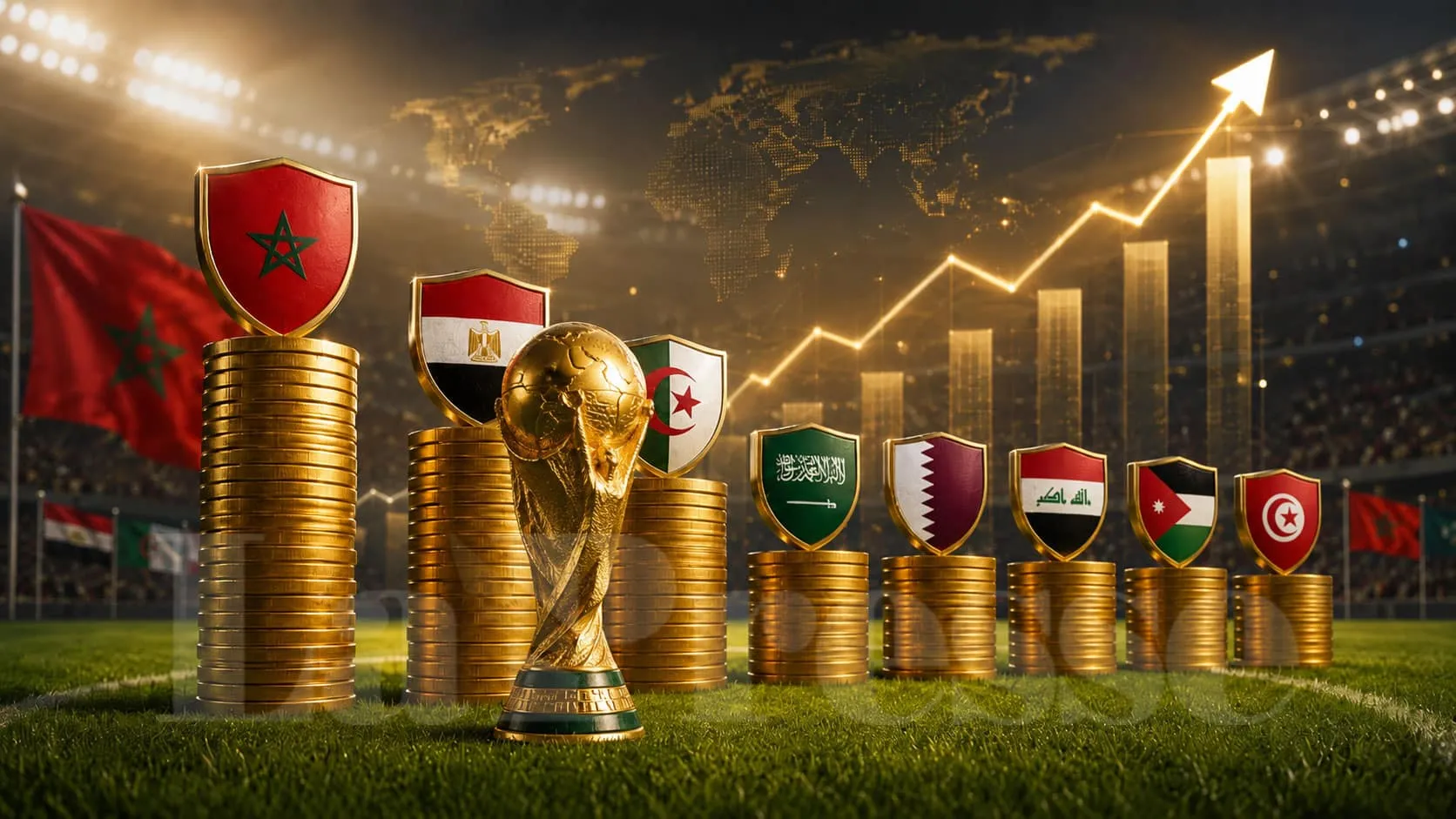

The 2026 World Cup has concluded, leaving behind not just memories of thrilling matches and emotional highs, but also a significant financial impact for the participating teams. Among the Arab nations, Morocco has emerged as the leader in financial gains, raking in an impressive $21.5 million, while Tunisia has also fared well, securing a total of $11.5 million in prize money.
As the dust settles on the 2026 tournament, Arab teams are now reflecting on their journeys, from early eliminations to remarkable achievements. The financial breakdown reveals that the discrepancies in earnings among these teams are largely attributed to their performance in the competition. Morocco stands out at the top of the regional rankings, with its substantial winnings stemming from a stellar run that saw them progress further than any other Arab representative.
This remarkable sporting achievement not only symbolizes a victory on the field but translates into significant financial rewards for the Moroccan Football Federation. It underscores the reality that in the World Cup, each stage reached is not just a symbolic triumph but also an economic boon.
Morocco Solidifies Its Status, Egypt and Algeria Follow Suit
Trailing behind the Lions of the Atlas, Egypt occupies the second spot among Arab teams with earnings of $17.5 million. The Pharaohs, buoyed by a robust campaign, managed to extend their World Cup journey and secure a financial reward that surpasses that of several other Arab teams. Meanwhile, Algeria completes the podium with $13.5 million in winnings, which, while lower than Morocco and Egypt, remains higher than the majority of other competing Arab nations.
These figures illustrate a fundamental truth in global football: the further a team progresses in the tournament, the greater the financial returns. Tunisia, alongside Saudi Arabia, Qatar, Iraq, and Jordan, has also benefited from a prize of $11.5 million. This amount corresponds to the earnings recorded by Arab teams that were unable to advance far enough in the competition to earn more.
For Tunisia, this financial influx is a significant boost, especially as national federations continually seek to enhance their resources, focusing on developing national teams, improving infrastructure, and investing in youth talent development. Beyond the numbers, the World Cup represents a human adventure filled with intense moments, disappointments, and aspirations. For Tunisian players, as well as other early-eliminated Arab representatives, the competition leaves behind invaluable experiences and lessons to be learned for the future.
Every Stage Reached Equates to Millions
The chasm between Morocco, the top Arab team with $21.5 million, and those earning $11.5 million stands at a staggering $10 million. This notable difference highlights the sporting and economic significance of advancing further in the World Cup. Behind the statistics and monetary figures, these prizes are crucial levers for the federations, potentially funding new projects, supporting training centers, and preparing for upcoming international challenges.
Thus, the conclusion of the 2026 World Cup brings forth a clear understanding: performance on the field is measured not only by victories and rankings but also by the financial benefits that can significantly influence the future of football in each country. As reported by lapresse.tn.