
Zina Daoudia Captivates Audience at the 55th Edition of the Marrakech National Festival
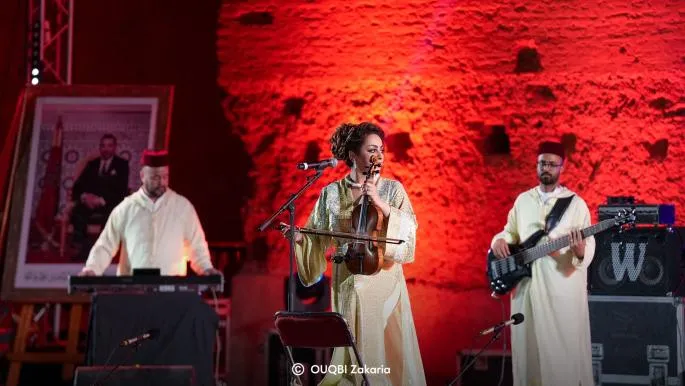
On July 6, 2023, Zina Daoudia took center stage at the grand finale of the 55th edition of the Marrakech National Festival of Popular Arts, captivating her audience with her poignant lyrics and heartfelt melodies. Her performance began with the evocative lines, "A day like my life today, my life today / The life I wished for is not this / Sometimes happy, sometimes angry, sometimes just ordinary / With tears, I sang, and I called out in exhaustion." The midnight crowd, predominantly composed of women, eagerly sang along to her famous songs characterized by a melancholic tune and steadfast rhythm. Many young women held their phones up, recording the performance while simultaneously sharing it on social media, creating a unique dual viewing experience. This phenomenon of recording and sharing not only enhances the enjoyment of the live performance but also allows them to express their feelings through the shared sentiments of the songs, which often lament themes of anger, misfortune, and the monotony of daily life.
A Celebration of Moroccan Heritage Through Modern Interpretation
The festival, which ran from July 2 to 6, 2023, honored Zina Daoudia for embodying a contemporary face of traditional popular music. With a modern look and innovative artistic approach, she is a "Sheikha"—a master of her craft. Daoudia aims to elevate the "Aita" genre beyond its rural roots by infusing it with Western instruments such as the organ, saxophone, and guitar, while carefully modulating their volume so that the lyrics remain audible and meaningful. This is how folklore is being modernized in the age of social media, particularly within historically rich venues like the Badi Palace, built by Sultan Ahmed al-Mansur to commemorate his victory in the Battle of the Three Kings in 1578 against the Portuguese invaders.
The festival, which was established in 1960 by the late King Mohammed V to promote Moroccan heritage both nationally and globally, is the oldest festival in the kingdom dedicated to preserving and transmitting intangible cultural heritage. This living heritage, which cannot be recorded in books or monuments, thrives through the voices and movements of its carriers from various regions, from the High Atlas to the edges of the Sahara. The festival showcased traditional dances accompanied by drums and flutes, illustrating how "life and worldviews are reflected in folklore" (Yuri Sokolov, "Folklore: Issues and History").
As the festival marked its 55th edition under the theme "Popular Arts: Treasures of Yesterday and Today," the director, Dr. Mohamed Kanidri, emphasized the importance of linking the past, present, and future through the preservation and transmission of Moroccan oral heritage to future generations. In a forward-thinking initiative, the festival has tasked music group leaders with selecting children aged 9 to 15 for practical training, enabling them to participate in a competition offering significant prizes in the next edition, ensuring the continuity of art across generations.
This year, the performances were not held at Jemaa el-Fnaa, a UNESCO-recognized masterpiece of intangible cultural heritage, due to the coinciding FIFA World Cup matches being screened on giant cinema screens. Thus, the musical festival aligned with the global soccer event, with players like Azzedine Ounahi, who celebrated his victory as Man of the Match after Morocco's triumph over Canada, remarking humorously, "This is the wedding microphone." Ounahi honed his skills in Casablanca with the "Rahal" team led by an internationally renowned Moroccan event planner, reflecting how folklore intertwines with soccer.
Folklore is deeply rooted in Moroccan culture and transcends mere performance; it is an expression of collective sentiment and popular taste. Every society resonates with rhythm and embodies it in their lives. According to Sokolov, "All of humanity shares the same mentality, which explains the similarities in cultural elements among distant peoples." Whether through the lens of soccer or dance, these artistic expressions communicate universally, devoid of language barriers. This global phenomenon was exemplified when Norwegian striker Erling Haaland celebrated a victory by playing the drum after a match, a gesture that resonated even in the Norwegian Parliament.
The festival honored the Aita genre in its feminine form through Zina Daoudia, who transitioned from playing soccer in the women's national team to becoming a celebrated singer. Such a profile intersects beautifully with the current era where folklore is becoming increasingly relevant to modern phenomena like soccer. Aita, originating from Morocco's plains, addresses themes of labor, life's hardships, the passage of time, and the beauty of women, often likening their movements to that of doves and their stature to horses. This cultural identity is rooted in the question: "Where am I from, and where are you from? From the heart of Morocco." In this way, Moroccan rural sociology has been orally documented long before formal studies were established by researchers like Paul Pascon.
Following Morocco's World Cup victory, young women donning the national team jersey gathered in luxurious cafes in Marrakech, joyously singing wedding songs whenever the handsome player Brahim Diaz appeared on screen. This evolving fan culture reflects a feminization of support for the Moroccan team, with a noticeable shift in cheering behaviors infused with dance. Traditional Aita war songs and group dances celebrated goals scored against teams like the Netherlands and Canada, showcasing a departure from individualistic performances towards collective action, a principle that also applies to soccer—teamwork is essential for achieving victory. This intersection of soccer and folklore is a testament to their interconnectedness.
The Aita songs often resonate with intense emotional beats, creating an atmosphere that may seem out of place in a luxurious five-star hotel in the heart of Marrakech. Zina Daoudia explained this intensity by saying, "Popular music is organized noise / Within popular music, there is the 'Haiha' (a communal call)." The term 'Haiha' draws from collective hunting to describe communal dancing on the brink of joy and chaos. Folklore is characterized by its imaginative exuberance, filled with exaggerations, serving as a genuine expression of the interests and aspirations of the masses. However, the portrayal of folklore often incites caution among serious writers, particularly in cinema, as Sokolov noted that committed intellectuals may perceive folk traditions negatively, viewing them as reflections of deficiency and hardship in life, much like Daoudia's songs.
As reported by alaraby.co.uk.