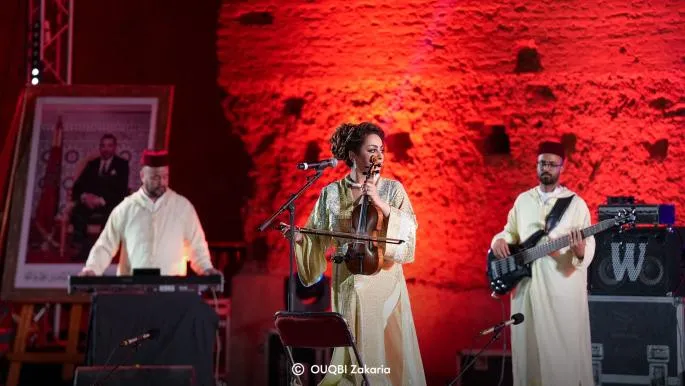

Zina Daoudia captivated audiences during the closing night of the 55th National Festival of Popular Arts in Marrakech, held on July 6. As she performed her poignant song, she articulated the complexities of life, expressing emotions ranging from joy to sorrow. The majority of the midnight audience was female, many of whom sang along to the well-known tune while capturing the moment on their phones, seemingly more engaged with the digital experience than the live performance itself. This dual experience of watching and sharing encapsulates the essence of modern entertainment.
The festival took place in the illustrious Bab Badi Palace, built by Sultan Al-Mansour Saadi to commemorate his victory in the Battle of the Three Kings against the Portuguese in 1578. The event honored Zina Daoudia for her embodiment of a contemporary face of traditional folk music. As a modern artist, she breathes new life into the "Aita" genre, blending traditional sounds with contemporary instruments like the organ, saxophone, and guitar, while ensuring that the essence of the lyrics remains audible and comprehensible.
This festival, which ran from July 2 to 6, is a celebration of Morocco's rich cultural heritage, showcasing how traditional art forms can be revitalized in today's digital age. The festival serves as a platform in historic royal palaces, where the past and present converge, allowing the ancient architectural beauty to resonate with the fresh content of modern folk songs. The late King Mohammed V founded this festival in 1960 to promote Moroccan heritage both nationally and internationally, making it the oldest festival of its kind in the country.
The festival reached its 55th edition under the theme "Popular Arts: Treasures of Yesterday and Today," prompting reflection on how it connects the past, present, and future of Moroccan folklore. Dr. Mohammed Kanidri, the festival director, expressed a forward-thinking vision aiming to preserve oral and intangible heritage for future generations. In a recent initiative, the festival appointed representatives from musical groups to mentor children aged 9 to 15, allowing them to participate in a competitive artistic showcase in the next edition, thus ensuring the continuity of this vibrant art form.
This year, the performances were not held in the famous Jemaa el-Fnaa square, recognized by UNESCO as a masterpiece of the intangible cultural heritage of humanity, due to the concurrent broadcasting of World Cup matches on large screens. The festival coincided with the global football event, further intertwining the realms of sports and folklore. The Moroccan football player Azzedine Ounahi, after winning the Man of the Match award for Morocco's victory over Canada, humorously remarked about the microphone being reminiscent of wedding celebrations, illustrating how deeply intertwined football and folk culture are in Morocco.
Folklore, deeply rooted in Moroccan soil, transcends mere performance; it is an expression of collective sentiment and popular taste. As noted by cultural theorist Yuri Sokolov, all human beings share a similar mentality, which explains the cultural similarities that exist among distant peoples. The joy of music and dance can be universally understood without the need for translation, showcasing a vivid global connection. Notably, Norwegian footballer Erling Haaland made headlines for drumming after a match, demonstrating how folklore and sports influence each other and unite people.
The festival celebrated the "Aita" genre through Zina Daoudia, who transitioned from playing football to a successful singing career. This multifaceted profile aligns with the current phase of folklore, which embraces the rhythm of football culture. Emerging from the plains of Morocco, "Aita" is a folk song that narrates the struggles of agricultural life, the passage of time, and the valor of horsemanship, often likening the grace of women to that of birds, and their stature to that of horses. The identity roots are articulated in the question of origin: "Where am I from? Where are you from? From the heart of Morocco."
In light of Morocco's World Cup success, young women donned national team jerseys in luxurious Marrakech cafes, celebrating and singing wedding songs whenever handsome players like Brahim Diaz appeared. The support for the Moroccan team has taken on a feminine touch, altering the dynamics of encouragement and blending it with dance. The traditional war songs and communal dances reflect the spirit of collective achievement, emphasizing that victory in both folklore and football requires harmony and unity.
In her performances, Zina Daoudia evokes a plethora of emotional beats, which may not suit the lavish atmosphere of a five-star hotel in Marrakech. She explained, "The folk genre is an organized chaos; it is full of life and energy." This chaos translates into an exuberant form of artistic expression that reflects the genuine interests and aspirations of the masses.
Consequently, engaging with folklore can provoke caution among serious writers, particularly in cinema, as noted by Sokolov, who observed that engaged intellectuals often hold a negative view of folk heritage, associating it with deficiencies and hardships in life. Nevertheless, the vibrant nature of Zina Daoudia's music challenges these stereotypes, showcasing the resilience and richness of Moroccan folklore.
As reported by alaraby.co.uk.