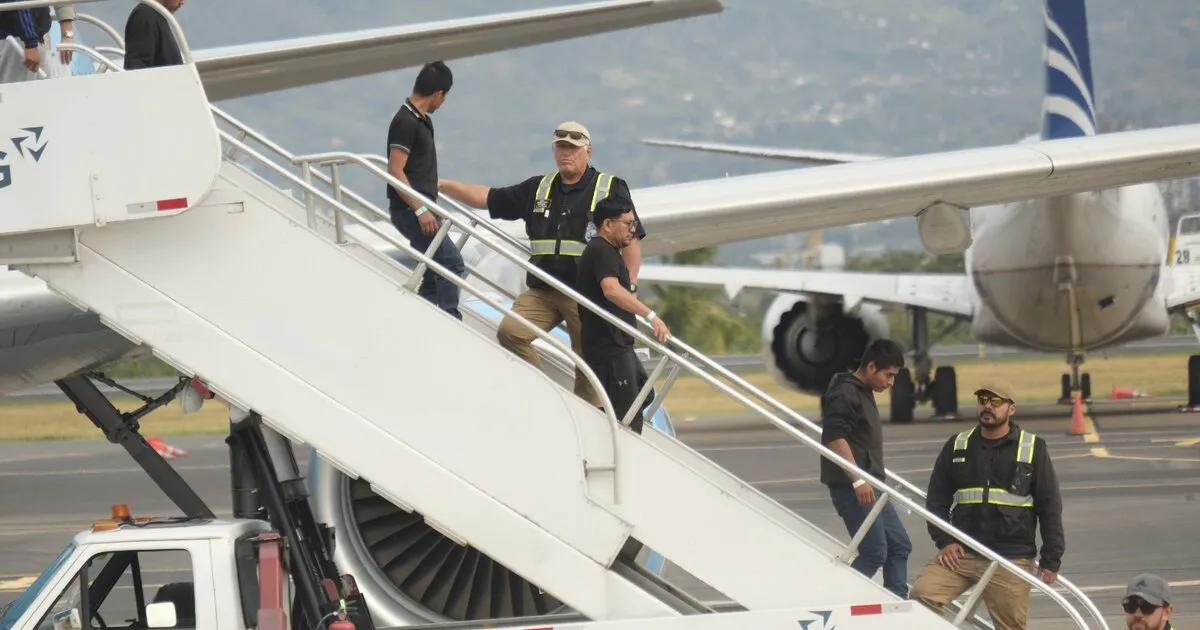

Arrival of Deportees Marks New Immigration Policy
On April 11th, a significant event took place as the first group of 25 deported individuals from the United States landed in Costa Rica. This group included nationals from various countries such as Albania, Cameroon, China, Guatemala, Honduras, India, Kenya, Morocco, and one Costa Rican citizen. Their arrival is part of a newly established immigration memorandum signed by President Rodrigo Chaves in late March with U.S. Special Envoy Kristi Noem. The flight touched down at approximately 2:45 PM at Base Dos of Juan Santamaría International Airport, where officials from the General Directorate of Migration and Foreign Affairs announced that the deportees were exempt from visa requirements, particularly for individuals from Albania, Cameroon, Kenya, China, India, and Morocco. Furthermore, Honduran nationals were exempted from providing police background checks, although authorities ensured that checks against judicial systems, Interpol, and other international bodies would still be conducted.
Support and Options for Deportees
The official statement detailed the options available for these migrants, including voluntary return, asylum requests, or participation in a temporary humanitarian regularization program. Initially, they will receive primary assistance from the Professional Migration Police, in collaboration with the International Organization for Migration (IOM). It was confirmed that the IOM will provide complimentary accommodation for these individuals in a hotel, where they will receive food and humanitarian assistance during their first seven days in the country. The financial responsibility for this arrangement will be covered by the IOM, after which it will be determined who may apply for the “Assisted Voluntary Return” program. Those expressing a desire to remain in Costa Rica legally will be granted permission under a temporary humanitarian regularization program.
Migrants can apply for special asylum status at any time, following standard legal procedures. Should they choose not to pursue either of these options, they are required to notify officials and exit the facilities where they are undergoing immigration control at their own discretion. Those opting to leave the country must inform the General Directorate of Migration and Foreign Affairs to clarify whether they will accept humanitarian assistance under the “Assisted Voluntary Return” program or if they will cover their own travel expenses.
This group of deportees adds to the 200 migrants previously deported to Costa Rica in 2025, who had been held for several months at the Temporary Migrant Care Center (CATEM). This arrangement faced significant scrutiny from several national institutions, including the Ombudsman's Office, the Constitutional Chamber, various members of the Republic's legislature, as well as international organizations and civil society groups. A recent regional report highlighted this case as a violation of the rights to liberty for those expelled from the U.S., who were forcibly brought to the country and deprived of their freedom without sufficient legal grounds. Notably, many individuals did not receive adequate information in their languages, timely medical attention, or proper living conditions during their stay at CATEM, which resembled a detention facility. Additionally, numerous deportees were returned to their countries despite facing political persecution.
According to Adam Álvarez, the director of the Jesuit Service in Costa Rica, the experiences of families from the previous group of 200 demonstrate the failures of such agreements. Currently, one year later, those who managed to remain in the country have settled in Monteverde and Liberia, with the support of the Quaker community, yet they find themselves in vulnerable situations. Many others were sent back to their home countries without sufficient information or language support to make informed decisions about their futures.
This field study was conducted by the American Friends Service Committee (AFSC), Casa Violeta in Guatemala, the Fray Matías de Córdoba Human Rights Center, and the Coalition for Immigrant Human Rights in Mexico, among others.
In this recent deportation, the individuals arriving in Costa Rica comprised:
- Cameroon: Four individuals (two men and two women)
- Guatemala: Eight individuals (five men and three women)
- Honduras: Four individuals (two men and two women)
As reported by semanariouniversidad.com.