
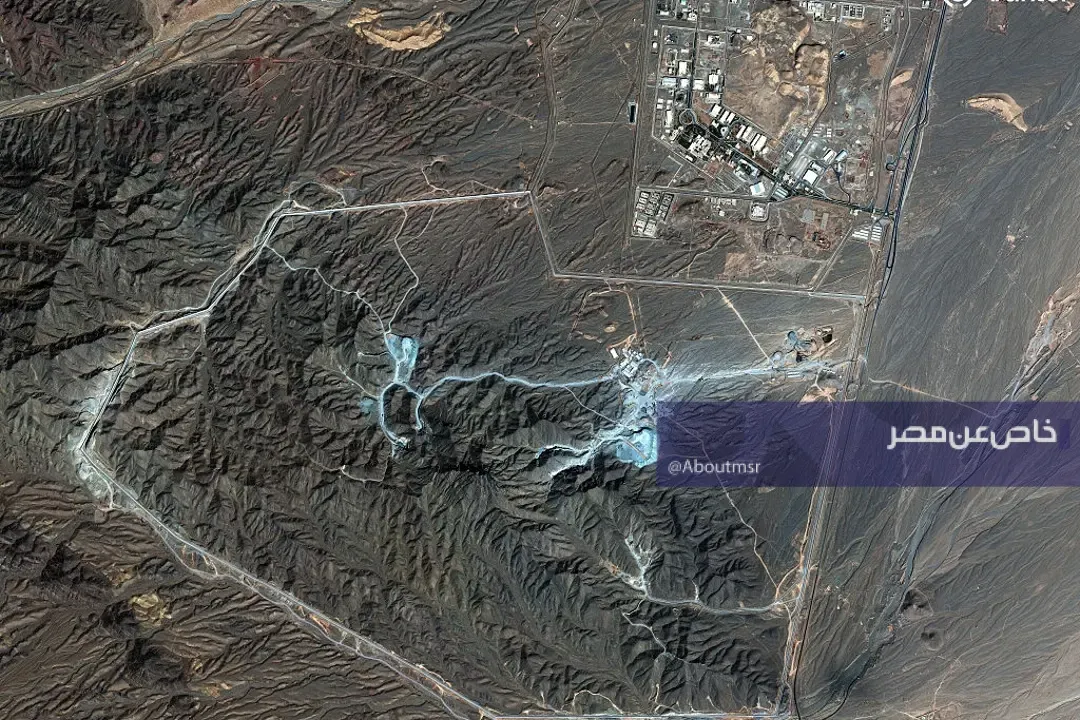

The Gabal Al-Fas has returned to the international spotlight following a statement from U.S. President Donald Trump, suggesting that the United States may launch a military strike against the suspected underground Iranian nuclear facility "very soon." According to a CNN report, this site, believed to be located near the Natanz uranium enrichment complex in Iran, is at the center of ongoing concerns regarding Tehran’s nuclear activities.
Israeli intelligence agencies suspect that the facility may contain enriched uranium and advanced centrifuge machines. However, Iranian officials deny these claims, insisting that their nuclear program is solely for peaceful purposes. In a statement made on Tuesday, Trump indicated, "It is very likely that we will strike that area soon, and they will not be able to do anything about it." In response, Tehran warned that any U.S. attack on its nuclear facilities would be viewed as an escalation of regional conflict, according to Iranian state media.
Understanding Gabal Al-Fas
The site known as Gabal Al-Fas is believed to be a heavily fortified underground facility, situated approximately one mile south of the Natanz uranium enrichment site, which has previously been targeted in U.S. and Israeli military strikes. Reports suggest that the facility is buried at a depth of at least 100 meters (328 feet) beneath the Kuh Kolang Gaz La mountain, whose Persian name contains the word "Kolang," meaning "axe." The construction of the facility reportedly began in 2020, when Iran informed the International Atomic Energy Agency (IAEA) that the underground complex would ultimately be used for assembling centrifuges to produce nuclear fuel.
Limited official information has been disclosed about this facility, with no engineering plans or technical designs made public. As a result, analysts have had to rely heavily on satellite imagery. Recent assessments indicate that the site possesses multiple underground tunnel networks, reinforced concrete entrances, extensive security perimeters, and infrastructure designed to withstand potential airstrikes. Experts believe that the complex is still under construction and has not yet begun full operations. It is thought that construction efforts accelerated following previous U.S. and Israeli strikes on Iranian nuclear facilities, including Natanz, increasing speculation that Iran might relocate sensitive nuclear infrastructure to more secure underground sites.
Why Analysts Are Monitoring Gabal Al-Fas
According to the Center for Strategic and International Studies (CSIS), several scenarios could explain the increased activity at Gabal Al-Fas. These scenarios include the manufacturing of advanced centrifuges for uranium enrichment, the transfer of operations from facilities damaged during past attacks, and the establishment of a secret uranium enrichment facility capable of supporting future nuclear activities. While analysts have proposed these possibilities, none have been independently confirmed.
An Israeli source informed CNN that Israeli intelligence believes Iran has relocated a portion of its enriched uranium stockpile and advanced centrifuges to Gabal Al-Fas following Israeli strikes conducted in June. During a 12-day conflict, Israel targeted three major Iranian nuclear facilities—Natanz, Isfahan, and Fordow—and several senior nuclear scientists were reported killed. The United States later joined the campaign, striking the same facilities with heavier weaponry. President Trump later stated that the attacks "completely destroyed" Iran's nuclear capabilities, yet Gabal Al-Fas was not among the targeted installations during those operations.
Subsequent assessments by U.S. intelligence and the United Nations indicated that despite damage to parts of Iran's nuclear infrastructure, elements of the program remained intact. The United States and Israel have identified two main objectives regarding Iranian nuclear materials: to encourage Tehran to relinquish its estimated 1,000 pounds of highly enriched uranium and to prevent the use of these materials in future enrichment operations. CNN previously reported that Iran has bolstered security around its uranium reserves by demolishing tunnels and placing explosives near the entrances of underground storage areas. When asked whether Iran had moved advanced centrifuges to Gabal Al-Fas, Trump appeared more cautious than previous Israeli assessments, stating, "We do not have any confirmed information on that matter."
Iranian officials continue to deny allegations that Gabal Al-Fas is being used to develop secret nuclear weapons. Earlier this month, a senior security source in Tehran told CNN that reports describing nuclear activity at the site are unfounded. Iran asserts that its nuclear program is entirely peaceful, arguing that uranium enrichment supports electricity generation for civilian purposes and future nuclear power plants while allowing for increased oil exports.
Experts remain divided on whether the underground complex could successfully be targeted militarily. Andrea Stricker, a nonproliferation specialist, stated to CNN that disrupting the facility would reduce Iran’s ability to restore uranium enrichment capabilities or access the thousands of remaining centrifuges tied to its nuclear program. However, analysts acknowledge that the depth of the site poses a significant military challenge. A report from the Institute for Science and International Security noted that while directly destroying underground chambers is difficult, many supporting systems may represent potential vulnerabilities, including ventilation infrastructure, heating and cooling systems, electrical power supplies, supply networks, and access routes for personnel. Targeting these supporting systems could disrupt operations even if the underground chambers remain intact.
Not all experts believe that military strikes would drastically reshape the strategic landscape. James Acton, co-director of the Nuclear Policy Program at the Carnegie Endowment for International Peace, argued that the United States would likely limit its efforts to demolishing entry tunnels rather than destroying the buried facility itself. According to Acton, such an operation would not fundamentally alter the regional balance of power, suggesting that military action alone may have limited long-term strategic impact. Gabal Al-Fas has become one of the most closely monitored sites within Iran's nuclear infrastructure as tensions between Washington, Tehran, and Israel continue to escalate. While Israeli intelligence believes that the underground complex may harbor enriched uranium and advanced centrifuges, U.S. officials have not publicly confirmed these assessments, and Iran continues to reject these claims, insisting that its nuclear activities are peaceful. Ultimately, the fate of Gabal Al-Fas, and whether it becomes the focus of any future military action, may hinge on intelligence evaluations, diplomatic developments, and the overall trajectory of regional tensions.
As reported by aboutmsr.com.

