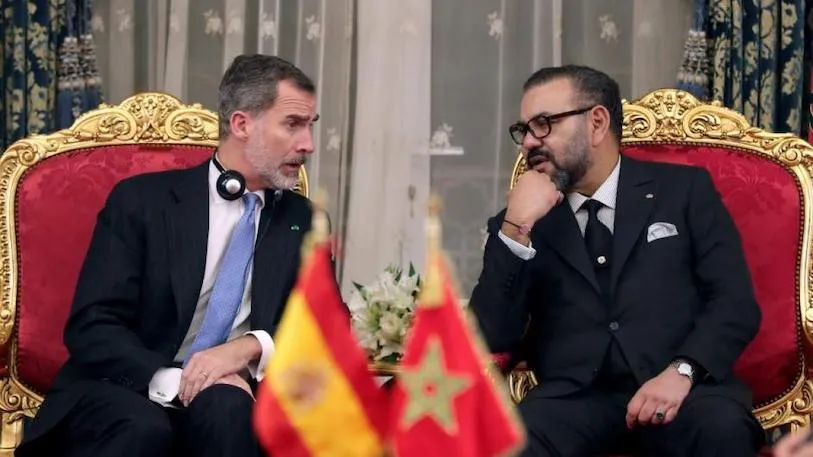

Geopolitical Battleground: The Case of Ceuta
The Swiss newspaper "Le Temps" reported in its weekend edition that the occupied city of Ceuta has become a complex geopolitical battleground involving Morocco, Spain, and the United States. In this dynamic landscape, Morocco has intensified its lobbying efforts and social networking activities aimed at garnering the support of American decision-makers, particularly from the Republican Party, to influence the future of the two occupied cities, Ceuta and Melilla.
According to the article, a U.S. congressional committee has initiated an investigation into Morocco's lobbying activities directed at the United States. This investigation has emerged in the context of a legislative measure adopted by the House Appropriations Committee last month, which pertains to national security issues, including what the newspaper describes as a "twisted alliance" between Morocco and the United States, with Washington allocating military aid of $40 million to Morocco.
"Le Temps" notes that the congressional committee is chaired by Republican Representative Mario Diaz-Balart from Florida, who shares Cuban ancestry with U.S. Secretary of State Marco Rubio. The committee has requested clarification from the U.S. State Department regarding its diplomatic stance on the status of Ceuta and Melilla. While this move does not carry any legal weight at present, it marks the first time an American institution has been established in such a manner concerning the status of these cities, raising concerns among Spanish political circles.
Implications for Spanish Sovereignty and Migration Patterns
The article further highlights that Diaz-Balart is known for advocating the view that Morocco is a "crucial" ally for both the United States and Israel, contrasting this with his description of the Cuban regime as "brutal and repressive." This development occurs against a broader backdrop, where allies of former President Donald Trump have been vocal in their criticism of the Spanish government led by Pedro Sánchez, accusing him of amplifying his "pro-Palestinian" stance. This sentiment was echoed by former U.S. Ambassador to the United Nations, David Friedman, who asserted that Sánchez appears eager to strengthen ties with the regimes of Iran, Cuba, and Venezuela, as reported by the conservative newspaper "El Español," which was referenced by "Le Temps" in its report.
These evolving circumstances have brought the issue of Western Sahara back into focus, a matter that "Le Temps" considers to be a significant leverage point for Morocco against Spain. It recalls that during the first Trump administration, the United States recognized Moroccan sovereignty over Western Sahara in exchange for normalization of relations between Rabat and Tel Aviv, known as the Abraham Accords. Meanwhile, Spain has maintained a more cautious approach regarding this issue.
Sources cited by "Le Temps" (which remained unnamed) suggested that Morocco has long utilized the Western Sahara issue as a means to unsettle the Madrid government, a tactic that has previously cost the former Spanish Prime Minister politically. The article posits that Spain's sensitivities regarding any infringement on its sovereignty over Ceuta and Melilla have become increasingly palpable, with Spanish Defense Minister Margarita Robles affirming that "no one undermines Spain's territorial integrity and sovereignty" over these cities.
In the context of the current migration situation in Ceuta, the paper reports that thousands of migrants continue to arrive in the city, with local authorities declaring that reception centers are at full capacity. This has prompted the Spanish government to deploy military forces to maintain security at the border with Morocco. Additionally, on July 31, calls for a new wave of migration towards Ceuta circulated via WhatsApp and Facebook, only to be deleted later. However, some groups remain active, exchanging practical advice on crossing the border by swimming or using diving equipment, with some suggesting a potential new migration movement on August 15, coinciding with holiday periods, which the paper interprets as a timing that could facilitate a larger influx of migrants.
In conclusion, "Le Temps" expresses skepticism about the "spontaneous" nature of these mass migration waves towards Ceuta, suggesting that there may be carefully orchestrated agendas behind these gatherings, although it refrains from definitively identifying the responsible parties or means involved.
As reported by lakome2.com.