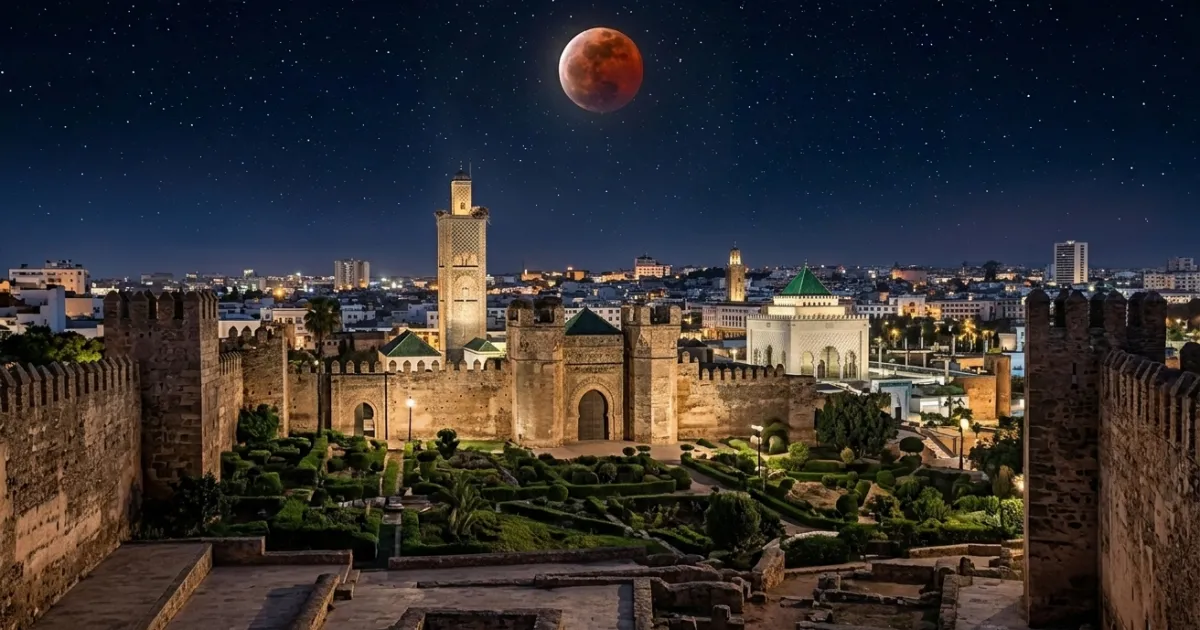

On the night of August 27-28, 2026, astronomy enthusiasts across the globe are gearing up for a spectacular celestial event: a deep partial lunar eclipse. During this phenomenon, the moon will pass through the Earth's umbra, creating a breathtaking sight that closely resembles a total eclipse. At the peak of this event, approximately 96.2% of the moon's disk will be enveloped in the Earth's central shadow, leaving only a small sliver illuminated directly by sunlight.
This lunar eclipse is notable as it will be the deepest of its kind observable from Earth until December 31, 2028, marking it as one of the most anticipated astronomical phenomena of the year. Unlike solar eclipses, which require special glasses or protective gear, lunar eclipses can be safely viewed with the naked eye, although binoculars and telescopes can enhance the experience and provide additional detail.

The penumbral phase of the eclipse is set to begin at 2:23 AM Mecca time, followed by the partial eclipse at 3:33 AM, with the peak occurring at 5:12 AM. The partial eclipse will conclude at 6:51 AM. Regions including Morocco, western Algeria, and various areas of Mauritania will offer some of the best viewing opportunities in the Arab world, as they will be able to observe the entire phases of the partial eclipse before the moon sets in the morning.
Understanding the Lunar Eclipse and Its Red Hue
A lunar eclipse occurs when the sun, Earth, and moon align, with Earth positioned between the sun and moon, blocking a portion of the sun's direct light from reaching the moon's surface. As the moon progresses into the Earth's central shadow, the dark area gradually expands across its surface. At the peak of the eclipse, the majority of the moon will appear in shades of red or copper-orange, with a thin crescent still lit by direct sunlight. This reddish hue is attributed to sunlight passing through the Earth's atmosphere, bending, and some of it reaching the moon's surface.

According to data from Time and Date, the total duration of the lunar eclipse will be approximately 5 hours and 38 minutes, with the partial phase lasting around 3 hours and 18 minutes.
What Will Arab Observers Experience?
Viewing conditions will not be uniform across the Arab countries, as the timing of the eclipse aligns with different hours of the night or dawn depending on geographical location. Areas in North Africa and parts of the Levant will be able to see various phases of the eclipse, while other regions may have limited visibility due to the moon setting before the peak of the event. The eclipse will reach its peak globally when 96.2% of the moon's disk is in the Earth's shadow, although the visible percentage will vary from one Arab country to another. North African countries will have the most favorable opportunities to witness the partial eclipse, while parts of the Levant and Gulf regions may only see the initial or penumbral phases.
In Morocco, Algeria, Tunisia, and Egypt, the chances of observing the partial eclipse will be significantly better, with visibility decreasing as one moves eastward, as the moon will dip below the horizon before reaching the peak eclipse in some areas.
To clarify the extent of the eclipse that residents of Morocco and the broader Arab world will realistically observe, we spoke with Moroccan astronomer Abdel Samad Dkan, president of the Moroccan Initiative for Science and Thought. We posed four questions to him:
Question 1: What does the 96.2% eclipse mean for viewers?
Abdel Samad: This means that roughly 96.2% of the visible moon's disk will enter the Earth's shadow at the peak of the global eclipse, covering most of the disk, while a very small part remains outside the shadow. Therefore, it is a very deep partial eclipse that approaches totality but will not become total. It is important to note that this percentage is global and may differ for observers depending on local factors such as the moon setting or the sun rising.
Question 2: How will the eclipse appear from Morocco?
Abdel Samad: Morocco is one of the best Arab regions for observing the eclipse, as viewers will be able to see its phases from the beginning at night until the early morning hours. In global timing, the partial phase begins at 2:33 AM, with the peak occurring at 4:12 AM, when the moon is towards the west and southwest. However, Moroccan observers will not see the global eclipse percentage of 96.2%; they will observe an obscuration of about 93.91% before the moon sets between 5:49 and 6:21 AM, depending on the city.
Question 3: What about the rest of the Arab world?
Abdel Samad: Visibility will vary greatly from one country to another. The Maghreb countries are the best for observing the eclipse, while viewing will be limited in the Levant and Gulf regions. For instance, in Jordan and Egypt, viewers can see the beginning of the eclipse and some phases before the moon sets, while visibility is very limited in Saudi Arabia. In the UAE and Gulf countries, the moon will be below the horizon at the peak of the eclipse, and most areas will only witness the penumbral phase.
Question 4: Does observing the eclipse require special equipment?
Abdel Samad: No, a lunar eclipse can be safely viewed with the naked eye and does not require special glasses like a solar eclipse. Binoculars or small telescopes can be used to see the details of the moon's surface and the edges of the Earth's shadow more clearly, and you can use a smartphone or camera to capture the stages of the eclipse, ideally mounted on a tripod.
The upcoming lunar eclipse is a celestial event worth waking up for, as the Americas will be in prime position to witness the various phases of the eclipse, while parts of Europe and Africa will see the event before sunrise, with the moon heading towards the western horizon. Estimates suggest that around 3.34 billion people may be able to observe at least the partial phase of the eclipse.
All you need for optimal viewing is a clear sky and an unobstructed location, but using binoculars or a telescope can make the experience even more thrilling, especially as the shadow gradually moves across the lunar landscape. This eclipse serves as a stunning reminder that the sky continues to present mesmerizing cosmic displays that everyone can enjoy without complicated preparations, and observing celestial movements remains one of the simplest and most inspiring ways to understand our place in the vast universe.
As reported by aljazeera.net.