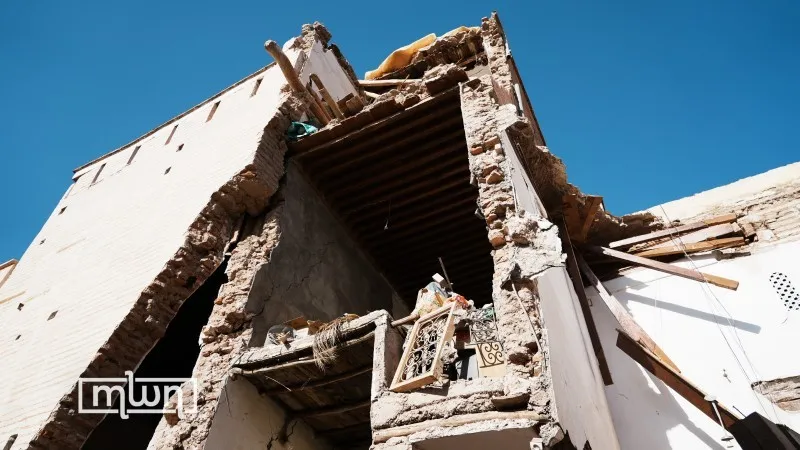
New Insights into the Al Haouz Earthquake
A recent scientific investigation published in the esteemed journal "Seismological Research Letters," a prominent platform of the Seismological Society of America, has provided critical insights into the Al Haouz earthquake of 2023, which stands as one of the most catastrophic natural disasters in Morocco's history. The paper, titled "The 2023 Mw 6.8 Al Haouz Lower Crustal Earthquake Buried in a Thick Crust Within a Thin Lithosphere Beneath the High Atlas Mountain Range (Morocco)," delves deep into the mechanisms behind this devastating seismic event that occurred beneath the majestic High Atlas Mountains.
The lead author, a dedicated PhD student from the Faculty of Sciences and Technics in Tangier, conducted this research under a fellowship supported by the International Centre for Theoretical Physics (ICTP) and the International Atomic Energy Agency (IAEA) through their Sandwich Training Programme, which provided essential resources and support for the project.
Significant Findings and Implications
This publication represents a collaborative effort among international research institutions, highlighting the global significance of comprehending the Al Haouz earthquake and its tectonic origins. One of the most noteworthy findings of the study indicates that the earthquake rupture extended through at least two-thirds of the thick crust located beneath the High Atlas. The investigation revealed that this rupture occurred in a distinctive area characterized by an unusually thin lithospheric mantle, measuring approximately 30 kilometers thick, situated at the edge of the western African craton.
The research suggests that the slow deformation of this region is likely influenced by a combination of oblique crustal convergence and localized asthenospheric uplift. The authors propose that this uplift may be associated with the lateral flow from the Canary Plume as it interacts with the western African craton. This indicates that the catastrophic earthquake was not solely a result of superficial tectonic processes but was also affected by deeper geodynamic forces within the Earth.
In order to arrive at these conclusions, the study employed a range of advanced geophysical techniques, such as satellite-based deformation measurements, aftershock analysis, Coulomb stress modeling, ambient-noise seismic tomography, and P-wave coda autocorrelation. The integration of these methods has yielded a more comprehensive understanding of the earthquake's source and the complex geological structure lying beneath the High Atlas.
The significance of these findings extends beyond merely describing the earthquake; they illuminate the underlying tectonic conditions that enabled such a devastating event to occur in a region where surface deformation is relatively gradual. This enhances scientific comprehension of seismic hazards in Morocco and provides valuable insights for future research on seismic activities in the area.
Moreover, this study has garnered considerable international recognition, currently holding the top position on the journal's "Most Read" list in "Seismological Research Letters." As Morocco continues to assess the repercussions—both human and infrastructural—of the Al Haouz tragedy, such scientific inquiries are pivotal in enhancing our understanding of the geological forces that contribute to the nation's seismic risk.
As reported by moroccoworldnews.com.