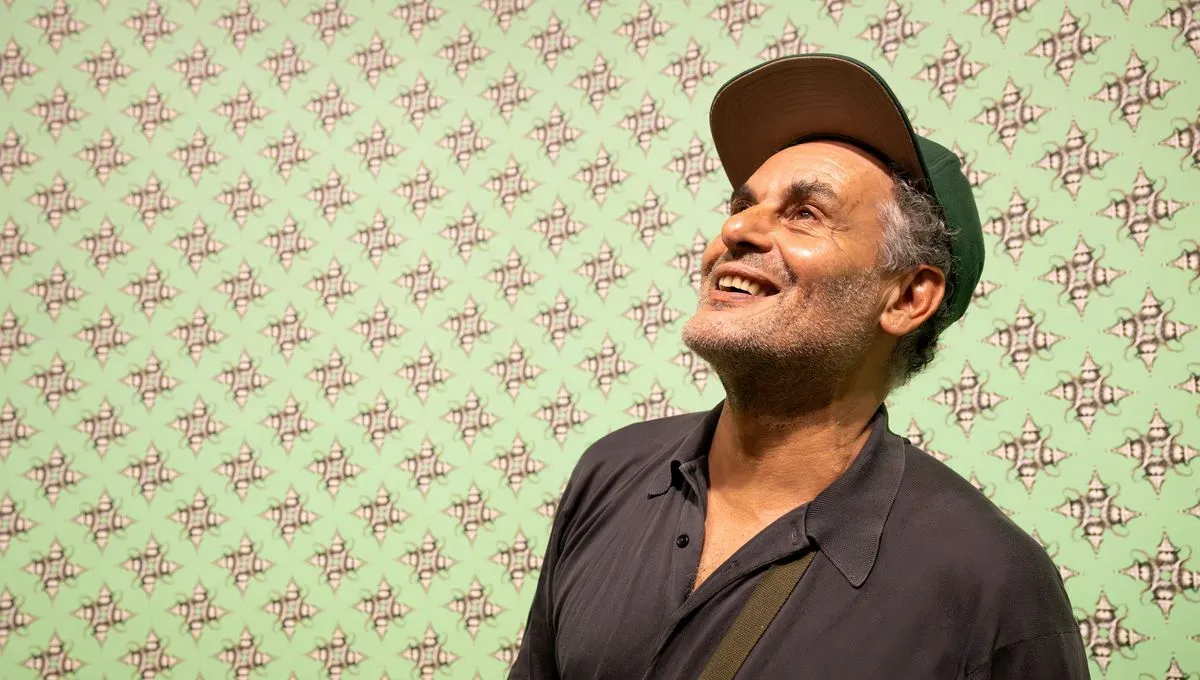

After his first exhibition in France seven years ago at the European House of Photography, Hassan Hajjaj now takes over the City of Music with his latest showcase titled 'My Rock Stars.' This exhibition serves as a vibrant homage to a previous project, 'My Maroc Stars,' and invites viewers into Hajjaj's colorful universe—a kaleidoscope where the cultures of yesterday and today, East and West, intertwine harmoniously. Notably, the project is deeply musical, set within the halls of the Museum of Music, resonating with a concert schedule at the Philharmonie. The exhibition is further enlivened by the musical contributions of Acid Arab, a collective of musician friends who also provided an exclusive mix for the show, which can be enjoyed through their recent album release. Hajjaj, often referred to as the Andy Wahloo by the late Rachid Taha, exemplifies a creative spirit that transcends boundaries.
From Larache to Paris with a Stop in London
As a child of the diaspora, Hassan Hajjaj grew up at the crossroads of Eastern and Western cultures, an experience that he believes is inseparable and intricately woven together. His early life unfolded in Larache, Morocco, along the banks of the Loukkos River, characterized by its picturesque houses nestled between the Atlantic Ocean and a riverbank. "Larache is a hidden gem in northern Morocco, near Tangier. It’s a quaint blue and white town that features an ancient medina and a fishing port. I have cherished memories of freedom there, enjoying summers on the beach and winters flying kites. While my childhood memories of Morocco remain vivid, I appreciate how Moroccans today have evolved while keeping traditions vibrant," he reminisces.
At the tender age of 13, Hajjaj faced exile, relocating with his family to the diverse neighborhood of Islington, London, where communities of Chinese, Indian, Caribbean, and African descent coexist. It was within the vibrant cultural tapestry of 1980s Britain—where punks mingled with rastas and The Clash's 'Rock the Casbah' played on the radio—that Hajjaj first immersed himself in the arts. Despite the challenges posed by unemployment, racial tensions, and the conservatism introduced by Thatcher's government, London was a melting pot of cultures, with a soundtrack comprising reggae, hip-hop, dub, and electro, all of which would significantly influence Hajjaj's work as he navigated this cultural shock. Interestingly, his first memory of England was not artistic but athletic, recalling how amazed he was to play soccer on an actual field with everyone fully equipped—a sight he had never encountered in Morocco.
At 16, he ventured out on his own, juggling odd jobs while organizing sound systems in the basements of Kentish Town. His unrestrained creative spirit set him apart from institutional confines and led him into the realms of photography and styling, eventually operating a shop in Camden and later a boutique in Covent Garden.
An Indelible Connection to Music
Hassan Hajjaj's photographic portfolio features an array of icons, from pop stars like Billie Eilish and Madonna to hip-hop legends such as Mobb Deep and the Wu-Tang Clan, alongside traditional gnawa musicians—an genre he holds dear. When asked which music he wishes to share, he expresses a deep affinity for gnawa and capoeira music, describing both as spiritual and akin to a heartbeat. “It’s music of the spirit, and I resonate with that,” he states. These rock stars reflect his eclectic journey: “Growing up in Morocco, music enveloped my childhood. We had only one radio, and I believe the first record I ever bought was 'Dread in Babylon' by U-Roy. My passion for music has remained significant throughout my life, including now. Although I can’t recall the last record I purchased, I would recommend 'Desert Jazz' by the Arfoud Brothers & Sisters, who are close friends.”
In 'My Rock Stars,' audio cassettes serve as a vital cultural connector to the music of the Maghreb, complemented by vinyl records that have inspired Hajjaj as a photographer. He believes that an album cover should be a work of art in its own right, even if it doesn’t directly relate to the music. He cites the striking cover of Pink Floyd's 'Wish You Were Here' as an exemplary piece that enhances the album's impact.
Hajjaj's life was forever altered through meaningful encounters, particularly with Rachid Taha, with whom he shared an artistic brotherhood forged by their experiences of early exile—Hajjaj in London and Taha in Paris. Taha affectionately dubbed him 'Andy Wahloo,' a nod to the Pop Art icon Andy Warhol as well as the Arabic expression meaning 'I have nothing at all.' This moniker also reflects Hajjaj's penchant for recycling objects in his creations, a nod to Africa's culture of repurposing, as seen in the cans and boxes that frame his photos and the plastic crates that delineate the exhibition's scenery.
As he reminisces about Taha, Hajjaj recalls, "The Rachid I knew was sensitive and caring, in addition to being immensely talented. On the day of our photo shoot in Paris, I expected him to arrive late, but he surprised me by being 30 minutes early. We ended up sharing a wonderful day together, which has become a cherished memory for me."
Hassan Hajjaj's commitment to artistic freedom has been unwavering since the outset of his career. He expresses, "By collaborating with a multitude of people worldwide, I learn from diverse cultures and celebrate our differences, which are our wealth. We should all remain humble and proud of our roots, regardless of where we come from. My journey has been a blend of Moroccan and London heritage, allowing me to exhibit my work across Europe, Africa, and the Middle East.” However, Hajjaj is not solely a photographer of musicians; he also captures the essence of everyday individuals. Celebrity status does not alter his approach, as he emphasizes, "I always photograph in the same manner: I create a connection with the person before me, regardless of who they are or where they come from. The common thread is that they are all inspiring human beings." In discussing photography, he admires the works of Jamel Shabazz and Malick Sidibé for their poignant documentation of their times, the people, places, and moments captured in their images.
'My Rock Stars' encapsulates a colorful and prolific career that melds various mediums—fashion and photography foremost—with a consistent vision: to celebrate cultural amalgamation, erase borders, and forge a compelling, humanistic creative force.
As reported by radiofrance.fr.