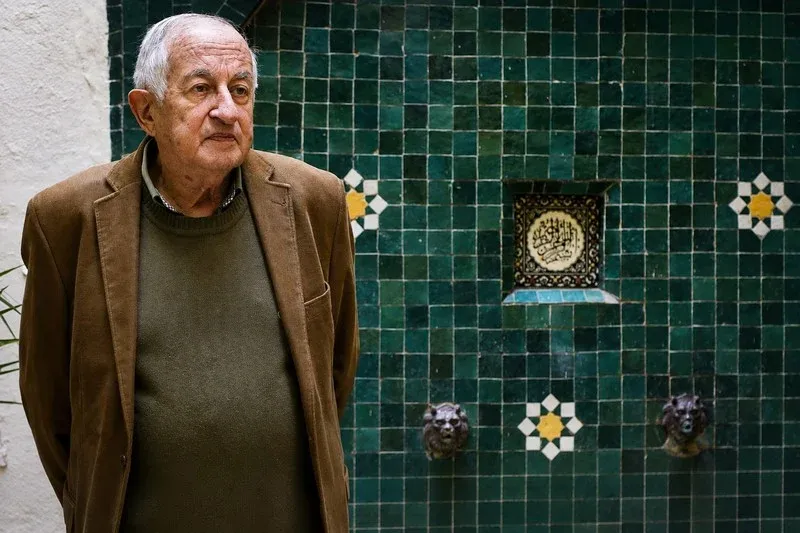

The Role of Translators in Expanding Literary Horizons
Moroccan translator and writer Ibrahim El Khatib asserts that translators are instrumental in crafting global literature. They broaden the reach of literary works by reinterpreting and disseminating them among readers who may not be proficient in the original languages. Over the decades, El Khatib has significantly contributed to the Arabic literary scene by 'rewriting' works from prominent authors such as Jorge Luis Borges, Juan Goytisolo, and Paul Bowles, as well as critical perspectives from influential schools of thought, including Russian Formalism and French Surrealism, alongside figures like Roland Barthes. His extensive literary criticism has provided insights into the latest publications, particularly those connected to Morocco or penned by Moroccan authors in the realm of narrative.
Juan Goytisolo: A Literary Legacy Intertwined with Morocco
In his latest work, released at the beginning of his eighth decade, Ibrahim El Khatib offers readers a vivid portrayal of Juan Goytisolo, highlighting his connections to Moroccan, Palestinian, and French landscapes, along with his engagement with Moroccan literary expressions, both rooted and contemporary. The book reflects on Goytisolo's life before his passing in Marrakech, where he was laid to rest in Larache. A notable figure in literature, Goytisolo, who hailed from the famous Jemaa el-Fnaa square in Marrakech, advocated for its recognition as a UNESCO World Heritage site, and the book is aptly titled 'The Last of the Moors.'
Published by Al-Mutawassit, the book, 'Juan Goytisolo: The Migration of the Last Moors,' is a testament to El Khatib's translation prowess. The introductory note explains that Goytisolo resided in Morocco since the early 1970s, producing a prolific body of work that encompasses novels, short stories, literary criticism, political essays, and documentaries addressing global issues. Throughout his career, he remained committed to humanitarian causes, exposing Western hypocrisy and opposing all forms of oppression, while emphasizing the importance of cultural diversity and the values of the Islamic world.
This new publication delves into Goytisolo's relationship with Morocco, El Khatib's connection to the writer, and the legacy of the esteemed author, showcasing the collaborative efforts of translators from both Morocco and the broader Arab world to produce a work that navigates between two realms: Europe and Morocco, two cultures: Christianity and Islam, and two languages: Spanish and Arabic. Mahmoud Abdel Ghani, poet, translator, and critic, who is known for his works such as 'The Tangier Dictionary' and 'The Essential Terms in Literary Translation,' regards El Khatib's latest work as a significant tribute to Goytisolo, a writer who enriched the world with the beauty of his narratives, his unwavering principles, and deep commitment to both Europe and Morocco/the Arab world. Goytisolo's profound connection with Morocco served as a cultural, aesthetic, and spiritual driving force that indelibly marked his literary output. For instance, in 1978, he defended Morocco's rights in the Sahara, as articulated in his book 'The Sahara Problem,' and he chose the city of Tangier as the backdrop for his novel 'Don Julian.' Additionally, the narrator in his novel 'The Cemetery' reflects the traditional storytellers who populate the Jemaa el-Fnaa square in Marrakech.
One aspect that particularly resonated with Abdel Ghani in El Khatib's writings is Goytisolo's critique of the negative stance of 'official and popular Spanish opinion' towards the 'Global South,' especially Arab countries, with a specific focus on Morocco. The Catalan author emphasized the necessity for a concerted intellectual effort to liberate Spain from its excessive European centrism, advocating for a deeper understanding of the language, thought, literature, and arts on the other side of the Mediterranean. This is particularly relevant given the prevalent deep-rooted ignorance within Spanish public opinion regarding the culture, values, and lifestyles of these peoples, alongside their political, economic, and social challenges.
As reported by hespress.com.