
Idris Ouaghich's New Literary Exploration of the Sahara
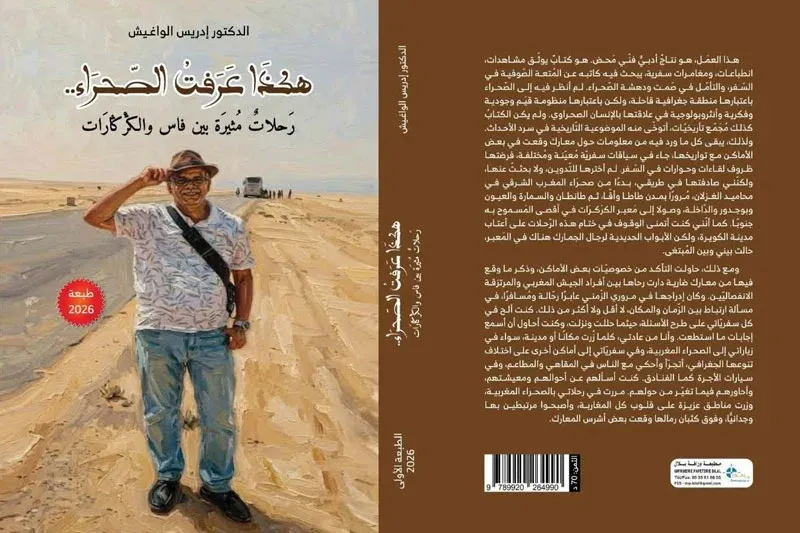
Moroccan author Idris Ouaghich has recently released a compelling new book titled “This is How I Came to Know the Sahara: Exciting Journeys Between Fez and the Karkarat.” Published by Bilal Press in the city of Fez, this literary work serves as a continuation of Ouaghich's exploration of Moroccan desert landscapes through narrative and reflective writing. This new release adds to his impressive portfolio, which already includes ten diverse publications spanning fiction, poetry, and criticism.
The book spans 402 pages and presents an artistic journey grounded in Ouaghich's observations and impressions during his travels between the city of Fez and the Karkarat crossing. The cover art, created by Ouaghich himself, features a contemplative moment set against the vast desert, symbolizing the very essence of the space that this publication seeks to explore.
A Tribute to Sacrifice and Identity
Ouaghich begins his book with a heartfelt dedication to the soldiers stationed along the borders and to all who have contributed, through action or word, to the preservation of the nation. He emphasizes that this work is a tribute to their sacrifices in the Moroccan Sahara.
In the introduction, critic Mohamed Youb notes that this publication transcends mere documentary writing or fictional narrative, offering instead a literary text that blends journey and contemplation. The Sahara becomes a backdrop for existential questions and reflections on history and identity, transforming the details of the road, the soldiers, the movement of trucks, and the winds into narrative elements that capture the depth of human experience in this region.
Furthermore, the author asserts in the preface that his work belongs to the genre of travel literature, drawing upon personal experiences and reflections on both place and humanity. He portrays the Sahara not just as a physical space but as a cultural and civilizational landscape filled with human and anthropological values, while also ensuring the text possesses an artistic dimension that harmonizes description, impression, and contemplation.
As reported by hespress.com.