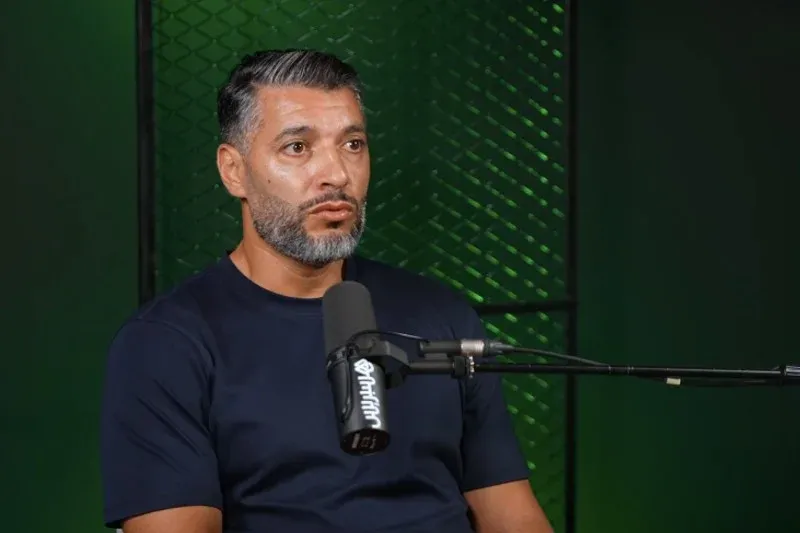

Ihsan Al-Shar'i, the Moroccan coach of the Belgian club Westerlo, recently shared insights during an interview on the program "Mal'ab Hespress" hosted by Mohamed Amin Metbar, the editor-in-chief of the sports section at Hespress. His visit to Morocco coincided with the national team's match against Gabon, where he expressed his satisfaction with the overall performance of the "Lions of the Atlas," despite noting a few areas for improvement. He also spoke about national team coach Mohamed Wahbi and the president of the Royal Moroccan Football Federation, Fawzi Leckja.
Al-Shar'i: Representing Morocco in Europe is a Responsibility
Al-Shar'i emphasized that his experience in European football is a significant responsibility for him, aiming to pave the way for other Moroccan coaches. He underscored the importance of elevating the status of Moroccan coaches, drawing parallels with the achievements of Moroccan players in recent years. His journey to Westerlo followed various experiences in France and Scotland, including contact from Chelsea after his stint with the Moroccan Olympic team. He briefly worked with the technical staff at Strasbourg alongside Patrick Vieira and later served as an assistant coach at Glasgow Rangers before seizing the opportunity to lead Westerlo as the head coach.
Aiming to Develop Future Stars for the National Team
Reflecting on his time with the Olympic national team, Al-Shar'i noted his pride in winning the African Cup of Nations in Morocco and leading the team to qualify for the Paris Olympics. He remarked that his primary goal was to prepare players for the senior national team. Al-Shar'i expressed pride in seeing several of his former players continue their journey with the senior squad, reiterating that the success of youth coaches should also be measured by their ability to develop players capable of reaching the highest levels.
The relationship between Al-Shar'i and national coach Mohamed Wahbi is founded on the exchange of ideas. Al-Shar'i described Wahbi as a "good person and a good coach" and called for more collaboration and sharing of experiences among Moroccan coaches, believing that the success of any Moroccan coach or player should be a source of pride for the entire profession. Furthermore, he commended Fawzi Leckja, highlighting his contributions to Moroccan football and recognizing the accomplishments achieved under his leadership.
Currently, Al-Shar'i's project at Westerlo focuses heavily on young players, with the team's average age around 21 years. He views this as a challenge rather than an issue and is committed to developing players while instilling confidence and ambition in them. He noted that several players who have left the club recently have moved on to other teams as part of Westerlo's initiative to cultivate young talent.
On the tactical front, Al-Shar'i prefers high pressing and raising the defensive line, emphasizing the need for organized and directed pressure. He acknowledged the importance of tactical flexibility and adapting gameplay to suit the players' abilities and the nature of the competition. He asserted that while foundational principles remain constant, specific details may change from match to match to counter the tactics of opponents, and that teamwork among the coaching staff and the entire team is essential to his philosophy.
Reflecting on his early coaching career in Saudi Arabia, Al-Shar'i credited Belgian coach Marc Brys for playing a crucial role in his development, particularly regarding discipline and daily work ethics. He noted that Brys encouraged him to pursue a head coaching position and that their relationship was built on honesty and the exchange of ideas, aiding his progression in the coaching world.
Al-Shar'i also clarified his role regarding Hamza Ighaman's transfer to Europe, denying any significant influence but acknowledging that he provided a certificate to confirm the player's capabilities to assist him in obtaining a special visa for his move to Scotland. He praised Ighaman's work with the Royal Army Club, which he believes was instrumental in securing the player's transfer to Europe, wishing him a speedy recovery from injury and a quick return to the pitch.
In closing, Al-Shar'i stressed that the advancement of Moroccan football requires a shift in mentality among players and coaches. He highlighted discipline, hard work, and the willingness to take responsibility as critical elements for success. He also urged improvements in the national league in various aspects, including infrastructure, training, coaches, and players, in preparation for upcoming challenges, particularly the 2030 World Cup.
Al-Shar'i's ultimate aspiration is to compete in the UEFA Champions League, and he identified Spanish coach Pep Guardiola as an international mentor whose ideas he admires while considering Moroccan coach Hussein Ammouta a role model. He selected Hamza Ighaman as a promising Moroccan player he has coached and extended heartfelt thanks to the Moroccan public for their ongoing support, reiterating his desire to represent his country in the best possible light.
Regarding the recent match between the Moroccan national team and Gabon, which ended in a 2-0 victory for Morocco, Al-Shar'i shared that he enjoyed the game, especially since it coincided with his visit to Morocco. He noted that while the match was generally good, it lacked the presence of all key players. He mentioned that numerous substitutions were made, allowing young players to gain experience with the senior team. He concluded by expressing that the match was satisfactory overall, despite a few challenging moments that the team could have avoided.
As reported by hespress.com.