
Celebrating Franco-Moroccan Cultural Heritage
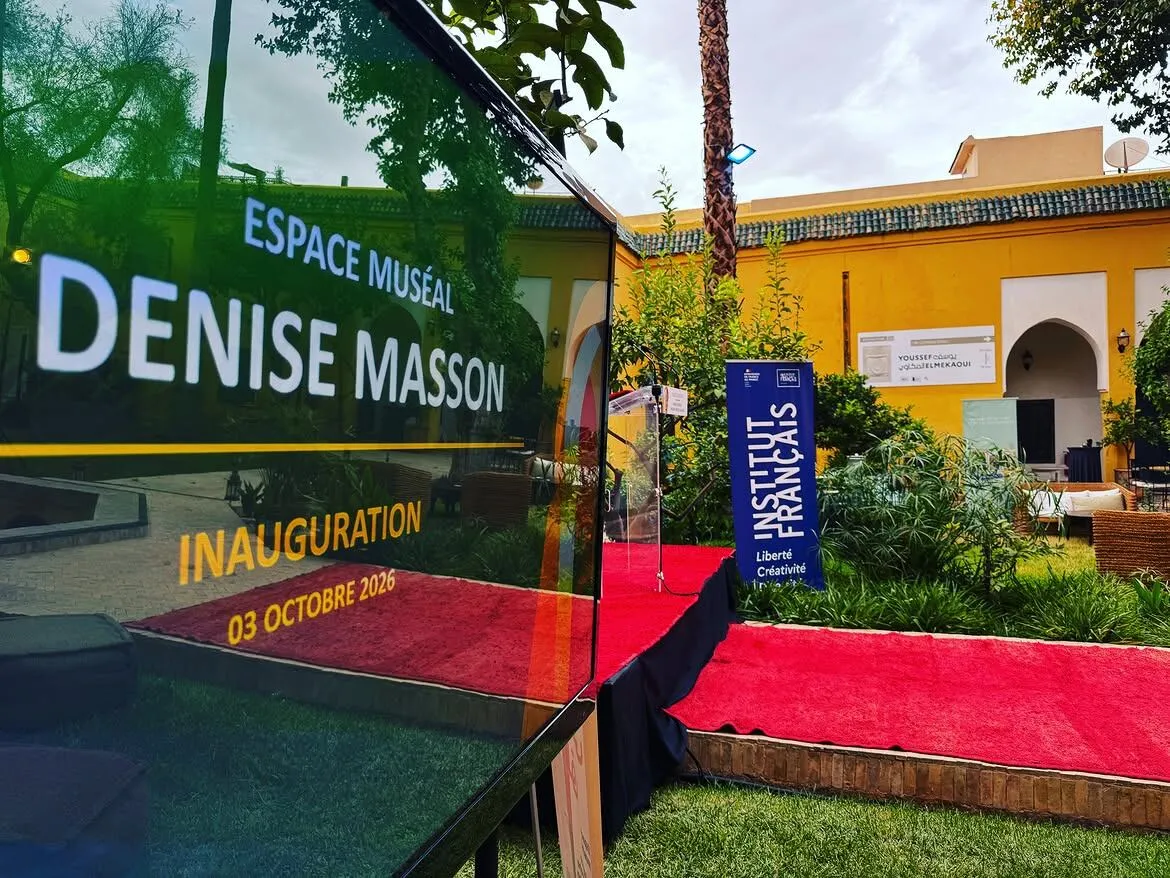
The French Institute of Morocco, through its Marrakech branch, recently inaugurated the Denise Masson House on Saturday, October 3, bringing together numerous prominent figures from French and Moroccan cultural, research, and artistic circles. This event marks a significant milestone in the history of the residence where Denise Masson lived for nearly sixty years. Philippe Lalliot, the French Ambassador to Morocco, emphasized the importance of this new space, stating, "This new venue illustrates the richness of Franco-Moroccan relations on profound topics such as religious matters, and also highlights the important work carried out by the French Institute of Morocco in collaboration with its partners to renovate and modernize cultural cooperation between our two nations."
Denise Masson, born in Paris in 1901 and who passed away in Marrakech in 1994, devoted a substantial part of her life to the study of religions, writing, and intercultural dialogue. She is particularly renowned for her translation of the Quran, published in 1967 as part of the Bibliothèque de la Pléiade by Gallimard, which continues to serve as a reference in the Francophone world. Her deep connection to Morocco is also reflected in the very walls of the house she occupied in Marrakech. In 1984, she bequeathed this 19th-century riad, nestled around a vast traditional garden, to the French state with the hope that it would remain a place for transmission and sharing.
A Hub for Cultural Exchange and Artistic Endeavors
Since then, the Denise Masson House has been managed by the French Institute in Marrakech, which is responsible for its upkeep, conservation, and cultural programming in line with the spirit envisioned by its founder. Chloé Goupille, a representative of the institute, articulated the dual purpose of the house, stating, "It serves as both a site of memory and a laboratory for ideas, research, and creativity. Today, this house stands as a meeting space that fosters vibrant exchanges between cultures and generations." Various activities, including artist and researcher residencies, conferences, literary meetings, film screenings, and temporary exhibitions, already enrich the life of the house, transforming it into a venue for reflection and creation that addresses major contemporary issues such as cultural diversity, spirituality, memory, creativity, knowledge transmission, and communal living.
With its newly established permanent museum space, the Denise Masson House aims to introduce a broader audience to this remarkable figure. The exhibition draws from unique archives, manuscripts, correspondences, personal items, period paintings, ancient books, and life stories, allowing visitors to trace Masson's journey and better understand the connections she forged with Morocco and her role in the intellectual and cultural dialogue between the two countries.
This new phase comes after significant rehabilitation work on the residence, which was severely damaged by the earthquake in September 2023. Flora Boillot, the director of the French Institute's Marrakech branch, confirmed that the renovation of the Denise Masson House was made possible through the support of the Fondation de France and the fund established in the aftermath of the earthquake. The design of the museum's pathway was curated by Sylvain Treuil, the delegated director of the French Institute in Marrakech from 2022 to 2025, along with Patrick Manac’h, co-founder of the Maison de la Photographie, and Manoël Pénicaud, a research officer at CNRS and a member of the Centre Jacques Berque.
The scenography was entrusted to Franco-Moroccan designer Younes Duret, offering a renewed perspective on this house located in the heart of the medina, while the rehabilitation work was carried out by Q.G. Agency of Architecture and Urban Planning. The inauguration also features two temporary exhibitions: the first, titled "Moroccan Interreligiosities," is curated by Manoël Pénicaud in collaboration with the Centre Jacques Berque; the second, titled "I Have Known God," is presented by Youssef El Mekaoui in partnership with Galerie 208 Paris-Marrakech. The French Institute of Morocco acknowledges the commitment of several partners alongside the Denise Masson House, including Es Saadi Marrakech Resort, the Maison de la Photographie, the Marrakech Perfume Museum, and Mustapha Blaoui, whose support contributed to the success of this launch.
As reported by fr.le360.ma.