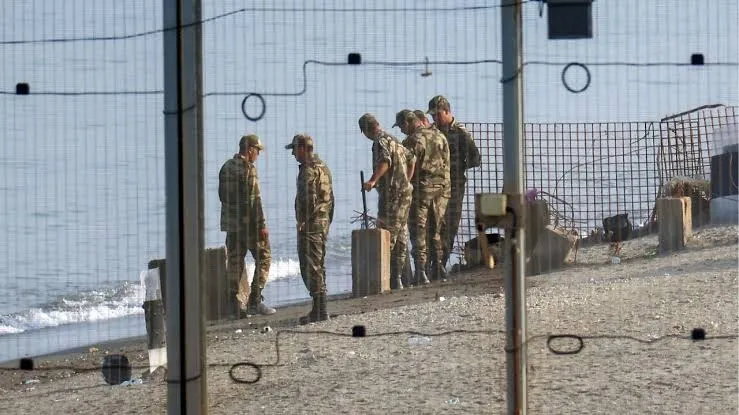

In a concerted effort to manage migration, Spain and Morocco have significantly bolstered their security measures ahead of anticipated crossings into the Spanish enclaves of Ceuta and Melilla. Reports from Moroccan authorities indicate that approximately 300 migrants, presumed to be attempting to reach the enclave, were intercepted by security forces near Fnideq, a border town situated about 20 kilometers away. This figure, while noteworthy, has become a commonplace occurrence in the region.
The Spanish newspaper "El Mund" highlighted the scale of security mobilization by King Mohammed VI's regime, noting that the number of Maghreb migrants attempting to reach Spain has dramatically decreased, reaching levels not seen in a long time. The atmosphere in Ceuta has been one of relief, with reports from various Spanish media including "El Correo" stating that the enclave "breathed a sigh of relief." An elderly resident expressed on television, "A weight has been lifted from our hearts. Many here were fearful that chaos would ensue once again." This follows an incident in late July when estimates suggested that up to 80,000 migrants flooded into Ceuta, with the vast majority returning to Morocco shortly thereafter.
A reporter from dpa confirmed the largely tranquil scenario on the ground, stating that the city center resembled a peaceful environment, with only occasional sightings of police and military personnel patrolling the area. Larger groups of young migrants were observed only in the outer districts, and a general calm prevailed even on the following Sunday.
Moroccan security forces have deployed a substantial presence around Ceuta and along the border with Melilla, effectively preventing potential crossings well before reaching the border. According to Moroccan security sources, 294 individuals were apprehended in this operation, including 248 from sub-Saharan countries and 46 Moroccans. Additionally, at least 61 further arrests were made on suspicion of inciting irregular migration through social media.
These intensified security measures were implemented to avert a repeat of the events witnessed in late July. Spain's Interior Minister, Fernando Grande-Marlaska, emphasized that the mass influx at that time was an "extraordinary" incident that would not be repeated. In Fnideq, Morocco has erected additional barbed wire and NATO wire barriers, deployed patrol boats to monitor the coastline, and stationed water cannons at the border. Numerous checkpoints have also been established on access roads.
Spain has similarly ramped up its security presence, with 880 National Police officers now deployed in Ceuta—an increase of 270 since late July—supported by around 2,000 soldiers and more than 700 members of the militarized police unit, Guardia Civil. Security experts suggest that the lack of a recent surge underscores Morocco's pivotal role in controlling irregular migration towards Europe. A senior police official quoted by "El País" stated, "This demonstrates that Rabat can halt irregular migration when it chooses to." The publication further emphasized Morocco's capabilities as a border guardian for Ceuta.
The unprecedented surge observed two weeks ago, particularly on July 30, saw tens of thousands of migrants reaching Ceuta, primarily via swimming. According to the latest official reports from Madrid, 83 bodies have been recovered from the sea, while NGOs estimate that the death toll exceeds one hundred. Most arrivals reportedly returned to Morocco within a few hours or days, but Interior Minister Grande-Marlaska acknowledged that around 5,000 migrants are still in Ceuta, indicating that it may take some time for the enclave to return fully to normalcy.
As reported by ref.ch.