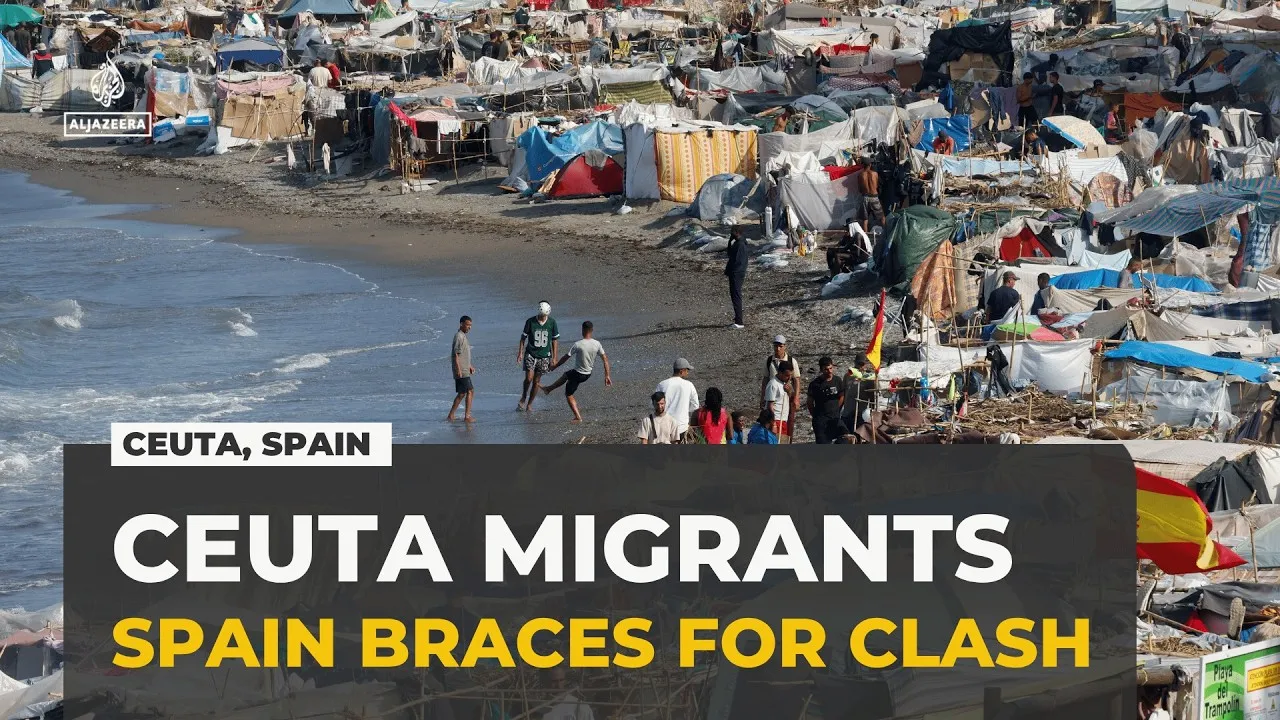
In a recent analysis by the Combat Antisemitism Movement, it has come to light that over 100 influencer accounts have propagated theories suggesting that Israel orchestrated the influx of Moroccan migrants into Ceuta, a Spanish enclave located on the northern coast of Africa. This surge in migration occurred when approximately 60,000 individuals swam or crossed on foot into Ceuta, a small city that borders Morocco. Tragically, the breakdown of border controls during this chaotic influx resulted in the deaths of at least 88 migrants, with some drowning or succumbing to stampede injuries. By the following Sunday, the majority of these migrants had returned to Morocco.
Ceuta, along with Melilla, another Spanish city situated on the North African coast, represents the last vestiges of European-held territories on the African mainland. The Moroccan government does not recognize Spanish sovereignty over these cities, viewing them as occupied territories. The recent exodus can be attributed to a combination of grim employment prospects for young Moroccans, a crackdown on government dissenters, and confusion arising from a shift in Spain's border policy, which coincided with a noticeable easing of patrols by Moroccan authorities.
According to a report from the Antisemitism Research Center, a division of Combat Antisemitism, social media platform X was inundated with posts connecting the border crisis to Israel. An analysis of 173 posts from 119 influencer accounts revealed that these posts accumulated an astonishing 57.5 million views. The conspiracy theories emerged from both right-wing and left-wing sources, both within Spain and internationally. Some posts referenced Spanish Prime Minister Pedro Sánchez’s critical stance towards Israel regarding its actions in Gaza and Iran, positing that Israel incited the border chaos as a form of retaliation. Others advanced a more sweeping narrative, alleging a global Jewish conspiracy aimed at eroding European societies through Muslim migration.
One particularly noteworthy post from the account “Forbidden HQ,” which garnered 5.3 million views, featured a graphic depicting Israeli Prime Minister Benjamin Netanyahu purportedly unleashing a torrent of migrants into Spain. Other influencers echoed provocative statements from Israeli officials and pro-Israel commentators. For instance, Candace Owens, a far-right commentator, revived a 2019 post made by Yair Netanyahu, the Prime Minister’s son, which controversially suggested that Spain should cease funding NGOs that advocate for the relinquishment of Ceuta and Melilla in exchange for Israel ceasing its funding of similar organizations within its borders.
Furthermore, podcast host Melissa Witte highlighted a March article by Michael Rubin from the right-leaning Middle East Forum, which encouraged Moroccans to gather and enter Ceuta and Melilla unarmed, raising their flag. Witte asserted, “They literally did plan this,” insinuating that Israelis were involved in orchestrating the migrant surge. Dan Bilzerian, a social media figure known for his controversial rhetoric, insinuated that Sánchez’s criticism of Israel had left Spain vulnerable to an influx of Moroccan migrants.
Despite the rampant speculation online, neither the Spanish nor Moroccan governments have implicated Israel in the border turmoil. Sánchez attributed the crisis to human traffickers exploiting a recent Spanish Supreme Court ruling that prohibits the immediate return of migrants intercepted at sea. The Moroccan Interior Ministry echoed this sentiment, stating that the incident was driven by smuggling networks and misinformation circulating on social media.
Additionally, commentators have noted that the apparent reduction in Moroccan border patrol activity might be a reaction to Sánchez’s recent diplomatic visit to Algeria, a country that supports Western Sahara's independence, a territory claimed by Morocco. While Sánchez refrained from linking the migrant surge to Israel, Spanish Transportation Minister Óscar Puente appeared to imply some degree of Israeli responsibility in response to a tweet from Danny Danon, Israel’s UN Ambassador, who criticized Spain’s immigration policy.
Combat Antisemitism, a coalition dedicated to combating anti-Semitism across the ideological spectrum, has faced criticism for allegedly conflating criticism of Israel with anti-Semitic sentiments. In 2023, two prominent U.S. Jewish organizations distanced themselves from the coalition following its release of a video that attributed rising anti-Semitism to “woke ideology.” This ongoing discourse reveals the complexities and sensitivities surrounding the intersection of migration, international relations, and social media narratives today.
As reported by jta.org.