From Challenges to Solutions: The Journey of Water in Aït Baâmrane
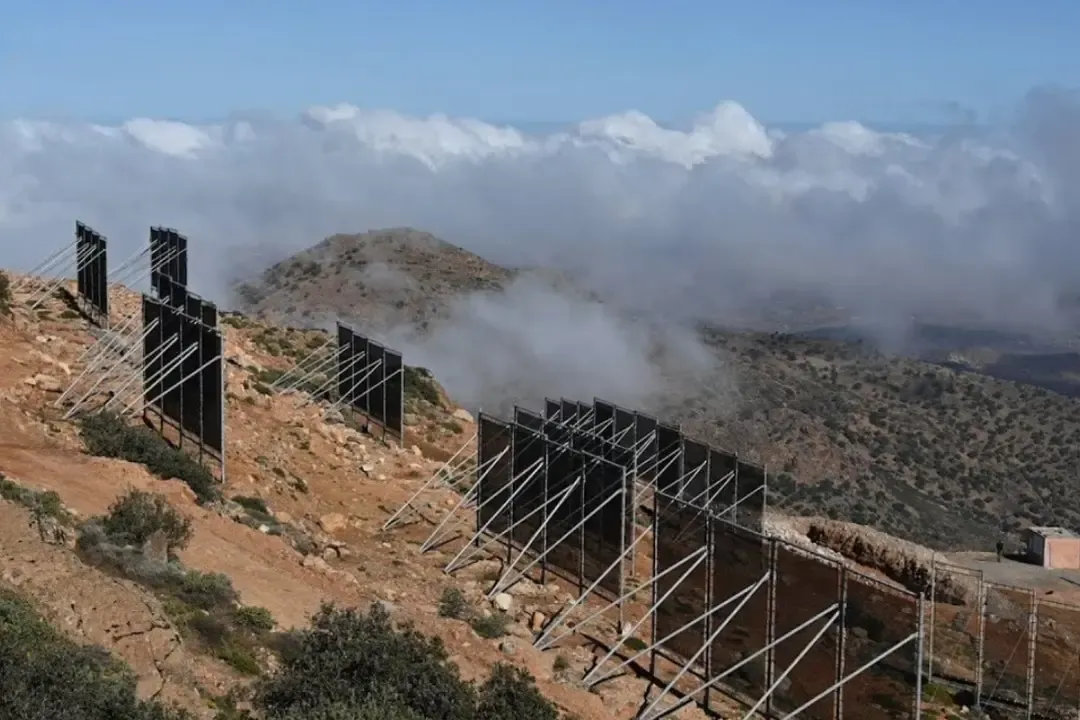
In the Aït Baâmrane region of southwestern Morocco, nestled against the backdrop of the Sahara Desert, the daily struggle for water was a relentless reality for local women. Their mornings were filled with arduous treks to distant wells, followed by the equally challenging return journey, often carrying containers weighing up to 50 lbs (23 kg) perched precariously on their heads. This time-consuming ritual not only prevented girls from attending school but also dictated the rhythm of each household, deeply ingraining itself into the community's fabric. However, everything changed when large polymer mesh nets began to adorn the slopes of Mount Boutmezguida. These nets, suspended on steel poles over 3,900 feet (1,200 meters) above sea level, adeptly capture moisture from the Atlantic fog that rolls over the Anti-Atlas range. The collected water then trickles down into storage tanks, flowing by gravity through pipes to faucets in the village, sometimes over six miles (more than ten kilometers) away. With this innovative system, there are no wells or motorized pumps; just the interplay of mesh, elevation, and the humid Moroccan air, reshaping the community's water access.
The Ingenious Science Behind Fog Harvesting
The concept of fog harvesting, although ancient—dating back to texts from the 16th century—has seen significant advancements due to modern engineering techniques. Gareth McKinley, a professor at MIT’s School of Engineering, notes that by altering the mesh's hole sizes, fiber dimensions, and applying specific surface coatings, the efficiency of water collection has surged by up to 500% compared to historical models. Currently, the nets installed on Mount Boutmezguida can harvest an impressive 65 liters (approximately 17 gallons) of water per square meter of mesh within a 24-hour period. Spanning approximately 6,460 square feet (600 square meters), the installation operates on minimal energy supplied by solar panels, allowing local residents to independently maintain the durable equipment. This marks a significant improvement over previous fog collectors deployed in regions like Eritrea, Chile, and Yemen in the late 20th and early 21st centuries, which were considerably more fragile.
Supported by Dar Si Hmad, a Moroccan non-profit organization established in 2006, this initiative aims to provide safe drinking water to the Aït Baâmrane region, where water scarcity is a pressing issue, exacerbated by the relentless advance of the desert. The moment the water system became operational is etched in the community's memory; it was a day of celebration as villagers gathered to witness water flowing from a tap for the very first time, passing around a crystal glass filled with what they now proudly refer to as "fog water." Although innovation can sometimes be met with skepticism, particularly from those like Fadma, a 52-year-old grandmother who initially viewed the fog as an unreliable source, the project has gradually shifted perspectives. Now, she recognizes fog as a legitimate source of water, allowing her granddaughters to attend school instead of spending their days fetching water.
Jamila Bargach, co-founder and director of Dar Si Hmad, articulates the duality of her experience: "On good days, I’m the queen of the fog," she says, humorously acknowledging the complexities of her role. The system now delivers drinking water directly to homes through an extensive network of pipes, significantly enhancing the quality of life in these villages. The improved access to running water has also disrupted traditional household roles, as women, once solely responsible for water procurement, have seen their authority shift. In response, Dar Si Hmad has initiated what they call a "water school," focusing on water conservation and basic literacy—an essential program since the ability to communicate issues like a broken pipe is contingent on reading skills. A 2022 case study from the University of Toronto highlighted the organization's commitment to cultural preservation, local collaboration, and women's empowerment—key factors in ensuring the project's long-term sustainability.
As the fog-harvesting technology gains attention, even the United Nations climate agency recognized its potential in May 2026, especially as water table depletion continues to escalate across North Africa and coastal regions globally. The World Health Organization recommends that a community requires around 75 liters (approximately 20 gallons) of water per person daily for basic needs, including hydration for people, crops, and livestock. Remarkably, a single modest installation can meet this threshold for an entire village. The human impact of such innovations is profound; in Africa alone, women collectively spend around 40 billion hours each year fetching water. For the families in the villages benefiting from this Moroccan system, that burden has been alleviated.
However, it is essential to recognize that fog harvesting is not a one-size-fits-all solution. The presence of consistent fog, suitable terrain, and high altitudes are critical factors in the success of such systems. For instance, Saudi Arabia's recent $7.2 billion investment in a desalination plant underscores the need for tailored solutions in arid regions lacking foggy mountainous environments. Yet, on Mount Boutmezguida, the Anti-Atlas range consistently captures Atlantic humidity at altitude, proving that a seemingly simple structure—nets suspended between poles—can effectively address a water shortage that traditional methods such as wells, trucks, and desalination have struggled to resolve.
As reported by futura-sciences.com.