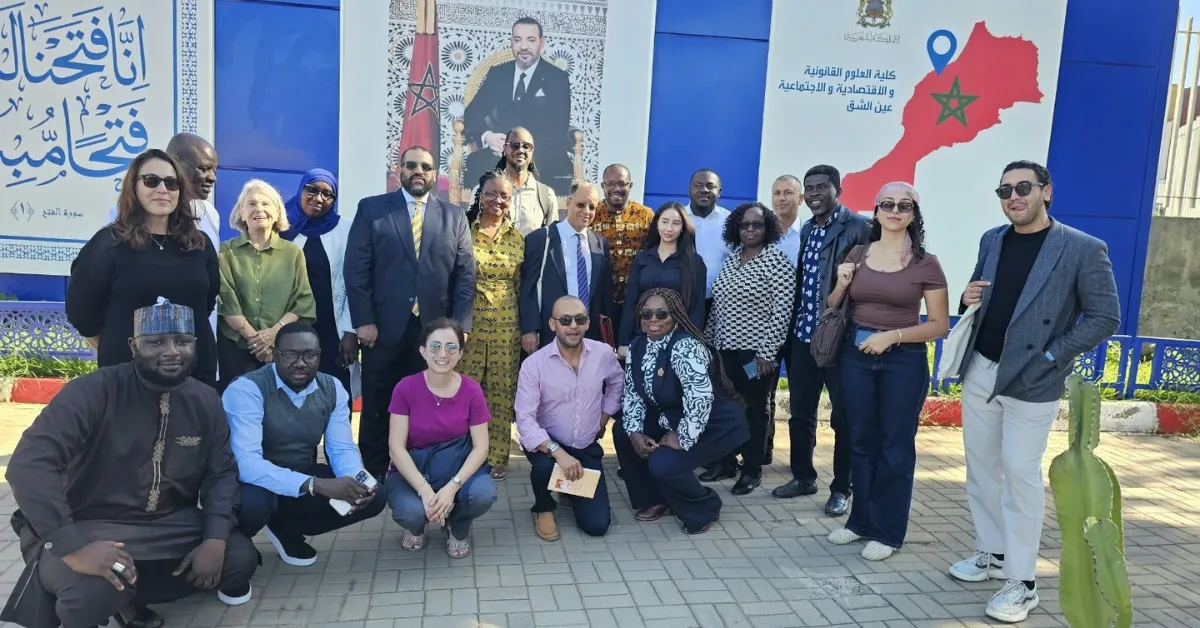

International Workshop on Social Innovation Index in Casablanca
On November 13 and 14, experts, researchers, social innovators, and institutional representatives from Sub-Saharan Africa, North Africa, and the Middle East convened in Casablanca for a workshop dedicated to developing a future international index for social innovation. Organized by the Government Council for Social Innovation (GCSI), this event aims to incorporate a Southern perspective in the design of an instrument intended to measure the impact of social innovations on development.
For two days, the Faculty of Legal, Economic, and Social Sciences (FSJES) in Casablanca serves as the backdrop for an international discussion on a topic that, while still not extensively measured, is increasingly gaining traction in public policy: social innovation. At the heart of the discussions is the objective of constructing an international index capable of evaluating countries' abilities to foster and implement innovative solutions addressing social, economic, and environmental challenges.
The workshop organizers seek to amplify the voices of Southern countries in a debate that has thus far been largely shaped by frameworks designed within developed economies. "The goal of this event is to allow colleagues from Sub-Saharan Africa and the MENA region to add a Southern touch to the design of this index," explains Professor Fouzi Mourji, an economist and academic. He emphasizes the ambition to create a more comprehensive indicator than existing ones. While some international indices focus on the business climate, economic environment, or corporate performance, the future index aims to encompass dimensions such as population well-being, individual flourishing, and environmental preservation. "The idea is to achieve a holistic vision of development rather than a sectoral approach," he notes.
Social Innovation as a Catalyst for Societal Transformation
Central to this discourse is the very concept of social innovation. Unlike technological innovation, which primarily aims at developing new products or processes, social innovation focuses on solutions that improve people's lives and address collective challenges. Dr. Wamuyu Mahinda, Senior Advisor for Anglophone Africa at the GCSI, asserts that this concept is fundamentally based on collaborative mechanisms that bring various stakeholders together around common objectives. "Social innovation includes participatory processes that unite different actors to co-create solutions to the challenges faced by populations and the planet," she explains.
This approach engages governments, civil society organizations, social enterprises, researchers, and the private sector. The GCSI was specifically established to facilitate this connection. Based in Amsterdam, the organization acts as a platform designed to link public authorities with social innovation stakeholders. "GCSI serves as a connector between governments and the entire social innovation ecosystem. Although it is government-led, its ambition is rooted in much broader collaboration," Dr. Mahinda clarifies. The organization structures its actions around seven pillars: public policies, funding, knowledge production, social impact measurement, communication, technology, and ecosystem development.
The discussions in Casablanca are part of an international momentum that was further strengthened in 2023 by the adoption of a resolution within the United Nations focused on the social and solidarity economy. This encourages governments to collaborate more closely with social innovators to accelerate economic and social transformations. According to Dr. Mahinda, the challenge is not to propose standardized solutions but to identify the specific needs of each country. "We always start by analyzing needs. If administrations need a better understanding of social innovation, we then work on strengthening their capacities," she explains.
This logic is also central to the work on the future index. For the organizers, the goal is not just to produce a new statistical tool but to provide decision-makers with an instrument capable of illuminating public policies and measuring the real impact of social initiatives.
For Mohamed Hittich, the workshop coordinator and head of research and data analysis at GCSI, the Casablanca meeting is a step in a broader process that will continue in Bangkok before the finalization of the framework. To this end, participants have been selected through GCSI's academic and professional networks to gather specialists in social entrepreneurship, impact evaluation, and public policy. Following this Moroccan phase, the organizers hope to enrich the methodology of the future index based on recommendations from experts originating from Sub-Saharan Africa and the MENA region. The conclusions from these discussions will feed into the next phases of the project, which include another meeting scheduled in Bangkok, Thailand, by the end of the month.
Beyond the technical dimension, the exchanges primarily highlighted the growing role of social innovation in development strategies. "Governments have their own policies and programs. However, there are also social innovators developing concrete solutions that can complement public action. The challenge is to create the necessary bridges between these two worlds," summarizes Dr. Wamuyu Mahinda. This conviction guides the work taking place in the heart of Morocco's economic capital, with an underlying ambition to make social innovation a lever for community transformation and a new tool for public decision-making.
As reported by h24info.ma.