
Escalating Tensions and Calls for Violence
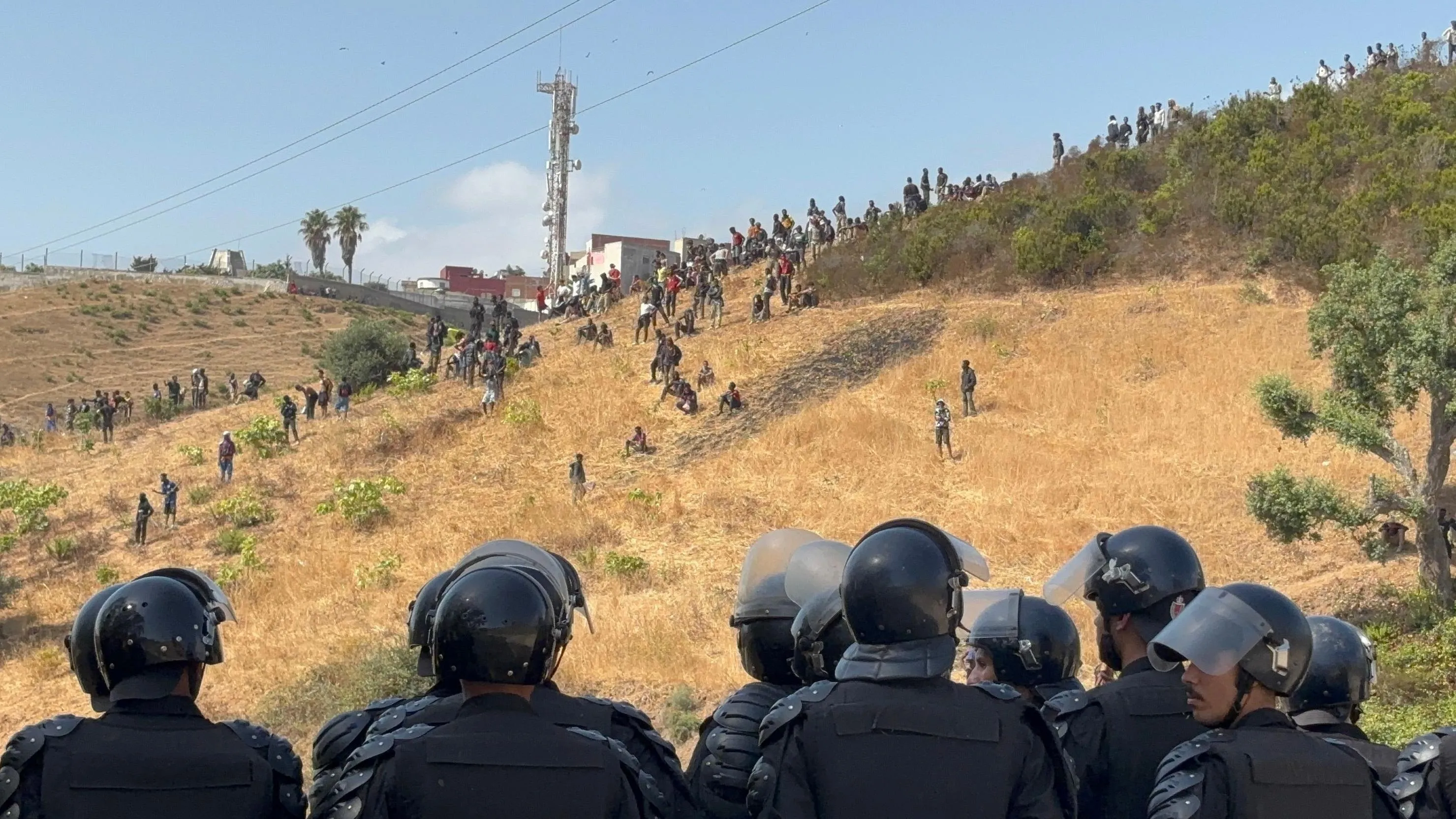
Intelligence analysts have identified troubling directives emanating from Moroccan groups aimed at intensifying violence during attacks on the Ceuta border, with the explicit goal of entering Spain. Despite the relative calm following the unsuccessful mobilization attempt on August 15, security sources have informed ABC that the organizers remain undeterred and continue to devise plans. Although there has been a decline in the volume of such messages, those that do circulate have taken on a more visceral tone, featuring alarming phrases such as "Attack the occupied Ceuta." This rhetoric is indicative of a more aggressive stance among those seeking to breach Spain's borders.
Predictions were met when no significant influx of immigrants occurred on August 15, as both the National Police and Civil Guard monitored social media, detecting messages that promoted this campaign. These messages had been proliferating since July 30 and 31, some even utilizing artificial intelligence to manipulate images of Spanish Prime Minister Pedro Sánchez in their calls to action. The messaging was unequivocal: the border would be open.
Despite these assertions, immigrants did not respond to the calls, and the extensive security measures in place effectively thwarted any attempts. Nevertheless, the organizers persist in their efforts to rally supporters for a crossing into Ceuta. The overall number of messages has diminished, and their reach is not as widespread as it was during the initial days or preceding the swimmer crisis.
Radicalization and Nationalist Sentiments
To capture the attention of radicals, the messaging has become increasingly violent. ABC has gained access to several of these communications, which leave no room for ambiguity. They appear on platforms like Facebook and TikTok with calls to action such as, "This is our opportunity; this time we will attack the occupied Ceuta." These desperate commands aim to further heighten tensions within the Ceuta community. Nationalistic sentiments are also on the rise in these forums, urging compatriots to seize sovereignty over Ceuta and Melilla.
Analysts have detected and warned about numerous social media posts featuring images of individuals near the coastal area alongside photographs of the Ceuta fence, marked with the flags of Spain and the European Union. While these posts do not contain Arabic text inciting an attack on the autonomous city, they present a very direct visual and symbolic reference to the border space, as explained by security sources to ABC.
These radical nationalist messages from Moroccan individuals are not a new phenomenon, having been in circulation since 2020. However, they are currently capitalizing on the existing situation to embed the idea within their compatriots who are waiting in Castillejos for any opportunity to re-enter Spain. Messages like "Everything is clear" accompany location tags indicating Fnideq-Ceuta.
The phrase "attack the occupied Ceuta" has resonated widely across Morocco, particularly among circles close to King Mohammed VI. Notably, a media outlet linked to the regime recently published a headline asserting that, "No, Ceuta and Melilla have not always been considered entirely Spanish." This publication, ‘Le360fr’, is regarded as one of the most pro-establishment in the country, reflecting Morocco's ongoing expansionist ambitions and its willingness to utilize any available means to communicate this agenda through its media channels.
Security experts sounded alarms about the potential dangers in the days leading up to a possible migrant surge. Informants from transport and individuals crossing the border daily alerted intelligence services about a significant concentration of people around the border area. However, no additional measures were taken to address this emerging threat.
The security apparatus established by the Ministry of the Interior in the autonomous city will remain in full force for several more days. According to ABC, the riot police and the National Police's Prevention and Reaction Unit (UPR) have been assigned to maintain their presence until August 31, with expectations that they will continue at least through September. Alarmingly, some voices predict that they may not be able to leave the area until late 2026.
The role of Morocco in this crisis has been called into question by various analysts who have gathered data and information regarding the incidents and the influx of migrants. José María Gil Garre, an intelligence, security, and international terrorism analyst, noted that during the mobilization in July 2026, the situation was not new; the territorial corridor was familiar, and the use of social media as a mobilization tool had been previously identified. Moroccan authorities had demonstrated effective capacity to detect and act upon comparable convocations.
Although police forces are stationed in Ceuta until August 31, there is a prevailing suspicion that their deployment could extend throughout September. Gil's analysis concludes that there is a "low probability" that Morocco was substantially unaware of the mobilization’s formation. Earlier reports by ABC published content from WhatsApp groups that disseminated information just hours after the assault on Ceuta. The Spanish government’s security measures redirected attention toward Melilla, where minor incidents occurred but did not reach the previous scale. Understanding Ceuta 2026 requires recognizing it as a crisis likely rooted in a social and digital mobilization that evolved within a space well-known and manageable by Moroccan authorities. Once a certain level of pressure was exerted on Spain, it was likely modulated, tolerated, or exploited within a hybrid pressure dynamic, although the current lack of direct evidence about the decision-making mechanism prevents a definitive empirical attribution.
As reported by abc.es.