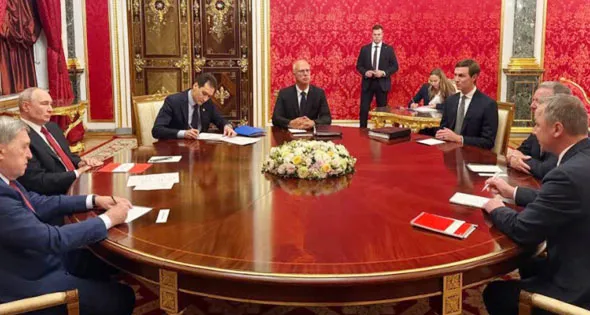

Diplomatic Discussions in Moscow: A Step Towards Resolution
In a significant diplomatic move, Russian President Vladimir Putin held discussions yesterday in the Kremlin with U.S. envoys Steve Witkoff and Jared Kushner regarding the ongoing war in Ukraine. Kremlin spokesperson Dmitry Peskov confirmed the resumption of negotiations, which had initially been announced by Ukrainian President Volodymyr Zelensky following the arrival of the U.S. representatives in Moscow. Peskov expressed Moscow's satisfaction with the collaboration with Witkoff and Kushner, emphasizing the high level of trust from their side and the critical importance of the quality of mediation and the trustworthiness of mediators in such sensitive discussions.
During this sixth meeting with the American envoys, President Putin affirmed that all aspects of the Ukrainian conflict were thoroughly discussed, noting that such communications are invariably beneficial. He commended the efforts of U.S. President Donald Trump, stating, "I understand that he is in a generally tough position, yet he continues his attempts at resolution, contributing to the resolution of the Russian-Ukrainian conflict." The Russian Foreign Ministry has urged the U.S. administration to acknowledge the realities on the ground in any efforts to resolve the Ukrainian crisis, pointing out that current developments are not favoring Kyiv.
Escalation of Tensions and Military Posturing
In a related context, U.S. and Iranian officials are still betting on time as a factor to gain an upper hand in the war that has now entered its seventh month. President Trump downplayed the implications of the conflict, referring to it as a "simple matter" and hinted at potential strikes on Iran's "Mount Khaf" nuclear facility in the near future. In comments made to reporters at the White House, Trump stated that the U.S. is "not currently fighting" and maintains control over the Strait of Hormuz, indicating the absence of underwater mines in the strait and claiming that the U.S. has destroyed all advanced Iranian radars, thereby preventing Iran from acquiring nuclear weapons.
Following these remarks, Trump echoed his Vice President JD Vance's position, stating, "I call it a military conflict (not a war) because it’s a simple matter for us; it’s not a big deal." Earlier, Trump had mentioned that the U.S. is monitoring Iranian nuclear sites through cameras, allowing them to identify individuals entering or exiting these facilities. He reiterated that three Iranian nuclear sites had been "completely destroyed," while suggesting that Iran may have another site in Mount Khaf.
On the Iranian side, President Masoud Pezeshkian asserted that the adversary is attempting to incite internal discord through its siege, but he expressed confidence that Iranians would thwart such conspiracies through unity. Concurrently, an Iranian military spokesperson declared that Iranian forces would carry out "preemptive operations" whenever they perceive a threat, framing such actions within the context of international law.
Simultaneously, the United States has intensified its economic campaign against Iran by imposing sanctions on three entities based in Turkey, marking the latest step in the Trump administration's efforts to tighten the grip on financial networks connected to Tehran. Iran is currently grappling with an escalating economic war, reflected domestically through soaring inflation rates that have reached record highs of 80% to 100% for certain goods, along with a more than 6% depreciation of the national currency within a single week.
Iran's judiciary chief, Gholam Hossein Mohseni Ejei, remarked that the country has not and will not yield to any form of injustice, indicating that the U.S. and Israel have imposed an illegal war on the nation. U.S. intelligence reports have recently highlighted that Iran has grown more confident in its ability to strike targets in the Middle East, seemingly determined to continue the confrontation for months, at least until the upcoming mid-term congressional elections in November, in an effort to deter Washington.
According to reports from the New York Times citing U.S. officials familiar with the intelligence assessments, Iran has emerged from its intermittent conflict with the U.S. with greater experience in military operations, believing it is now more capable of sustaining the confrontation. The intelligence reports suggest that the Iranian government may be contemplating a significant escalation. Current and former officials have indicated that reaching an agreement to fully end the war with Iran will be challenging, especially in the absence of any signs of Iran's willingness to engage in negotiations with the United States.
Meanwhile, Iranian media reported yesterday that an Iranian oil tanker near Kharg Island was targeted by a U.S. missile strike, with Fars news agency mentioning explosions heard in proximity to the island. Tasnim reported that U.S. forces struck the tanker six nautical miles from the island, noting that the vessel was hit by four projectiles launched by U.S. military forces while it was in the docking area of the island.
As reported by gate.ahram.org.eg.