
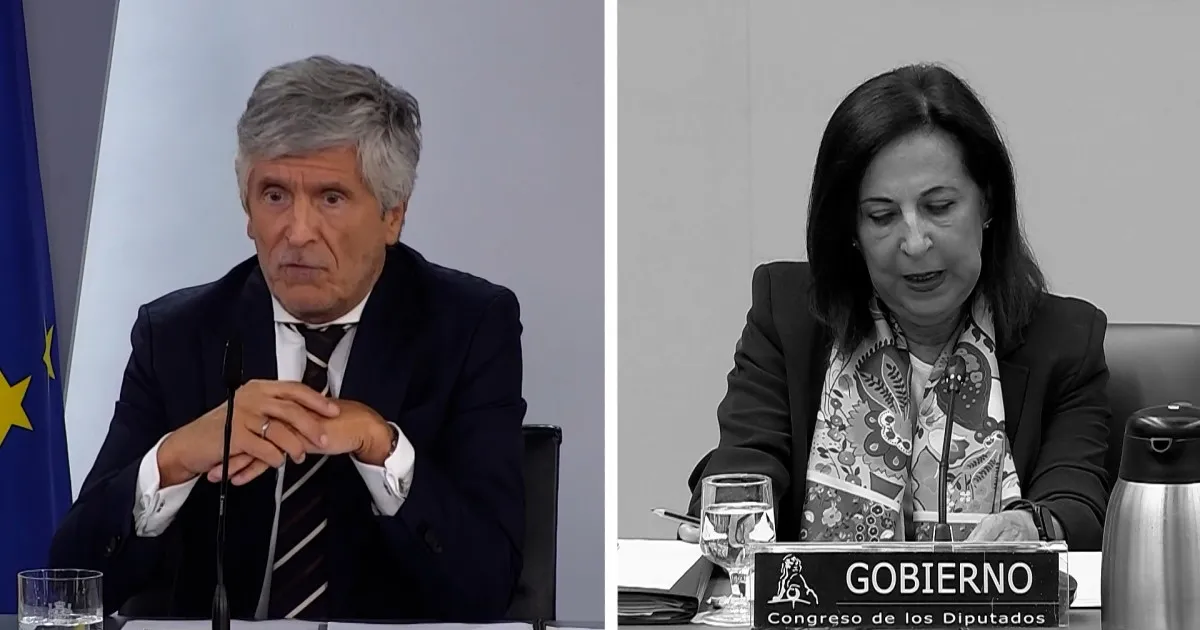

The recent crisis in Ceuta has ignited a significant public dispute between two of Spain's key ministers responsible for border security. Margarita Robles, the Minister of Defense, and Fernando Grande-Marlaska, the Minister of the Interior, have presented conflicting accounts regarding the massive assault that occurred on July 30 and the government's prior knowledge of the situation, which saw tens of thousands rushing towards the autonomous city's border.
This confrontation coincided with remarks from Morocco, where Ahmed Toufiq, the Minister of Islamic Affairs, used the term "liberate the occupied cities" in a ceremony presided over by King Mohamed VI. His colleague, Abdellatif Ouahbi, the Minister of Justice, has also recently asserted Morocco's "historical and geographical right" over the two Spanish cities, further complicating the diplomatic landscape.
Back in Spain, Robles defended her position in Congress, asserting that intelligence services carried out their duties effectively and shared relevant information with the State Security Forces and the Government Delegation. She stated, "Operationally in Ceuta, our Armed Forces, the intelligence services, and obviously the CNI performed their mandated roles and shared and analyzed information with the State Security Forces and the personnel of the Government Delegation." Furthermore, she revealed that 25 agents from the National Intelligence Center are stationed in Ceuta, although the specifics of their deployment remain classified. Robles confirmed that on July 29, CNI agents alerted the Government Delegation about a planned event the following day encouraging individuals to cross the border, capitalizing on Morocco's Throne Day celebrations.
Additionally, she noted that in the days leading up to the crisis, as reported by El Debate, there were already approximately a thousand entries into Ceuta daily. On July 27, a meeting took place between Ceuta's president, Juan Jesús Vivas, and the government delegate to discuss the rising influx and the potential for a collapse in city services.
However, just hours later, Grande-Marlaska provided a starkly different perspective, denying the existence of any reports suggesting that an incident of such magnitude was imminent on July 30. "There was no report indicating that what occurred on July 30 would happen," the minister asserted, adding that neither foreign intelligence services nor other intelligence groups had detected any similar threats.
Morocco Reiterates Claims to 'Occupied Cities'
Amidst this internal conflict, Moroccan officials have made a series of statements in recent weeks that once again bring the territorial claims over Ceuta and Melilla to the forefront. The latest instance occurred during the celebration of Eid al Maulud, led by King Mohamed VI in Rabat, where Ahmed Toufiq drew on historical and religious references to emphasize Morocco's ties to the two Spanish cities.
Specifically, Toufiq referenced the works of various Muslim scholars historically connected to Ceuta and recalled prayers invoked by Moroccans "in their sacred struggle to liberate the occupied cities" along the Atlantic coast during the early modern era, as reported by the official Moroccan news agency MAP.
Just days prior, Moroccan Justice Minister Abdellatif Ouahbi reiterated that Ceuta and Melilla remain part of Rabat's territorial claims. In an interview with Moroccan public television 2M, Ouahbi stated, "The issue of Ceuta and Melilla will continue to be a topic of dialogue between us and Spain, and we will maintain our historical and geographical rights." He further called for a "definitive solution" to ensure the two cities "return to the homeland" and advocated for the establishment of a bilateral commission to address the matter.
As reported by eldebate.com.

