
Critical Warnings on International Law and Regional Stability
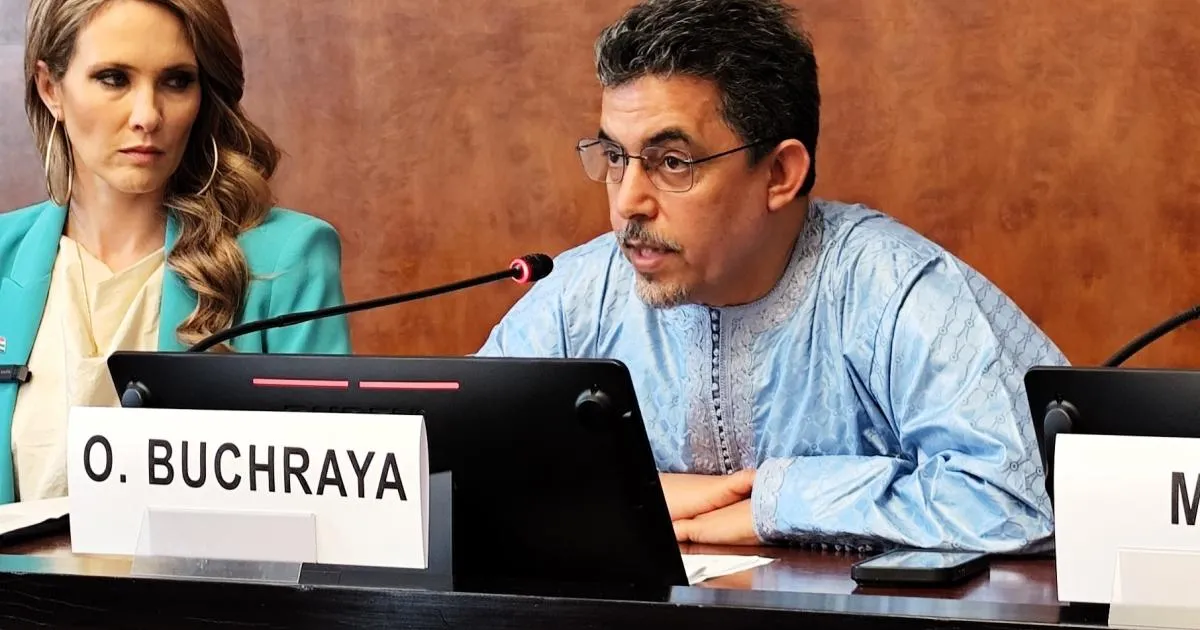
On June 17, 2026, during a high-level seminar at the United Nations Human Rights Council in Geneva, Ambassador Abba Basharaya Bashir, the Special Advisor to the President of the Republic on Natural Resources and Legal Affairs, issued urgent warnings about the repercussions of violating international law in Western Sahara. He emphasized that such breaches could set a dangerous precedent that threatens multilateral cooperation globally and undermines regional stability in North Africa.
In his address titled "Western Sahara and the Right to Self-Determination: Challenges to International Legitimacy," the Sahrawi diplomat provided a critical analysis of unilateral political maneuvers and Moroccan diplomatic narratives. He explicitly linked the struggle of the Sahrawi people to the integrity of the modern rules-based international system, pointing out that international institutions are currently facing unprecedented structural challenges.
Ambassador Basharaya highlighted that the seminar's theme critically examines the credibility of international law, the effectiveness of multilateral organizations, and the universality of the right of peoples to self-determination at a time when the respect for international law faces significant and unprecedented challenges. He stated, "The lack of progress in the decolonization process, coupled with the prevailing international context, creates a dangerous precedent that threatens multilateralism and the future of the 17 remaining non-self-governing territories that continue to struggle for their right to self-determination."
The Interconnectedness of Regional Security and the Western Sahara Conflict
Moreover, the Sahrawi ambassador explicitly linked the resolution of the Western Sahara conflict to the overall security of the Maghreb region. He described Morocco as an expansionist entity with undefined structural borders, warning that the support of certain countries for Rabat's expansionist ambitions in Western Sahara could ignite broader regional chaos. He pointed out that Morocco is the only country in the world that has not definitively mapped its borders with its neighbors, noting ongoing historical grievances with Spain, Algeria, Mauritania, and Western Sahara.
Ambassador Basharaya asserted that the resistance of the Sahrawi people, backed by international legitimacy, has served as the primary barrier against Moroccan expansionist tendencies. He cautioned that undermining the Sahrawi people's right to self-determination would only embolden Morocco to pursue new adventures, highlighting that the discourse paving the way for such outcomes is already present. Therefore, he concluded that the stability of the region heavily relies on the proper decolonization of the territory in accordance with international law.
In addressing the latest diplomatic developments, Ambassador Basharaya refuted the Moroccan media propaganda surrounding the United Nations Security Council framework and the ongoing joint diplomatic efforts between the UN and the United States. He emphasized that the resolution clearly reaffirms the centrality of the Sahrawi people's right to self-determination as the primary goal of any political solution while firmly establishing its legal reference within the UN Charter. Furthermore, Resolution 2797 explicitly identifies the Polisario Front and Morocco as the direct parties to the conflict and stresses that any solution must be acceptable to both parties, all the while extending the MINURSO operational mandate for one year without any structural or operational modifications.
While acknowledging that the joint diplomatic efforts between the UN and the US have succeeded in bringing the parties to face-to-face discussions for the first time in six years, allowing each side to present its proposal, he firmly corrected the narrative regarding which party is engaging responsibly. He clarified that Moroccan propaganda attempts to polish Morocco's image as a positive participant in negotiations, while the reality is that the responsible and constructive engagement of the Polisario Front has allowed UN efforts to persist for decades, while Morocco has always been the obstructive party in these endeavors.
He emphasized that the Polisario Front is negotiating in good faith and cooperating with the UN to achieve a fair and lasting solution that ensures the Sahrawi people’s right to self-determination, asserting that "sovereignty over Western Sahara exclusively belongs to the Sahrawi people, and the final status of the territory cannot be determined by anyone else."
In conclusion, the Sahrawi diplomat evaluated the dire situation in the occupied territories of Western Sahara, warning international actors against adopting any proposals that do not respect international law. He highlighted the systematic violations of human rights, the media blockade, the systematic expulsion of international observers, and the arbitrary arrests occurring daily in the occupied areas. He concluded his remarks by asserting that "the proposal of so-called autonomy under these circumstances is tantamount to pushing the Sahrawis into an abyss and inviting them to join the open prison currently constituted by the occupied territories."
As reported by spsrasd.info.