
Judicial Investigation Unveils Involvement of Moroccan Police and Intelligence
The judicial investigation into the massive assault in Ceuta has successfully identified over twenty "dynamizers" who were instrumental in orchestrating the irregular entry of migrants into the autonomous city at the end of July. According to sources cited by LA RAZÓN, all of these individuals operated without uniforms and are connected to either the Moroccan police or its intelligence services. Furthermore, these reports suggest that the total number of dynamizers involved may approach thirty, as indicated by National Court magistrate María Tardón in her decision to take jurisdiction over the case.
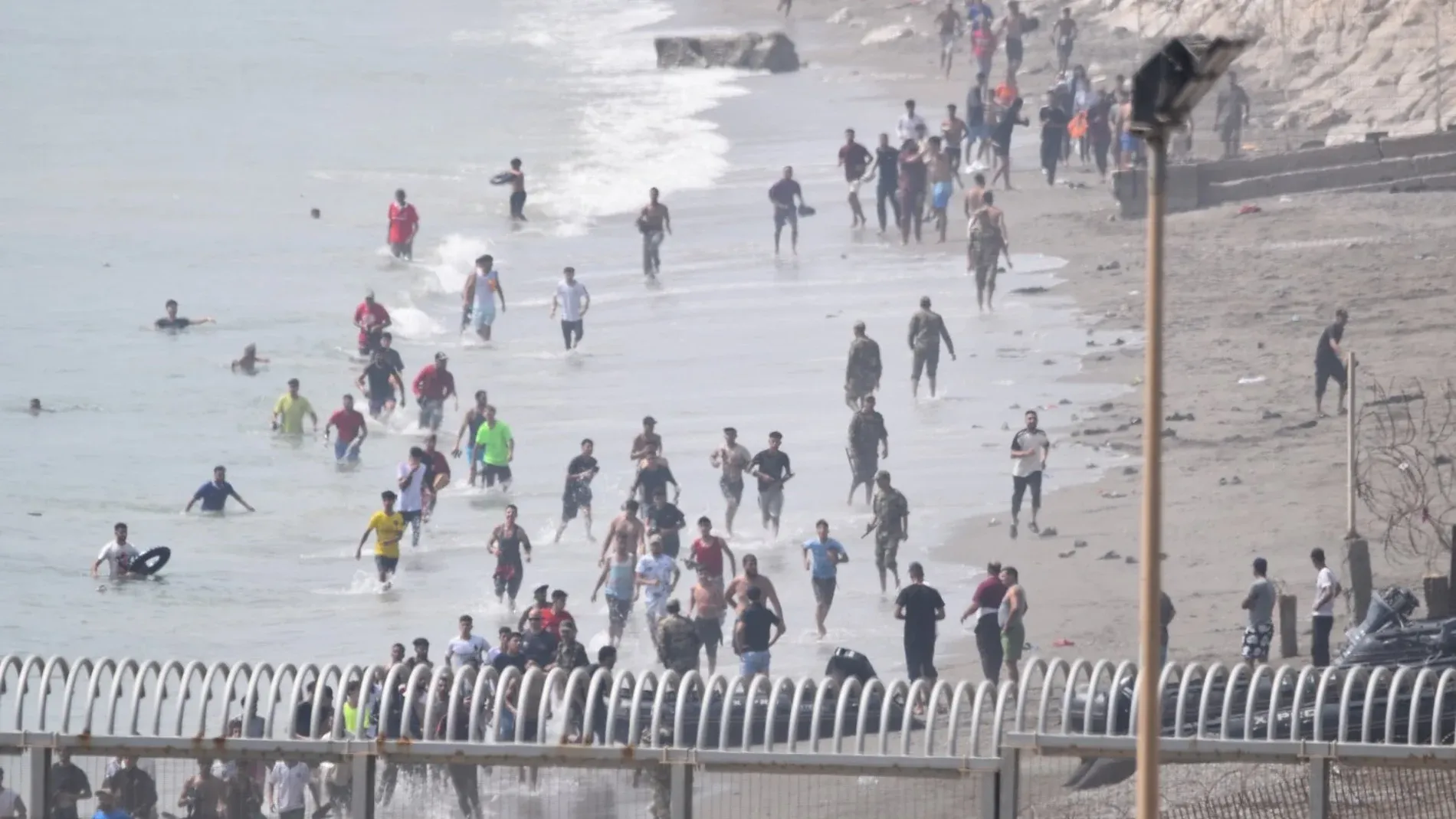
In her ruling, Tardón noted the presence of uniformed members of Morocco's Security Forces at the El Tarajal border, as well as the so-called "on-ground dynamizers" who, in some instances, provided instructions to the former. This has led investigators to point to the Moroccan Security Forces as the intellectual authors behind the mass and irregular influx of migrants into Spain.
The investigation is now focused on determining the specific roles played by each dynamizer and, crucially, whether they acted under the directives of even higher authorities. Consequently, the inquiries extend beyond the actions of Moroccan agents on the ground to reconstruct the decision-making chain that may have preceded the events of July 30 and 31, aiming to identify the material authorship behind the invasion the autonomous city suffered.
Ambiguous Legal Landscape Amidst International Relations
However, the current situation is fraught with ambiguity. Even though Tardón has implicated these dynamizers for participating in what is classified as an "attack" on Spain's territorial integrity and a "violation" of national sovereignty, Moroccan authorities do not appear inclined to issue extradition orders for any of the individuals involved.
It was Tardón who, in an effort to ascertain whether the National Court had the jurisdiction to investigate the events, directed officers from the General Commissariat of Immigration and Borders to compile a report evaluating the situation. Sources indicate that despite repeated "pressures" from the upper echelons of the National Police to absolve Morocco from involvement in the migration assault, the police unit has made a decisive statement linking the Rabat Security Forces to the invasion, distancing itself from the narrative put forth by the government of Pedro Sánchez.
The report submitted to the magistrate revealed that this was not a typical migratory flow or merely a spontaneous episode; rather, it demonstrated an intentional act aimed at undermining the state, characterized as a method of "hybrid warfare," as "the majority of migrants were not seeking to remain in Spanish territory." In her ruling, which followed the receipt of reports from both the Police and Civil Guard, Tardón referred to these dynamizers, pointing out their interaction with uniformed agents and their role in guiding the movements of individuals entering illegally into Spanish territory.
Evidence from several videos recorded during this unprecedented migration surge shows the presence of individuals in civilian clothing directing migrants. Testimonies from interviewed migrants overwhelmingly indicate that police forces not only maintained a "passive attitude" but also provided "directions to access through the water at the Espigón de El Tarajal rather than through other entry points." This task was aided by the now-exposed dynamizers, thanks to police efforts.
Tardón also referenced the "message dynamizers" who rallied thousands of migrants via social media, whose role involved "promoting, disseminating, and virally spreading the call" that ensured the mobilization of such a vast number of people. The investigation will also focus on identifying these individuals, which will require tracking hundreds of messages on social media and probing various profiles.
As the investigation progresses, the magistrate has approved the participation of the Ceuta government in the inquiries, recognizing that the autonomous city and its residents have been "victims" of the mass and irregular influx of migrants. Tardón acknowledges their right to pursue legal action as a private prosecution due to the "serious events" that have impacted their "freedom, exercise of rights, and the integrity of individuals and their property."
As reported by larazon.es.