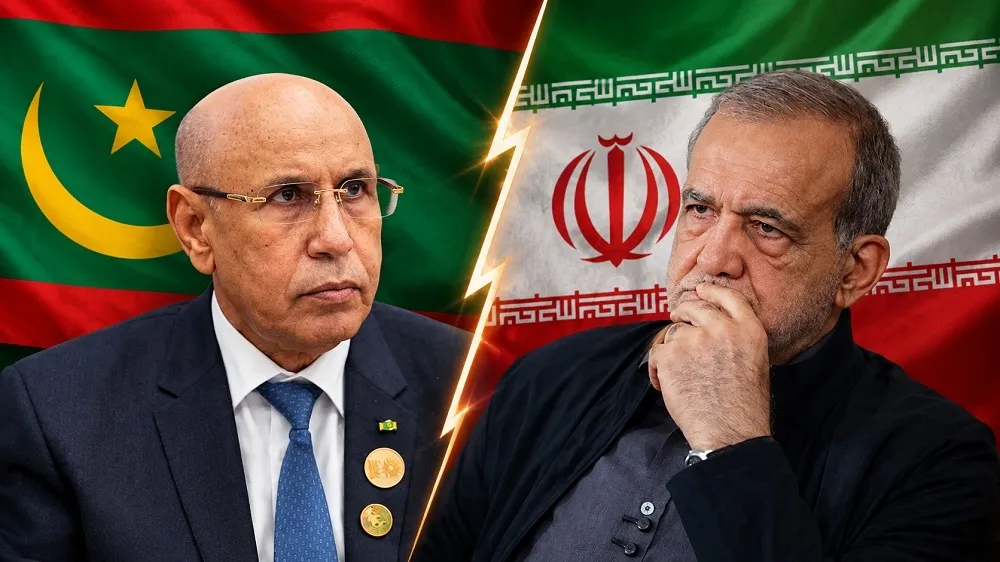

The recent summoning of the Iranian ambassador to Mauritania, Jawad Abu Ali Akbar, by Mauritanian authorities is not merely a routine diplomatic action; rather, it brings to the forefront a pressing issue that Morocco has been sounding alarms about for years. This issue pertains to Iran's attempts to extend its influence across the African continent, particularly in the geopolitical, social, and security domains surrounding Morocco.
While the Mauritanian Ministry of Foreign Affairs has reiterated its commitment to fostering relations with Tehran, its message to the Iranian envoy was unequivocal: engagement with the Islamic Republic does not grant its representatives the leeway to violate diplomatic protocols or engage in activities that disregard Mauritania's sovereignty and the established norms governing foreign missions. This diplomatic stance reflects a growing awareness of the complex geopolitical landscape in which these nations operate.
Signs of Iranian Intrusion into Mauritania
Although the Mauritanian authorities did not disclose all the details regarding the actions that provoked their protest, local media outlets have circulated information and images concerning the Iranian ambassador's recent visit to rural areas, including the village of Boussidra in the Boutilimit district, after receiving an invitation from a local resident. Furthermore, Mauritanian media sources reported the arrest of three individuals in connection to the invitation extended to the ambassador and his visit, indicating that the issue transcends mere diplomatic etiquette, becoming instead a matter of national security within a country situated in one of Africa's most strategically sensitive regions.
This diplomatic maneuvering by Mauritania is set against a background of regional tensions that cannot be divorced from the warnings issued by Morocco over the years regarding Iran's influence strategy in North and West Africa. This strategy, as outlined by Rabat, relies on cultivating a network of political, religious, and security relationships, as well as enlisting agents and allies beyond Iranian borders.
Will Nouakchott Heed Morocco's Warnings?
The year 2018 marked a pivotal moment in this narrative when Morocco severed diplomatic ties with Iran, demanding the departure of the Iranian ambassador from Rabat and recalling its own ambassador from Tehran. Morocco characterized this decision as a direct response to a perceived threat to its national security and vital interests. At that time, Foreign Minister Nasser Bourita emphasized that Morocco had acquired compelling evidence of Iran's involvement, through Hezbollah, in providing financial, logistical, and military support to the separatist Polisario Front.
Morocco did not merely allege a political alliance or ordinary engagement among regional actors; it unveiled a network of coordination between Hezbollah and the Polisario, aimed at training members of the separatist front and providing them with military assistance through channels linked to the Iranian embassy in Algeria. This information was significant enough for Morocco to redefine the nature of the threat it faced, indicating that it was no longer just a political dispute over Western Sahara, but a concerted effort to introduce Iranian-linked entities and networks into a matter that directly affects Morocco's national security and territorial integrity.
In this context, the name Amir Mousavi emerged, who held a role related to Iranian diplomatic and cultural representation in Algeria. Reports from the 2018 crisis associated him with communication channels between Iranian entities, Hezbollah, and the Polisario Front, confirming the involvement of at least one individual from the Iranian embassy in Algeria in operations linked to supporting the separatist front. This situation highlighted how Iran's approach to expanding its influence involves combining official diplomatic efforts with informal networks of influence and leveraging relationships with regional proxies, primarily Hezbollah.
Such a model has made Morocco increasingly vigilant regarding Iranian expansion in Africa, recognizing that this is not just about direct political and economic relationships, but also about investing in religious and cultural domains, thereby creating networks of influence that could transform, depending on circumstances, into tools of political and security pressure.
The Iranian expansion in Africa continues to provoke rising concerns, especially given Tehran's reliance on various tools to build its influence, particularly in regions characterized by security fragility and institutional weaknesses, facing challenges related to terrorism, organized crime, and separatist conflicts. This issue becomes even more sensitive when considering the Sahel region and the geographical area extending between Morocco, Mauritania, and Algeria, where borders, trade routes, smuggling networks, and armed movements intersect, alongside the presence of the Polisario Front, which uses the Tindouf camps in Algeria as a base for its leadership and armed groups.
In 2025, for instance, the British newspaper "The Daily Telegraph" published a report examining Iran's connections with various armed groups outside its borders, linking Iran and the Polisario while suggesting that the diminishing capabilities of some of Tehran's allies in the Middle East might prompt it to search for alternative channels of influence. Recent years have also seen more specific reports about the nature of the relationship between Tehran and the Polisario, with media outlets citing regional and international sources that discuss the training of front members. Additionally, other sources have reported the presence of Polisario fighters in Syria during the war alongside Bashar al-Assad's forces.
The significance of this matter lies in the fact that the Polisario does not exist in a geographical vacuum; its leadership centers and associated refugee camps are located in southwestern Algeria, close to Mauritania and the desert areas extending towards Morocco and the Sahel. The African Strategic Studies Center has previously noted that the status of the Polisario and the Moroccan-Algerian conflict have historically made Mauritania a space where regional rivalries intersect, reflecting the potential repercussions of the rift between Rabat and Algiers.
As reported by assahifa.com.