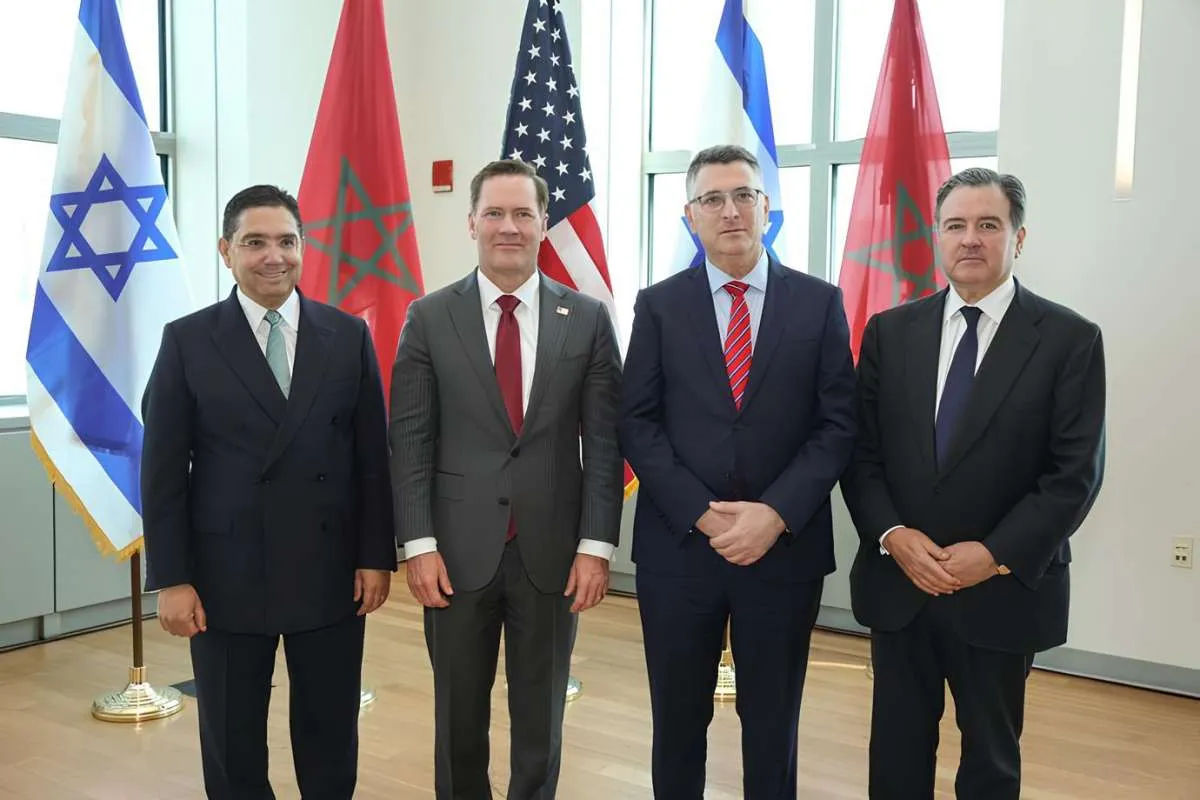

In a significant diplomatic advancement, Israel and Morocco have formally agreed to elevate their diplomatic missions to the status of embassies, appointing ambassadors as part of a broader initiative to solidify their relationship, which was reestablished in 2020 under the Abraham Accords. This announcement came following a recent meeting held in New York, involving the foreign ministers of both nations alongside U.S. Ambassador to the United Nations, Mike Waltz. The agreement also encompasses the expansion of air travel connections, the establishment of protective agreements for investments, mechanisms to prevent double taxation, and plans for high-level visits between the two nations.
The implications of this agreement extend beyond mere bilateral relations. The presence of the United States during the discussions and its pivotal role in the normalization process in 2020 place the burgeoning relationship between Rabat and Tel Aviv within a broader strategic framework orchestrated by the U.S. administration across the Middle East and North Africa. Within this framework, one notably sensitive issue arises: the status of Western Sahara.
Western Sahara: A Central Element of the Agreement
It is essential to recognize that the normalization between Morocco and Israel is intrinsically linked to the U.S. diplomatic maneuvering executed in December 2020. A joint declaration issued at that time included the U.S. acknowledgment of Moroccan sovereignty over the entire territory of Western Sahara and expressed support for Rabat's autonomy proposal as a viable resolution to the ongoing conflict. This matter has resurfaced in the current agreement, with both the United States and Israel reaffirming their backing of Morocco's claim to the territory and its autonomy plan as foundational to resolving the issue.
Thus, this trilateral relationship introduces a dimension that transcends the immediate region. For Morocco, the endorsement from Washington and Tel Aviv regarding its stance on Western Sahara serves as a significant diplomatic advantage. Conversely, the United States views Rabat as an essential strategic ally in North Africa and the western Mediterranean. For Israel, fostering ties with Morocco not only enhances its regional partnerships but also positions it favorably with an Arab nation that holds strategic significance due to its geographical location and ties with Europe.
This dynamic transforms Western Sahara from being solely a territorial dispute between Morocco and the Polisario Front into a broader geopolitical issue, intricately linked to the balance of power involving Washington, Rabat, Tel Aviv, and Brussels.
Europe's Complex Position
In contrast, the European Union adopts a more intricate stance on this matter. Officially, Brussels regards Western Sahara as a separate territory from Morocco, a position supported by the European Court of Justice. Nonetheless, the EU maintains an exceptionally close economic and political relationship with Rabat. In an agreement reached for 2025, the EU and Morocco outlined a new framework to apply trade preferences to products originating from Western Sahara, adhering to the Court's rulings. This delicate situation forces Brussels to navigate a challenging balance: fostering a strategic partnership with Morocco while upholding the EU's legal standpoint on the territory.
The strengthening of the Washington-Rabat-Tel Aviv alliance could further complicate this balance. While the recent agreement does not appear to include a coordinated strategy to exert pressure on the EU, the backing from the U.S. and Israel for Morocco’s claims on Western Sahara provides the latter with additional international support against an EU that maintains a divergent legal perspective. This issue gains added significance considering Morocco's key role as a partner for the EU across various domains that affect European interests, including trade, investment, security, migration, and the overall stability of the western Mediterranean.
Within this geopolitical context, Spain finds itself at a crucial intersection. Its geographical proximity makes Morocco an indispensable partner for Madrid, yet it also presents particularly sensitive matters, ranging from the enclaves of Ceuta and Melilla to immigration and security issues, including the contentious Western Sahara situation. Recently, the Spanish Congress of Deputies approved a bill that may escalate tensions in relations with Rabat. This bill grants Spanish nationality by naturalization to Sahrawis born in the territory of Western Sahara under Spanish administration prior to September 29, 1977, regardless of their current legal residency in Spain. Approved on September 10, this initiative is now pending further deliberation in the Senate.
The political ramifications of this measure extend beyond administrative concerns. Morocco regards Western Sahara as an integral part of its territory and prioritizes the recognition of its sovereignty or, at minimum, support for its autonomy proposal, as fundamental objectives of its foreign policy. Consequently, Spain's decision to create a pathway for Sahrawis to reclaim nationality for those born during Spanish administration may be perceived in Rabat as a sensitive gesture, despite the bill not formally altering Spain's position on the political future of Western Sahara.
As reported by escudodigital.com.