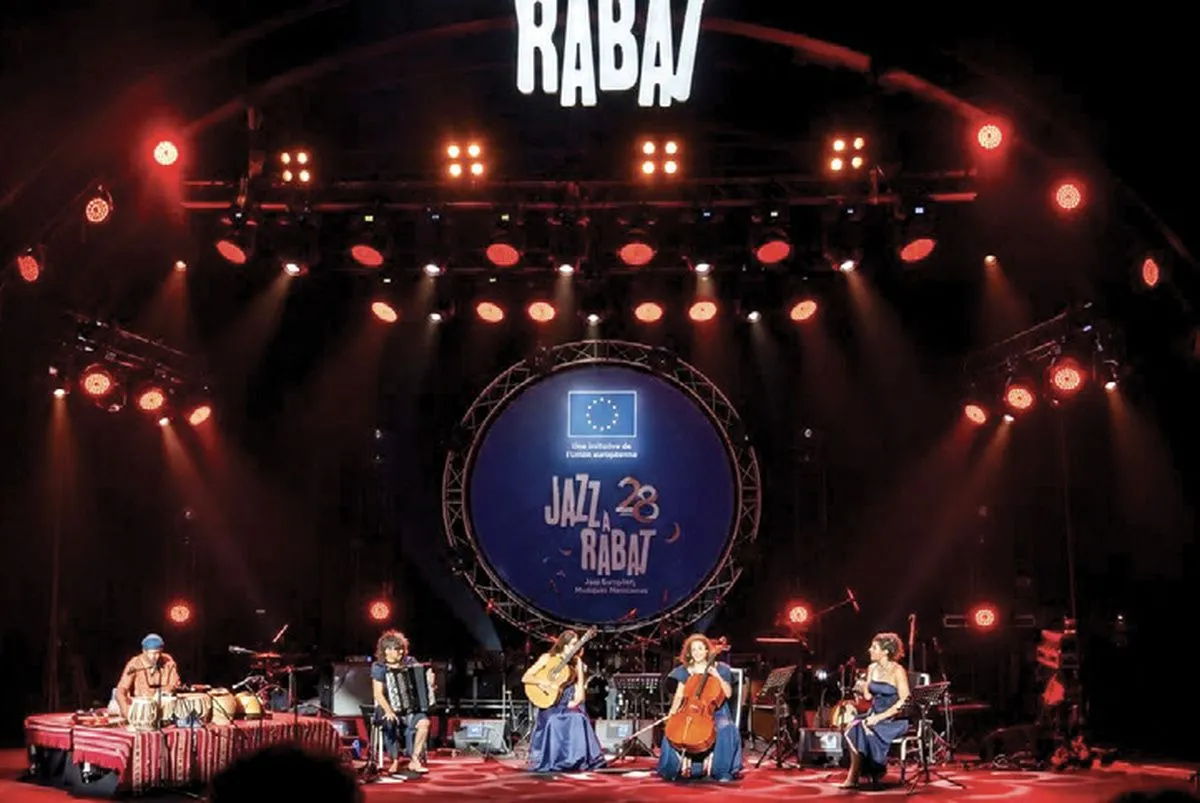

As night falls, the grand amphitheater at Parc Hassan II begins to fill steadily with an eager audience. Conversations blend seamlessly with the initial notes emanating from the stage, setting the stage for a vibrant cultural experience. In Rabat, this annual event has firmly established itself as a must-attend occasion. From Thursday, September 24, to Saturday, September 26, the amphitheater, with its 1,000 seating capacity, is completely sold out. Among the attendees are locals from Rabat, visitors from other cities across Morocco, and international guests drawn to the three-night celebration of jazz.
This 28th edition of Jazz à Rabat, an initiative supported by the European Union in Morocco, places a strong emphasis on collaboration as the heart of its programming. Alongside Moroccan ensembles, musicians from Portugal, France, Germany, Belgium, the Czech Republic, Austria, Bulgaria, and Spain grace the stage. Rather than simply hosting isolated concerts, the festival has ingeniously woven musical bridges between artists, facilitating collaborative performances throughout the evenings. The festival kicks off on Thursday night with the Amara Quartet, an all-female Portuguese group that beautifully blends jazz with traditional Portuguese fado. Just moments later, Moroccan musician Khalid Kouhen joins the quartet, enriching their musical dialogue. The evening continues with Thérapie de Couple, a Franco-German ensemble, before yielding to the ST-VNK Quintet, led by Moroccan artist M’hamed El Menjra.
On Saturday evening, the festival highlights another peak moment with the performance of Azure, an Austrian trio led by saxophonist Ulrich Drechsler. Following a collaboration with a Moroccan quartet led by Younès Fakhar, the night progresses with the Antonio Lizana Quintet from Spain. This sequence showcases one of Jazz à Rabat's primary ambitions: to transform artistic creation into a dialogue across diverse horizons. This engaging relationship with the audience has also resonated with foreign artists. In an interview, Ulrich Drechsler expressed his astonishment at the Moroccan audience's response, stating, "For me, playing a concert is always about finding a way to connect with people in the most emotional way possible." He recounts being deeply impacted by the "hospitality" and "warmth of the people," a revelation that inspires him to return to perform in the Kingdom.
This intercultural dimension has been central to Jazz à Rabat since its inception. Supported by the European Union in Morocco, in partnership with the Ministry of Youth, Culture, and Communication, as well as the Wilaya of the Rabat-Salé-Kénitra region, the festival has gradually embedded itself into the cultural landscape of the capital over the years. Dimitar Tsanchev, the European Union Ambassador to Morocco, also emphasizes the importance of cultural exchanges in the relationship between the two partners. "With Morocco, we have excellent cooperation in cultural and artistic exchange," he remarked in an interview with Maroc Hebdo. On stage, this cooperation manifests in tangible ways, as artists confront their influences, improvise, and compose together. European ensembles do not merely present their repertoire; they engage in a dialogue with Moroccan musicians and their traditions, creating bridges between jazz, Maghreb sounds, and global music styles.
Abir El Abed encapsulates this approach in a testimonial we gathered: "This is a festival where we can represent Moroccan and Maghreb culture while also blending it with other styles and music from around the world." By the end of the three evenings, Jazz à Rabat will have offered much more than a series of concerts. In the amphitheater of Parc Hassan II, musical boundaries have blurred, unique collaborations have flourished, and the audience has often participated in the spectacle itself. This edition showcased jazz as a vital meeting point between cultures.
As reported by maroc-hebdo.com.