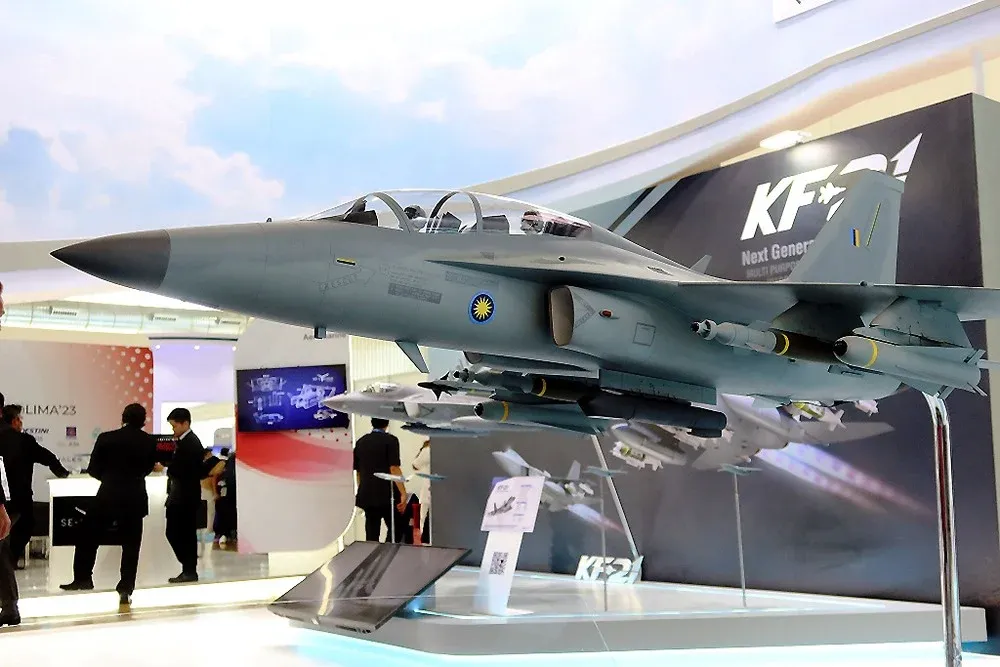

The participation of Korea Aerospace Industries (KAI) at the Marrakech Air Show 2026 marks a significant milestone as the South Korean manufacturer seeks to introduce its FA-50 aircraft into the Moroccan market. This event, taking place from October 7 to 10, showcases not only KAI's ambitions but also the competitive landscape of military training aircraft, with Italian firm Leonardo promoting its M-346 Master as a direct rival. The stakes are particularly high as Morocco looks to modernize its military training fleet, an initiative that places both manufacturers in the spotlight.
KAI's presence at the Marrakech Air Show is a strategic move aimed at solidifying its commercial foothold in Africa. The FA-50, an advanced trainer and light combat aircraft derived from the T-50 family, is being positioned to meet the Royal Moroccan Air Force's pressing need for updated training planes. This initiative has been underscored by KAI's recent endeavors to engage with Moroccan officials, including discussions at the World Defense Show in Riyadh earlier this year, where the interest in the FA-50 was notably highlighted. According to sources from the South Korean press, Morocco is keen on transitioning away from older aircraft to enhance its military capabilities.
The FA-50 boasts several advantages that align with Morocco's requirements for an advanced training aircraft. Its design facilitates integration into an operational environment that heavily relies on American technologies, a factor that could appeal to an air force equipped with F-16s. This compatibility positions KAI favorably as it navigates the complexities of the Moroccan defense market.
Leonardo's M-346 Master: A Competitor in Advanced Military Training
In tandem with KAI's entry, Leonardo has also confirmed its participation in the Marrakech Air Show, where it aims to assert its presence in the Moroccan military training sector with the M-346 Master. The Italian company has been actively pursuing contracts with the Royal Moroccan Air Force and has tasked its Vice President for Business Development, Davide Fazio, to spearhead these efforts. The M-346 is marketed not merely as a training platform but as part of a comprehensive military training system, which has already proven successful in multiple air forces including those of Italy, Singapore, and Israel.
This extensive operational experience enhances Leonardo’s appeal, allowing the company to showcase not only the aircraft but also the complete ecosystem involved in pilot training, including simulators and operational support. Furthermore, Leonardo is not limiting the M-346 to basic training roles; it is also developing versions of the aircraft with enhanced combat capabilities, thus broadening its operational spectrum. This versatility is a significant selling point, especially for air forces looking for a robust training solution that can evolve with their needs.
Two Approaches, One Market
The competition between the FA-50 and the M-346 is intriguing as it encapsulates two distinct industrial philosophies. KAI's FA-50 represents a supersonic platform that seamlessly transitions from advanced training to combat missions, appealing to air forces that require an aircraft capable of fulfilling dual roles. In contrast, Leonardo's strategy centers around a dedicated advanced training aircraft integrated into a complete training system, capitalizing on the maturity of its design and the extensive experience garnered from various air forces.
Ultimately, the decision between these two aircraft will hinge not only on their comparative performance but also on broader factors such as training models, ownership costs, maintenance, aircraft availability, armament capabilities, and the potential for industrial cooperation. As both companies vie for a foothold in Morocco, the outcome will significantly shape the future of military aviation training in the region.
As reported by fr.hespress.com.