
Unpacking the Complexities of Migration in 'Strawberries'
Premiering in the Un Certain Regard section at Cannes, Laïla Marrakchi's film 'Strawberries' seeks to challenge the often predictable narratives surrounding exploited migrant labor. This cinematic endeavor attempts to provide a fresh perspective by featuring a protagonist whose flawed nature and questionable decisions evoke a complex emotional response from the audience. However, this ambition is somewhat undermined by a narrative imbalance that detracts from the film's overall impact. In recent years, stories centering on exploited migrant workers have become a staple in global cinema, reflecting the ongoing struggles of individuals caught in the grips of capitalism, particularly in the Global North. As viewers, we are naturally inclined to empathize with those oppressed by the forces of an unyielding economic system. In this context, 'Strawberries' aims to subvert the traditional formula by presenting a protagonist who is not just relatable but also deeply flawed and at times unlikable. While this approach is commendable, the screenplay falls short in exploring the intricacies of her poor choices. While subtlety can be a powerful narrative tool, a deeper examination of the protagonist's motivations would have enriched the storytelling experience.
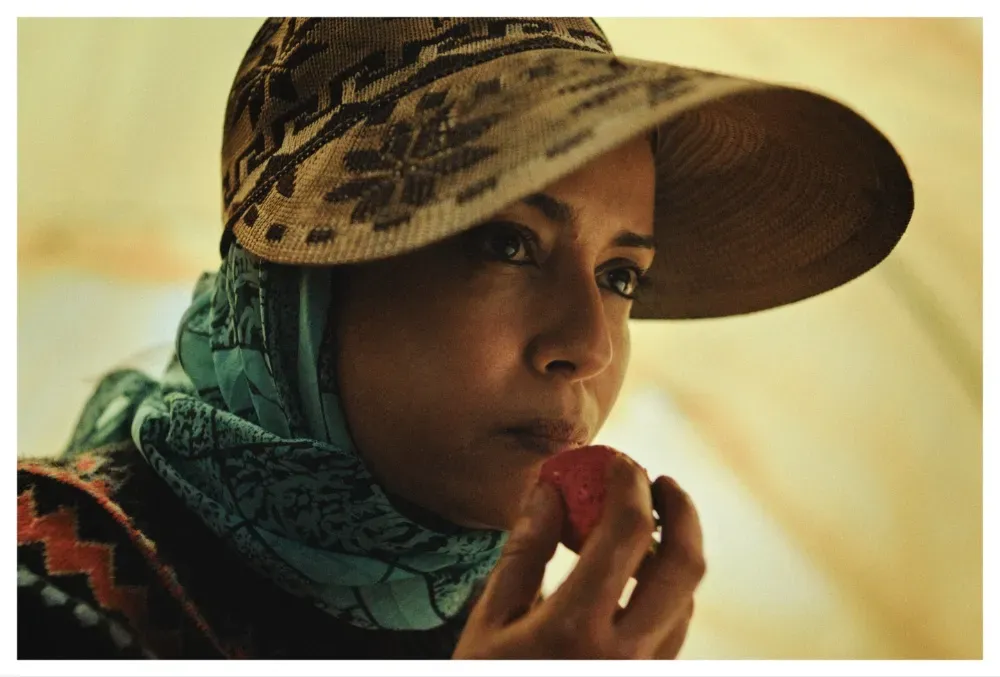
One of the film's strengths lies in its powerful opening sequence, which effectively conveys a wealth of information without feeling contrived. Through close-up shots of hands engaged in labor, we gain insight into the interchangeable nature of these women's lives as they pick strawberries in the Spanish province of Huelva for a meager wage of €35 a day. For these Moroccan women, this paltry sum is a means to support their families back home, highlighting the stark realities of their situation. Among the women is Hasna, portrayed by Nisrin Erradi, whose determination to work stems from a need she is reluctant to share. Accompanying her is Meriem, a quiet hijab-wearing woman, as they navigate the challenges of cramped living conditions alongside their fellow workers, Zineb and Khadija. The film subtly introduces Hasna's backstory through a newspaper article about her taekwondo achievements and a photo of a boy, offering glimpses into her life before entering this harsh reality.
The working conditions at the 'Fresa del Carmen' farm are grueling, yet the women remain focused on their tasks, knowing that any dissent could jeopardize their meager earnings. The language barrier exacerbates their plight, as no one speaks Arabic, including the ineffective union representative, Antonio, who serves the interests of the owner rather than the workers. Days are spent in relentless labor within the oppressive confines of plastic-covered greenhouses, with their limited off-hours spent grappling with financial constraints and the control exerted by the foremen. Despite their challenging circumstances, a sense of camaraderie among the women is evident, yet it is shattered when the owner, Iván, intrudes upon their privacy, leading to a harrowing moment that tests Hasna's loyalty to her coworker Meriem.
This bold narrative choice creates an immediate rift between Hasna and the audience's sympathies as we grapple with her troubling decision to abandon Meriem in a violent situation. While we can understand Hasna's internal conflict—protecting Meriem could jeopardize her financial stability—the script struggles to provide enough clarity about her past to justify her actions. As the story unfolds, we are left with lingering negative feelings regarding her betrayal, particularly as the other women also turn away from Meriem, who is visibly traumatized yet unable to articulate her experience. The film's exploration of women's solidarity is further complicated when Hasna accuses Meriem of using her body for personal gain, showcasing the internalized misogyny that pervades their environment.
Surprisingly, it is not the sexual assault that ignites Hasna's sense of injustice but rather the sudden loss of work that prompts her to take action. After Meriem suffers a miscarriage and is denied medical attention, Hasna finally reaches out to Pilar, a young human rights lawyer, through a sympathetic local shop worker. From this point, 'Strawberries' begins to tread a more predictable path, as Pilar remains oblivious to the realities of conservative Moroccan society, while local authorities treat the migrant workers with disdain. Although these societal attitudes are accurate reflections of the world, their portrayal risks falling into one-dimensionality. Marrakchi's previous works have shown her ability to weave complex narratives, and a similar depth in character development for Hasna could have elevated the film's emotional resonance.
Nevertheless, the film succeeds in creating a palpable atmosphere within the workers' camp and farm, effectively conveying a sense of oppression that permeates their lives. The constricted spaces where the women labor contribute to their eroding solidarity, while the indifference of the outside world highlights the challenges faced by those trying to advocate for their rights. Hasna's controversial actions are intended to be viewed through this lens, and as her backstory gradually unfolds, our engagement with her character is more influenced by Erradi's compelling performance than by the script's character development. The cinematography, helmed by Tristan Galand, captures the unsettling environment of the greenhouses with a roving camera that mirrors the women's instability, while the contrasting visuals within Iván's home serve to heighten the film's thematic depth.
As reported by variety.com.