
Latifa Toujani's Historic Inclusion in the Guggenheim Abu Dhabi Collection
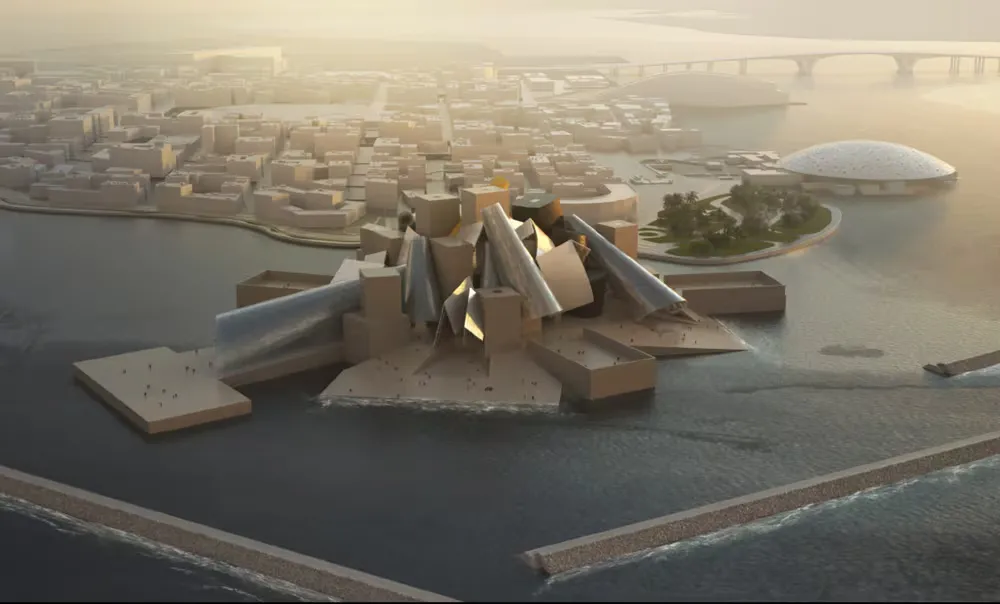
The name of Latifa Toujani is poised to make its mark in the annals of the Guggenheim Abu Dhabi. As the museum, designed by the renowned architect Frank Gehry, prepares to welcome its first visitors on December 11, 2026, a remarkable painting by the Moroccan artist—a 1.99 by 0.99-meter oil on canvas created in the 1970s—has been added to its prestigious collection.
According to Hicham Daoudi, the general director of the Moroccan Company of Works and Art Objects (CMOOA) and founder of the gallery Le Comptoir des Mines in Marrakech, "After the Barjeel Collection in Dubai, the Dalloul Foundation in Beirut, and the Mathaf in Doha, it is now the Guggenheim Abu Dhabi that embraces and recognizes her work as a militant and observer of the social conditions within Arab societies." This acquisition resonates deeply, particularly in light of Toujani's artistic journey. The future museum in Abu Dhabi aims to curate an international collection that spans from the 1960s to the present day, with a significant focus on artists and voices that have long been underrepresented, especially those from North Africa and the Arab world.
A Multifaceted Artist with a Social Conscience
Latifa Toujani is a multidisciplinary artist whose career spans over five decades, transcending boundaries of discipline and aesthetic. Born in 1948 into a traditional family in Fès, she nurtured a passion for drawing and Arabic literature from an early age. Between 1965 and 1968, she began her painting journey in Lille before relocating to Rabat, where she settled near Bab Rouah at the end of the 1960s. During this period, she encountered significant figures in the Moroccan art scene, including Larbi Belcadi, Moulay Ahmed Drissi, Mekki Murcia, and Mohammed Kacimi. From the outset, her work tackled potent themes such as women's condition, solitude, confinement, poverty, power dynamics, and Palestine.
In 1972, she became one of the founding members of the Moroccan Association of Plastic Arts (AMAP), and the following year, she showcased her first major solo exhibition at the Bab Rouah National Gallery in Rabat. The Palestinian cause emerged as a central theme in her work early on; in 1974, she was invited to create several posters for the Arab Summit held in Rabat, including the iconic piece "Palestine Awaits," which has become emblematic of her activism. Rather than depicting the violence of the conflict directly, Toujani opted for symbols and signs—such as the dove, the hand, and Arabic writing—transforming her paintings into spaces for political expression while maintaining the poetic essence of imagery.
In the same year, she participated in the Baghdad Biennale, a vital event in the realm of Arab plastic arts, and continued her training in printmaking in Salzburg, Austria, engaging in various Arab and Maghreb artistic manifestations. Her involvement included the traveling exhibition "Palestine," which was presented in Rabat, Algiers, and Tunis. Latifa's political engagement is complemented by her commitment to women's rights, as she actively participated in discussions about women's rights in Morocco alongside prominent figures like Fatima Mernissi.
In the 1980s, Toujani made a significant shift in her practice, turning to photography to document often inaccessible religious and ritualistic universes, especially for women. Starting in 1982, she captured the moussems and practices of brotherhoods associated with Sidi El Hadi Ben Aïssa in Meknes, as well as Sidi Ali Ben Hamdouch and Lalla Aïcha Hamdouchia. Her photographs went beyond mere folkloric documentation, instead immersing viewers in the ceremonies and focusing on gestures, bodies, faces, and the relationships between individuals and the sacred.
In her series "Atlas Women," created in 1987 and 1988, she portrayed Moroccan women adorned with tattoos, jewelry, and traditional costumes, adopting a perspective that emphasized their presence, individuality, and gaze. This attention to the female body was also evident in her earlier series "Body, Signs, Henna," initiated in 1979, where the body transformed into a territory of memory, signs, and expression.
In 1997, she participated in the photographic exhibition "Retrats de l’Anima" at the Fundació La Caixa in Barcelona, representing Morocco alongside celebrated photographers like Mali's Malick Sidibé. The 1990s saw the emergence of a new dimension in her work, marked by a spiritual quest. She began developing textile installations under the title "Maqamats Latifa," where textiles, Arabic letters, geometric forms, and mysticism became integral to her evolving artistic vocabulary.
It was not until recent years that Latifa Toujani's work gained renewed recognition in the narratives surrounding modern and contemporary Moroccan art. Her art re-emerged in the institutional spotlight in 2014 during the inaugural exhibition of the Museum of Mohammed VI of Modern and Contemporary Art in Rabat. A significant milestone occurred in 2021 with the "Trilogia Marroqui 1950-2020" exhibition at the Museo Reina Sofía in Madrid, which contributed to repositioning her work within a broader history of Moroccan creation and rekindled interest among researchers, collectors, and international institutions. In May 2025, Le Comptoir des Mines in Marrakech will host a solo exhibition titled "Latifa, Pioneer Too," offering a retrospective of her journey from the 1970s to the early 2000s, showcasing a diverse array of media including painting, printmaking, photography, drawing, textile works, and graphic research.
The inclusion of Latifa Toujani's artwork in the Guggenheim Abu Dhabi collection represents a significant milestone in a broader movement of recognition. Following the Barjeel Collection in Dubai, the Dalloul Foundation in Beirut, and the Mathaf in Doha, this addition underscores the growing interest of major institutions and collections across the Arab world in an oeuvre that has long remained in the shadows. It arrives at a pivotal moment for the Guggenheim Abu Dhabi, which has been curating its collection since 2009, aiming to create dialogues between artistic scenes from different regions worldwide while paying special attention to historically less visible voices. The museum, set to open on December 11, will be the fourth institution in the Guggenheim constellation after New York, Venice, and Bilbao. Designed by Frank Gehry, it will span 80,000 square meters and feature 30 galleries interconnected by a central atrium.
For Latifa Toujani, this inclusion in such a collection transcends mere acquisition; it honors a journey that has consistently intertwined creativity with activism over several decades.
As reported by fr.le360.ma.