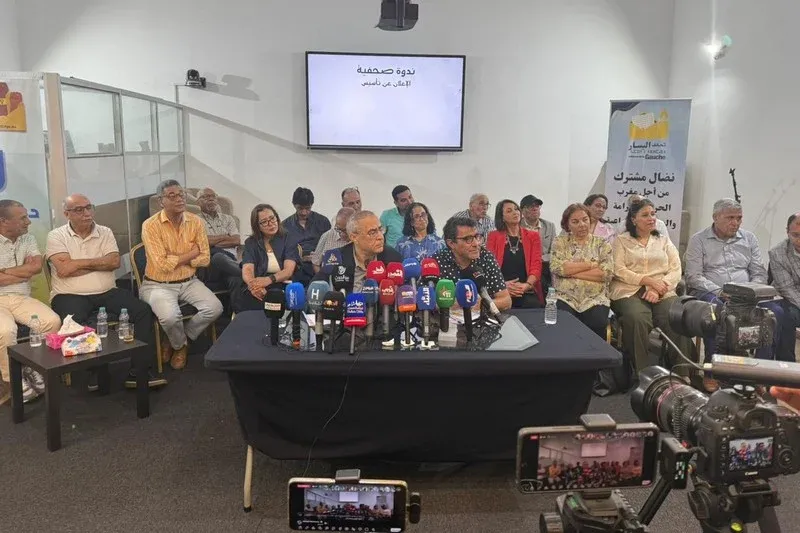

The Emergence of a Unified Leftist Coalition
The Leftist Alliance, comprising the Democratic Left Federation and the Unified Socialist Party, is gearing up to form a joint parliamentary group following the preliminary results of the 2026 legislative elections. According to the Interior Minister's announcement, this coalition has successfully secured eight parliamentary seats, five of which are regional. Among the victorious candidates are Fatima Zahra Abdoon from the Marrakech-Safi region, Sana Fawzi from Souss-Massa, and Monia Rashashi from Fes-Meknes, alongside Soad Freqish from Rabat-Salé-Kénitra, and Nabila Jalal from Casablanca-Settat. The alliance also claimed three local seats, with notable wins from Nabila Munib in Casablanca-Anfa, Omar Mahmoud Benjelloun in Rabat-Area, and Rashid Meshesh in Beni Mellal.
Strategizing for the Future
Abdel Salam Al-Aziz, the Secretary-General of the Democratic Left Federation, announced the upcoming meeting aimed at coordinating and establishing a unified parliamentary group that includes both parties. The discussions will focus on the structural formation of this alliance and its future trajectory, delving into the details and coordination mechanisms that will be employed. Al-Aziz emphasized that this alliance transcends being merely a transient electoral achievement; it represents a sustained political project grounded in shared principles and agendas. He anticipates that the alliance's vision will become clearer and more precise in the forthcoming meetings.
Reflecting on the eight seats won and the level of trust from the electorate, Al-Aziz highlighted the significant role of youth engagement. He noted that if the national ID card registration system had been implemented as previously proposed, youth participation could have been even greater. The electoral campaign experienced considerable enthusiasm among young voters and other demographic segments. He concluded by pointing out that the failure of many young individuals to register in the electoral rolls did not hinder their positive influence and support through their families and communities. Al-Aziz asserted that had there been an opportunity to rectify the electoral process, the results could have been remarkably different and more favorable for the coalition.
Meanwhile, Jamal Al-Asiri, Secretary-General of the Unified Socialist Party, reiterated that the existing alliance with the Federation is a political partnership rather than a fleeting electoral agreement. He stated that this coalition is set to endure beyond the elections to realize shared aspirations for democracy, freedom, dignity, and parliamentary governance. Al-Asiri pointed out that this is the first instance of the new left in Morocco achieving a total of eight seats, emphasizing that more could have been accomplished were it not for irregularities and violations observed in certain electoral districts, particularly the calamity that unfolded in Tangier involving the use of money and corruption.
He dismissed the notion that the youth's lack of voting participation is due to apathy, attributing it instead to the challenges posed by the electoral rolls and the governing laws. Al-Asiri mentioned that many young people expressed enthusiasm for the party following the lifting of media restrictions during the campaign, yet they were unable to vote due to not being registered. He reiterated the call for voting to be facilitated through the national ID card. Conclusively, he expressed pride in all elected representatives, recognizing them as dedicated activists within the party who hold a steadfast belief in their mission. Al-Asiri expressed strong confidence in their ability to form a distinctive and unified voice in parliament to advocate for the people's and the nation's interests.
As reported by hespress.com.