
Immigrants Brave Long Lines for Essential Documentation
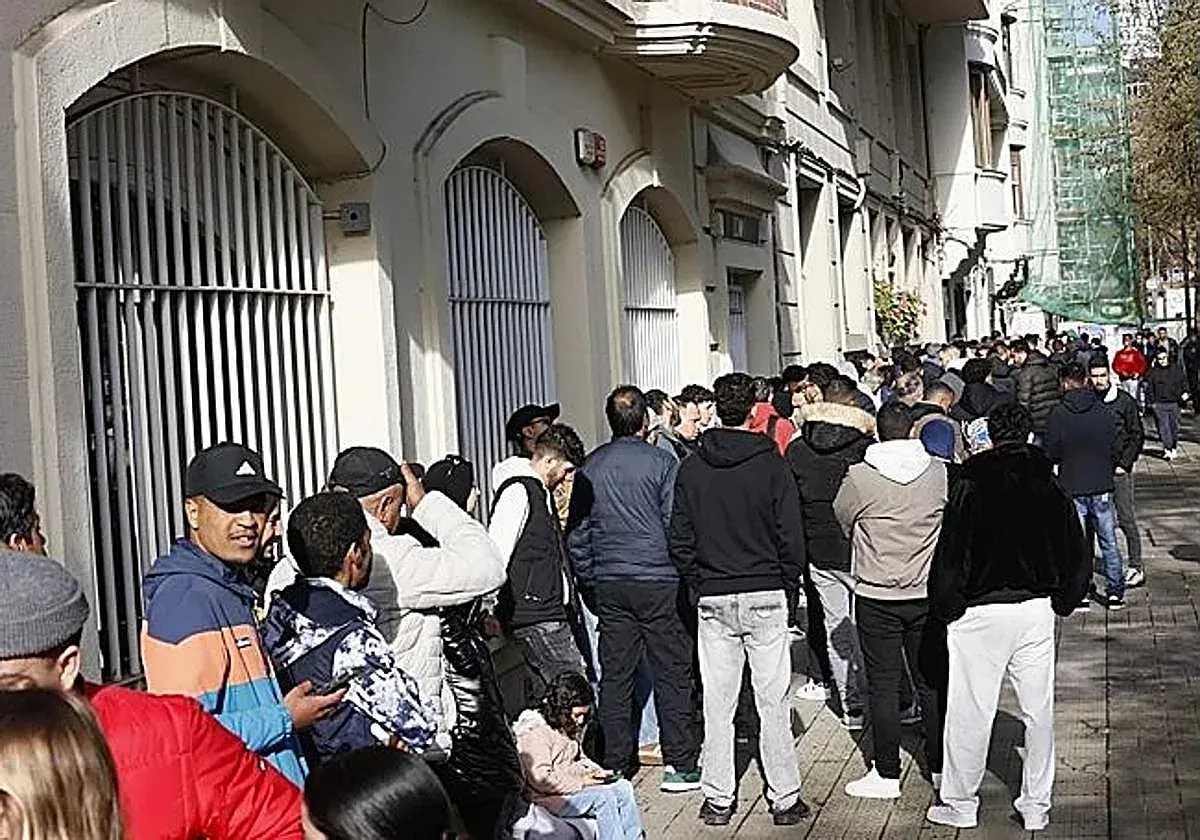
This Wednesday, hundreds of immigrants formed long lines outside the consulates in Bilbao, eager to obtain their criminal record certificates, which are crucial for regularizing their legal status in Spain. The urgency of their situation was underscored by the recent approval from the Council of Ministers for a Royal Decree that amends the regulations concerning the rights and freedoms of foreigners in Spain, as well as their social integration. This new regulation aims to streamline the process for migrants and their families, fostering long-term social inclusion and adapting to the evolving realities of migration.
The new guidelines stipulate that applicants must have no criminal record and pose no threat to public order or safety. The high demand for these certificates was evident, as many individuals flocked to the consulates. One family, who traveled from Gijón, shared their experience: "We woke up at five in the morning to be here," highlighting the lengths they were willing to go to navigate the bureaucratic process. The consulate serves as a vital resource for thousands of migrants residing throughout northern Spain, from Galicia to Navarra, including regions like Castilla y León and La Rioja.
Louiza, accompanied by her husband and niece, sought the certificate despite her family's long-standing presence in Spain. Having arrived three years ago in pursuit of a brighter future, she expressed her frustration: "This is our third time here for the same issue. Sometimes the process can be quite complicated." Her niece Yasma, who drove her to the consulate for convenience, echoed her sentiments about the challenges of public transport: "It's impossible to arrive on time by bus." Louiza dreamt of a better life, emphasizing her desire to work and improve her circumstances.
Extraordinary Regularization for Over 500,000 Immigrants
The recent reforms are set to facilitate the extraordinary regularization of more than 500,000 immigrants currently residing in Spain without legal status. In the Basque Country, approximately 26,000 foreign residents from Colombia, Morocco, Nicaragua, Venezuela, and other countries are expected to benefit from this initiative. Starting tomorrow, residency and work permits can be applied for online, with in-person appointments available from April 20th.
Among those waiting were Jalal and Mohamed, aged 22 and 27, who traveled from Pamplona and Vitoria, respectively. Mohamed shared his optimism about the future, stating, "Once I have the necessary paperwork, I will start looking for job opportunities. The processes here in Spain are easier compared to the rest of Europe." Jalal, who has been in Spain for seven years and works in a bar, expressed satisfaction with his life here, though he was present to renew his paperwork.
For some, establishing a future in the Basque Country remains a daunting challenge. Redoune, who has a physical disability, sought the criminal record certificate to enable him to work legally. "Life is very hard without papers. My goal is to obtain a residence permit so I can find work and get my disability card. It’s more complicated for me because I can't work in construction or similar jobs. I'm hoping to try my luck in supermarkets," he explained, revealing the struggles faced by many immigrants.
The city of Bilbao has recorded a surge in requests for criminal record certificates, with the local council noting that 418 requests have been submitted this year alone. This morning, a similar scene unfolded at the Venezuelan consulate, where a group of immigrants awaited assistance to obtain dual nationality. Roxana, who was there with her infant daughter, remarked on the improvements in processing times: "It used to be more complicated, but now things are quicker, even if there are always many people waiting."
Ildemaro, who has been in Spain for seven years but only worked for four, described his arduous journey to legalize his status after being denied asylum. With the help of foundations, he pursued another process and was now at the consulate to take a step closer to acquiring Spanish nationality. "It took a lot of effort and perseverance, but I finally succeeded. My colleagues have also been supportive. Now I have a permanent contract," he celebrated, underscoring the resilience and determination of immigrants striving for a better future in Spain.
As reported by diariovasco.com.