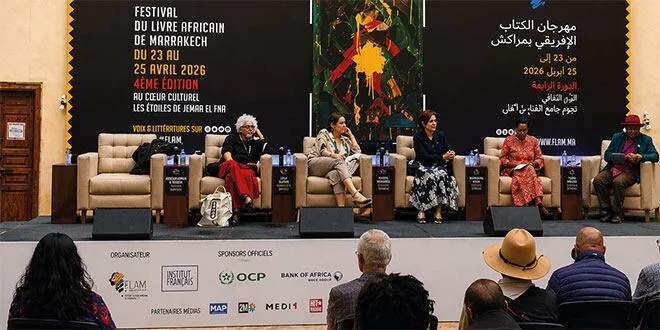

The fourth edition of the African Book Festival, taking place from April 23 to 25, 2026, showcases a rich cultural program aimed at highlighting new African literary experiences. The festival management strives to illustrate the innovative qualities inherent in African poetry and prose, particularly how these texts resonate with the political and social transformations sweeping across the continent today. This ambitious program has positioned Marrakech as a burgeoning capital of African literature, with a diverse array of writers beginning their presentations on Thursday, April 23, 2026. These contributions, free from the confines of academic monotony, offer valuable insights that stem from authors' personal experiences with literature, language, identity, and publishing institutions. They collectively craft a robust cultural discourse that examines the complexities of African literature, shedding light on its various forms and the intellectual foundations upon which it builds its creative narratives.
Contributors such as Leila Chawni, Malika Slawi, Isabelle Sayah Bodis, Lola Chonieh, Diadi Haidara, and Rodny Saint Elie have dissected the publishing landscape in Africa by addressing the challenges faced within the sector and the barriers hindering the development of a robust African publishing industry. This critical issue is inseparable from the creative practice, as it represents a foundational element essential for facilitating the publishing act itself. Consequently, the participating voices have shared insights based on their personal journeys within publishing institutions. Although these presentations are marked by a personal touch, they provide significant reflections on the myriad challenges confronting the book industry and its distribution across Africa, particularly concerning Arabic and English literature.
The festival's reputation has grown significantly within the cultural arena, owing to its distinctive approach that regards Africa not merely as a geographical space but as a vibrant laboratory for generating ideas, stances, and imagery. The festival unveils the artistic and aesthetic characteristics that define African literature through a variety of experiences, including poetry, short stories, and novels from different countries worldwide. It effectively portrays the transformations that have occurred within African literature since the formation of national identities following the independence of numerous African nations, progressing towards advanced phases where many African authors now reside in global cultural centers, producing texts parallel to those emerging post-independence.
Initially, literary works focused heavily on themes related to land, independence, and colonialism, allowing readers to perceive literature as a means of liberation from colonial powers. In the subsequent phase, a wider array of themes emerged, moving beyond mere notions of liberation to encapsulate childhood, history, memory, the body, reality, violence, and more. Through these explorations, African authors have dissected their daily lives, using literature as a tool for reflection on the significant transformations that have impacted Africa throughout the twentieth century.
The value of the African Book Festival lies in its ability to restore recognition to this often-overlooked literature within the global context, presenting distinguished literary models capable of transforming literary writing into a mechanism for contemplating society, memory, and history. African literature possesses artistic features, aesthetic properties, and intellectual mechanisms that render it deeply rooted in the human experience, reflecting the rhythm of political and social changes within Africa since the mid-twentieth century. Consequently, it serves as a literary document illustrating the arduous struggles endured by Africa since that time.
Moreover, it profoundly demonstrates that Africa has never existed on the periphery; rather, it has played a pivotal role in political history through liberation movements that have emerged in the region, establishing numerous concepts associated with freedom, justice, and equality. What sets this festival apart is its parallel contribution to solidifying Moroccan-African relations through literature, offering a unique perspective on international relations shaped by culture rather than politics. It relies on symbolic capital to broaden the dimensions of these relations, making literature an active element in the fabric of Moroccan-African connections.
The festival has also evolved into a cultural space for open dialogue among writers from various African nations, allowing them to present their works and engage in discussions intertwining factors of politics, history, and memory. Each African writer brings forth their interpretation of literature and its relationship with writing and publishing, rooted in their personal experiences. Through this approach, the African Book Festival in Marrakech has become a luminous cultural event that revitalizes Moroccan culture, transforming the festival into a genuine creative space liberated from the monotony of cultural tourism. It serves as a mechanism for cultural change and a true laboratory for contemplation and reflection on numerous issues related to Africa's growth, history, memory, and creativity.
All of this occurs at a time when cultural festivals are increasingly resembling mere tourist spaces, where cultural glorification overshadow the culture of self-criticism and acknowledgment, paving the way for a range of behaviors and thought patterns that often lead to the deterioration and homogenization of some festivals.
As reported by ar.le360.ma.