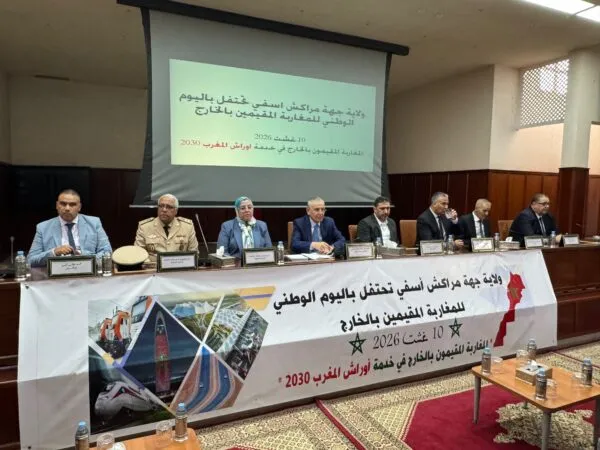

Marrakech was the host city for a significant communication meeting organized by the Marrakech-Safi region on Monday, celebrating the National Day of Moroccans Residing Abroad. This event aimed to highlight the vital roles that Moroccans around the world play in supporting national and regional development, while also showcasing the major projects currently underway in the city in preparation for the upcoming milestones linked to the year 2030.
During the event, Khalid El Habib, the Governor of the Marrakech-Safi region, emphasized the special significance of this celebration, describing it as an opportunity to strengthen the communication bridges with Moroccans abroad and to enhance their involvement in the ongoing developmental dynamics of the Kingdom. He elaborated on this year's theme, "Moroccans Residing Abroad in Service of Morocco's 2030 Projects," which reflects the reliance on Moroccan talents overseas as a valuable human resource that can contribute to the transformative changes taking place in Morocco. This contribution can manifest through investment, the transfer of expertise and technology, as well as support for innovation, entrepreneurship, and promoting the Kingdom on the global stage.
El Habib also addressed the preparations for the joint hosting of the 2030 World Cup by Morocco, Spain, and Portugal. He underscored that this event transcends mere sports, representing a vast national project aimed at accelerating development, modernizing infrastructure, improving service quality, and enhancing the attractiveness of Morocco as a destination.
Marrakech holds a pivotal position within this developmental dynamic, given its global tourism and cultural significance, coupled with its economic potential and hospitality capabilities. Furthermore, numerous structured projects are underway to ensure the city's readiness for future challenges.
Among the prominent projects discussed was the enhancement of the Grand Stadium of Marrakech, aimed at increasing its capacity. Additionally, the modernization and expansion of Marrakech-Menara Airport are anticipated, with an expected capacity rise from around 8 million passengers currently to 14 million by 2030, accompanied by the implementation of a comprehensive digital system to transform it into a 'digital airport.'
Planned projects also include the construction of a high-speed rail line connecting Marrakech to Casablanca, which would reduce travel time to approximately 1 hour and 15 minutes. A new industrial zone spanning 40 hectares is also in the pipeline, along with the rehabilitation of road networks and entrances to the city, as well as the development of urban transport systems.
In addressing traffic congestion, preparations are underway for building several bridges, tunnels, and other infrastructure at high-traffic points. Moreover, strategic parking areas with a total capacity of approximately 7,200 spaces are being developed.
The iconic Jemaa el-Fnaa Square, a hallmark of the ancient city and a major attraction for visitors, is also set to undergo a renovation project. The hotel sector is expected to expand and upgrade, aiming to increase accommodation capacity to around 80,000 beds in Marrakech and approximately 110,000 beds across the Marrakech-Safi region by 2030.
For the regional government, these initiatives are not only about preparing for the global sporting event, but they also form part of a broader vision for sustainable development, enhancing quality of life, and boosting the city’s competitiveness in attracting investments and tourists.
El Habib highlighted that Moroccans around the world constitute one of the most significant components of the national human capital, given the wealth of expertise and experiences they possess in various economic, scientific, technological, and cultural fields. He urged the mobilization of these talents to support the Kingdom’s major projects through encouraging productive investments, the transfer of technology and expertise, and fostering innovation and startups, while also contributing to enhancing Morocco's image as an attractive destination for investment and tourism.
During the meeting, representatives listened to the concerns and suggestions of the Moroccan diaspora, addressing several observations related to improving the support mechanisms for Moroccans abroad and facilitating their contributions to national development. The proposals focused particularly on enhancing coordination among various stakeholders, expediting processing times, and developing more suitable mechanisms to meet the needs of community members, thereby allowing their desire to invest and contribute to development to materialize into tangible projects and initiatives.
As reported by alyaoum24.com.