
Marrakech's Ambitious Urban Development Initiatives
Marrakech is undergoing a significant transformation as it prepares for the World Cup 2030, with ten public contracts among approximately 140 tenders recently launched by various public institutions. These initiatives represent an estimated investment of around 733.58 million dirhams, focusing on key sectors such as railway transport, road infrastructure, sanitation, public facilities, cleanliness, road safety, and education. This investment surge underscores a robust momentum aimed at enhancing the city’s infrastructure and overall livability in anticipation of the upcoming global sporting event.
Key Projects Driving Change
Leading the list of these transformative projects is the railway construction initiative, spearheaded by the National Office of Railways (ONCF), which has earmarked 462.288 million dirhams for the development of several stations linked to the future high-speed rail line connecting Kénitra and Marrakech. This ambitious program includes the establishment of the Green City station in Benguerir, a regional express train station in the same area, and future stations in Sidi Bou Othmane, Sidi Ghanem, and Marrakech Stadium. The enhancement of the railway network is essential for improving access to major urban centers and significant city facilities, particularly in light of the anticipated influx of international sports events.
The extension of the high-speed rail line to Marrakech will span approximately 430 kilometers, drastically reducing the travel time between Tangier and Marrakech to under three hours. The national railway program for 2024-2030 also envisions the expansion of the regional express train service, the acquisition of new rolling stock, and modernization of existing stations and railway infrastructure, thereby laying the groundwork for a more interconnected transportation system.
In addition to rail initiatives, road infrastructure is another critical component of this urban metamorphosis. The Marrakech municipality has launched a project to rehabilitate, strengthen, and widen the road connecting the southern district of Mhamid to Avenue Bouaâkaz, with an investment exceeding 80.3 million dirhams. This project is integral to accommodate the urban expansion in this part of the city and the growing demand for mobility.
Moreover, significant investments are being directed towards liquid sanitation systems. The works related to the "M" collector in Mhamid represent an investment of 48 million dirhams for the first lot and 31.23 million for the third lot. Additional expenditures include the relocation of networks affected by the high-speed rail line, amounting to 21 million dirhams for the first lot and 16.8 million for the second, leading to a total exceeding 117 million dirhams in this sector alone.
In the realm of public facilities, the new headquarters of the Marrakech Urban Agency has a budget of 33.2 million dirhams, while waste management in Tassoultante is allocated 14.21 million dirhams. The National Highway Company of Morocco is also planning 13.6 million dirhams for treatment and security works in areas prone to landslides on the Marrakech-Agadir highway. Education initiatives are also being prioritized, with nearly 12.94 million dirhams dedicated to constructing the Souihla high school to meet the needs of a rapidly evolving demographic and urban landscape.
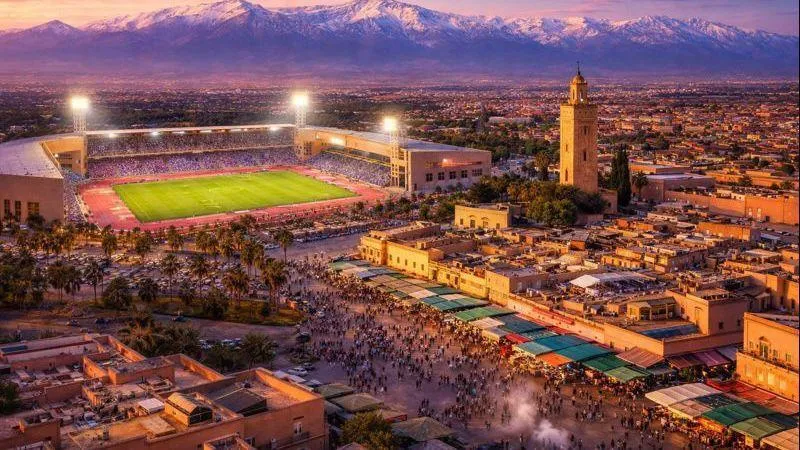
Sports infrastructure is particularly prominent in this transformation narrative, with the Grand Stadium in Marrakech at the center of preparations for World Cup 2030. Renovations aim to modernize its facilities, enhance hospitality conditions, and adapt the venue to meet the standards required for major international competitions. Concurrently, access and mobility infrastructures surrounding the stadium are expected to evolve, with a new railway station dedicated to the stadium, alongside roadworks and other urban improvements, contributing to the creation of a comprehensive sports hub capable of accommodating supporters, teams, and visitors alike. The World Cup thus serves as a catalyst, linking sports facilities with significant transportation and urban development projects.
However, it is notable that among these major contracts, there appears to be a lack of significant investment directly aimed at environmental concerns, green spaces, or the creation and rehabilitation of gardens, all of which are essential components to enhance the attractiveness and quality of life in a city like Marrakech. Similarly, the condition and organization of underground passages remain a point of tension in several areas of the city, particularly amidst increasing traffic pressures. A successful urban transformation must not only focus on large-scale projects and transportation infrastructure but also integrate aspects of daily life, mobility, and concrete solutions to the congestion challenges that are becoming more pronounced.
These investments chart a unified trajectory towards a Marrakech that aspires to elevate its status. High-speed rail, roadways, sanitation, public facilities, and sports infrastructures contribute to a transformation that far exceeds the timeline of 2030. The 733.58 million dirhams allocated to this selection already indicates the magnitude of this movement. The next crucial step is to turn these tenders into active construction sites and ultimately, tangible achievements that will benefit both residents and visitors.
Marrakech is not just preparing for World Cup 2030; it is also laying the foundation for its future. By 2030, the city of ochre may present a new face: more connected, more accessible, greener, and better equipped to host significant international events.
As reported by lopinion.ma.