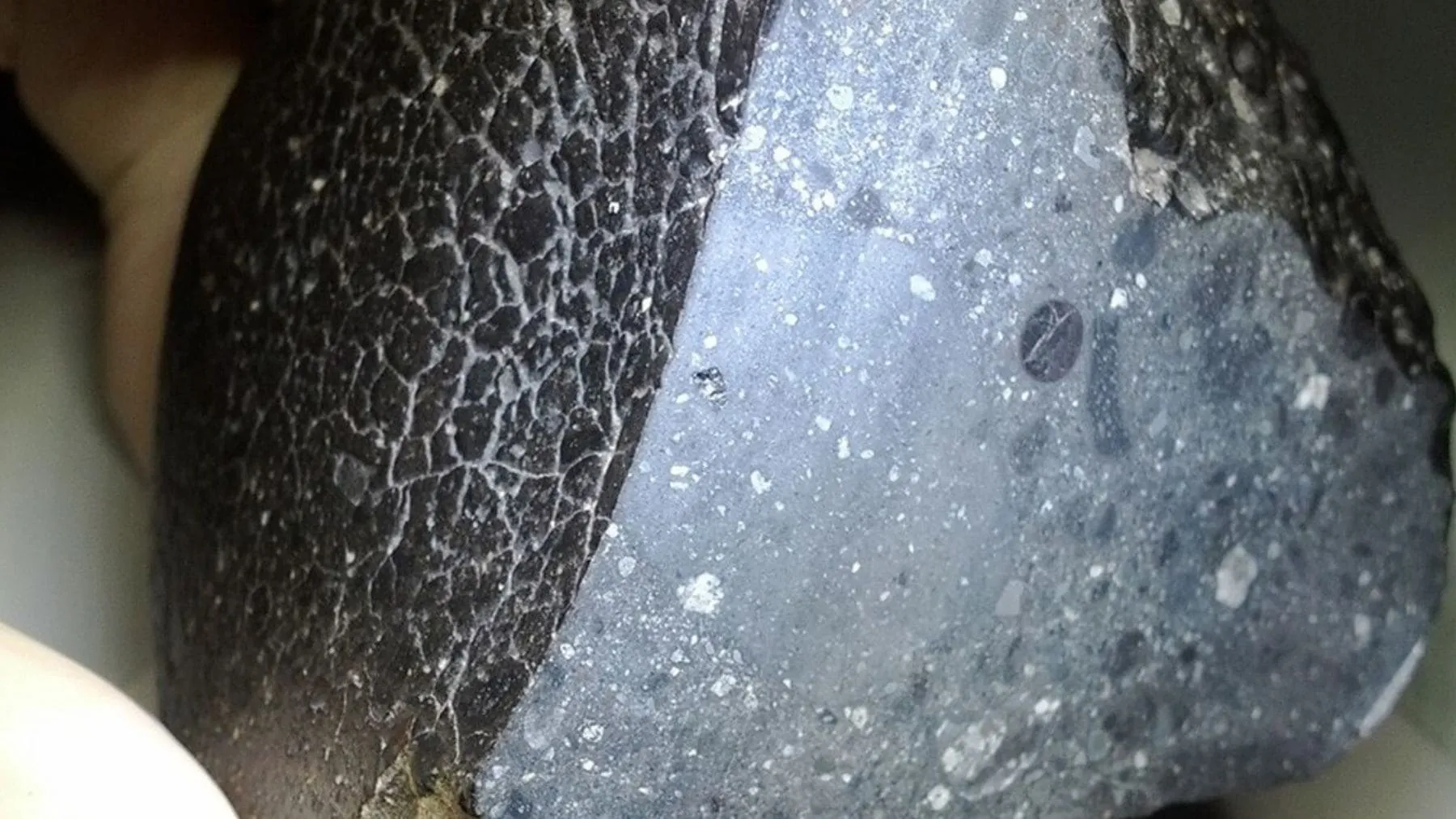

The Remarkable Journey of NWA 7034
In 2011, a seemingly ordinary black stone discovered in the Sahara Desert made its way into the meteorite trading scene in Morocco. Initially regarded as a mere curiosity, it turned out to be NWA 7034, a fragment from Mars that now serves as a time capsule revealing the secrets of the Martian crust. This intriguing meteorite has recently garnered attention due to groundbreaking research published in January 2026. A team of scientists successfully mapped hydrogen—an essential indicator of water—within a small piece of the meteorite using non-destructive scanning techniques. The findings provide invaluable insights into how and where water existed on ancient Mars.
Unlocking the Mysteries of Ancient Water on Mars
NWA 7034 weighs approximately 320 grams and was uncovered in the desert in 2011, according to a detailed study conducted by researchers from the University of New Mexico (UNM). The rock first made headlines in 2013 when analyses revealed it belonged to a "new class" of Martian meteorite, showcasing a chemical composition strikingly similar to rocks studied by NASA's missions on the surface of Mars. One of the most surprising discoveries was the presence of water, with researchers estimating a concentration of around 6,000 parts per million, which constitutes about 0.6% of its mass—a remarkably high figure for a Martian meteorite. Carl Agee, one of the study's authors, described it as "a completely new type of Martian meteorite," an assertion that in scientific terms often signifies the unveiling of previously unseen possibilities.
Traditionally, studying the water content in meteorites came with a significant cost: it often required cutting, polishing, and sometimes destroying portions of the sample. Given the rarity of such materials, every millimeter is precious, as there are no duplicate specimens tucked away for future analysis. However, the recent study, dated January 14, 2026, employs a combination of X-ray computed tomography and neutron tomography, akin to performing a CT scan on the rock. This innovative approach allows researchers to locate hydrogen, providing insights into the presence of water even when it is trapped within minerals.
The research team analyzed a tiny fragment measuring just 12 by 8 by 2 millimeters, uncovering localized regions rich in hydrogen. Although these areas make up only about 0.4% of the meteorite's volume, they are significant, as they are associated with iron oxyhydroxides rich in hydrogen found within clasts (small rock fragments) embedded in the meteorite—minerals that resemble rust when iron interacts with water.
Upon further analysis, these "islands" of hydrogen could potentially contribute up to 635 parts per million of water, accounting for roughly 11% of the total estimated water content of the meteorite. This finding transforms our understanding of how water may have been stored, challenging the notion that it was uniformly distributed throughout the rock.
It is essential to clarify that the research does not suggest the presence of liquid water within the rock akin to a bottle; rather, it indicates hydrogen incorporated into mineral structures, more akin to "chemical" moisture than a puddle. The narrative surrounding trapped water does not conclude here. In November 2024, another research team analyzed a zircon grain aged at 4.45 billion years within the same meteorite and found geochemical signatures compatible with water-rich fluids and early hydrothermal activity. This suggests a Mars with internal heat, active geology, and circulating water.
Co-author Aaron Cavosie succinctly summarized the findings, stating, "We used nano-scale geochemistry to detect elemental evidence of hot water on Mars 4.45 billion years ago," emphasizing the significance of hydrothermal systems in fostering life on Earth. While this comparison does not confirm the existence of life on Mars, it certainly positions the scenario within an appropriate context.
How does this reshape our mental map of Mars? It suggests that the story of Martian water goes beyond just oceans and rivers; reservoirs may have existed close to the surface, linked to minerals and processes of impact and alteration. Furthermore, the technique employed is nearly as important as the results themselves. As space exploration advances into an era of sample return missions, possessing tools that can "read" the interior without consuming material represents a substantial advantage. Ultimately, it exemplifies a more resource-conscious approach to scientific inquiry.
Nevertheless, it is crucial to remain grounded. A meteorite offers a glimpse into the past, but it does not encapsulate the entire landscape, and each study operates on small fragments and evolving hypotheses. Thus, it is prudent to view these discoveries as pieces of a puzzle that is still being assembled while also recognizing the invaluable nature of water, both here on Earth and beyond.
As reported by ecoticias.com.