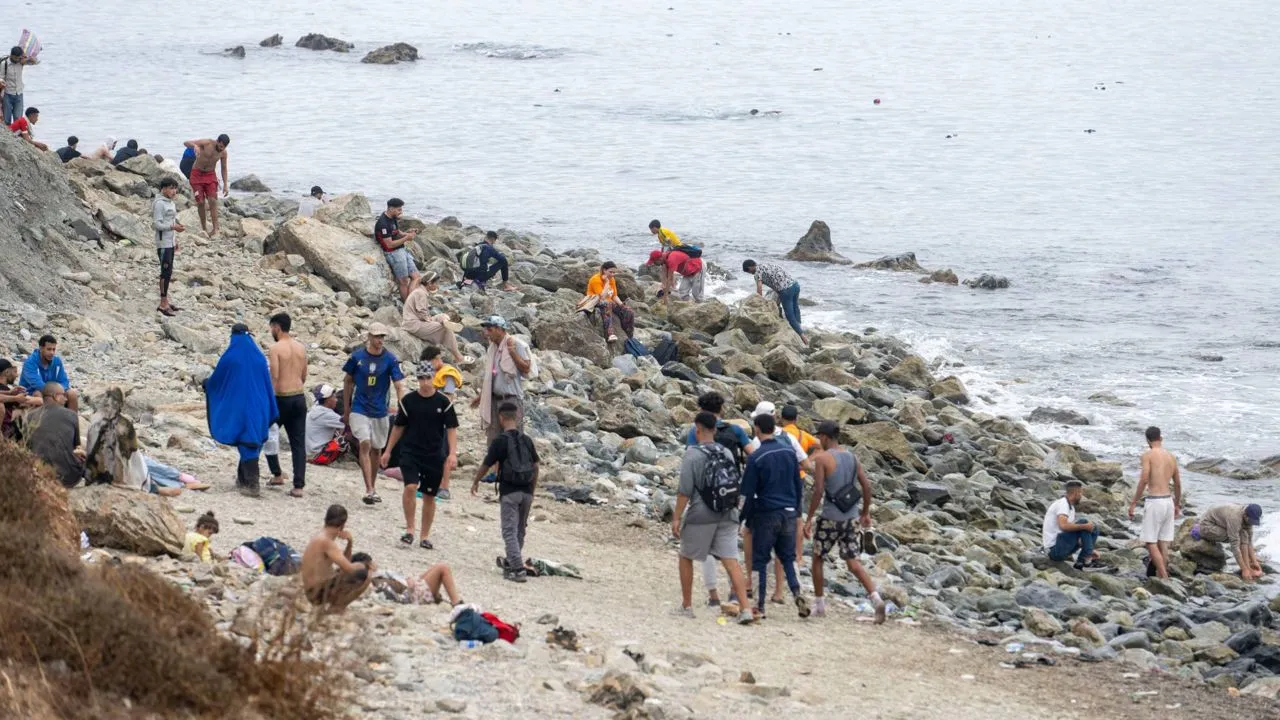

In a startling development, approximately 60,000 migrants made their way from Morocco into Ceuta, a small Spanish enclave, in just a 24-hour period, as reported by Ceuta's president on Friday. This staggering number represents about 70% of the local population, highlighting the magnitude of the situation. Tragically, at least 57 migrants lost their lives during the perilous journey, underscoring the dangerous conditions these individuals faced as they sought refuge and better opportunities.
The Spanish government indicated that a significant portion of these migrants returned to Morocco voluntarily after the sudden surge overwhelmed local resources, resulting in chaos and a humanitarian crisis. Many of the individuals who attempted the crossing endured perilous swims through the sea, confronting authorities who employed water cannons, tear gas, and warning shots in efforts to deter them. Among the deceased were individuals who either drowned or were caught in a stampede while trying to navigate a breakwater barrier near a crucial border checkpoint.
In response to the turmoil, Spain deployed armed forces along with additional police to restore order in Ceuta, a territory that has been under Spanish control since 1580 and is strategically located at the entrance to the Mediterranean Sea. On the Moroccan side, security forces engaged in confrontations with migrants attempting to cross. The ripple effects of this crisis were felt beyond Spain, with both Italy and France announcing intentions to reinforce border controls in response to the influx.
Ceuta's President Juan Jesús Vivas expressed his concern, stating that the current situation is “absolutely unsustainable.” Meanwhile, a similar scenario unfolded in Melilla, Spain's other North African territory, where migrants clashed with police during their attempts to enter. Spanish Prime Minister Pedro Sánchez visited Ceuta and condemned the border breach, labeling it a violation of Spain's territorial integrity. He attributed the crisis to human smugglers who mislead vulnerable individuals, often leading them to tragic ends.
As the Spanish Interior Ministry released estimates indicating that around 50,000 migrants crossed from Morocco since Thursday, it also reported that approximately 48,300 had returned by Friday evening, with many more doing so hourly. Local authorities voiced alarm over the conditions faced by migrants, with thousands, including unaccompanied minors, forced to sleep in public spaces, leading to a “serious humanitarian crisis,” as described by Rachid Sbihi, a representative of Civil Guard officers.
European Commission President Ursula von der Leyen condemned the events in Ceuta, calling the situation “unacceptable” and emphasizing the need for stringent controls on migration into the European Union. She called for a halt to dangerous crossings and the dismantling of smuggling networks, underscoring the necessity for swift repatriations in accordance with EU regulations. As the crisis unfolded, the waters near the border were littered with personal belongings, further illustrating the desperation of those involved.
Many young Moroccans who managed to cross into Ceuta expressed their hopes for better employment opportunities, only to find themselves in a chaotic environment that forced them to reconsider their journey. Abdulah Buji, a 21-year-old from Tetouan, shared his disillusionment, stating, “There's nothing at home. I'd have to work 12-hour shifts for a meager wage. That's why I came here. But I haven't found any opportunities here either, so I have to go back.”
Moroccan police resorted to measures such as water cannons and warning shots to deter further crossings, while the Moroccan ambassador to Spain highlighted that the unfolding situation was contrary to Morocco's wishes for orderly migration. The journey to Ceuta often involves swimming from nearby Moroccan towns, with some migrants attempting a shorter crossing from Belyounech.
The recent surge in crossings has been linked to a ruling by the Spanish Supreme Court, which determined that migrants arriving by sea could not be summarily deported, a decision that was misinterpreted by human trafficking networks, according to Prime Minister Sánchez. His government, which has previously taken steps to regularize the status of many undocumented migrants, has faced criticism for its approach, with detractors claiming it encourages further migration.
Meanwhile, the United States voiced its support for Spain and Europe in addressing the crisis, stating that the situation constituted a serious violation of sovereignty and human rights. In response to the chaos, Italy temporarily suspended its open-border Schengen agreement with Spain, reintroducing border controls, while France announced similar measures. The Spanish government sought to clarify that the recent regularization efforts had no connection to the surge in migration.
The turmoil in Ceuta is mirrored by similar disturbances in Melilla, where migrants engaged in violent confrontations with police, resulting in injuries among security personnel and multiple arrests. Both Ceuta and Melilla are regarded by many Moroccans as occupied territories, further complicating the already tense dynamics of migration in the region.
As reported by spectrumlocalnews.com.