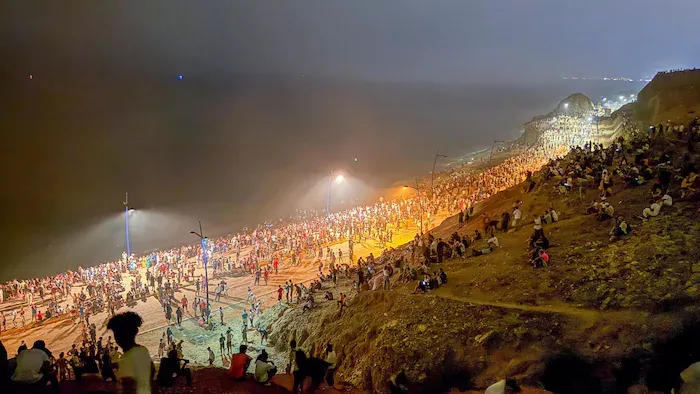

On Friday, nearly 60,000 migrants from Morocco entered the Spanish territory of Ceuta within a matter of hours, significantly swelling the local population, which typically numbers around 80,000 residents. This unprecedented surge is not merely a migration crisis but rather a complex geopolitical issue, as highlighted by experts who assert that migrants are increasingly being used as pawns to destabilize governments. The gravity of the situation is underscored by the tragic loss of at least 67 lives during the perilous crossing, with many attempting to swim to Ceuta to evade land border controls.
Understanding Ceuta's Geopolitical Landscape
Ceuta is an autonomous Spanish city located on a mere 18 square kilometers of land in North Africa, sharing an 8-kilometer border with Morocco and lying approximately 15 kilometers from the Spanish coastline. In an effort to curb illegal immigration and smuggling, a border barrier was constructed in 2001 at a cost of €30 million (around $45 million). However, Morocco does not recognize Spain's sovereignty over Ceuta, nor over the other Spanish enclaves of Melilla and Peñón de Vélez de la Gomera. Under normal circumstances, the situation is relatively stable, with only 2,582 migrants crossing into Ceuta from January to June, according to the United Nations High Commissioner for Refugees.
In light of this recent influx, local authorities requested the national government to declare a state of emergency, a request that was ultimately denied. Nonetheless, Spanish Prime Minister Pedro Sánchez visited the region, where the military was deployed, businesses were shuttered, and residents sought refuge in their homes. By Saturday, reports indicated that nearly all the migrants who had entered illegally had been returned to Morocco, with authorities from both countries reportedly collaborating closely. Notably, a 500-meter inflatable barrier is being installed in the Mediterranean Sea to deter migrants from swimming across.
Potential Triggers for the Migration Surge
Numerous theories circulate regarding the causes of this sudden influx. Many migrants interviewed by journalists cited social media rumors suggesting that the border between Ceuta and Morocco had been opened, prompting thousands to flock to Fnideq, a Moroccan town adjacent to Ceuta. The origin of these rumors remains unclear, but a decision by the Spanish Supreme Court on July 8 may have played a role. This ruling indicated that the immediate expulsion of a migrant without a prior administrative procedure did not apply to individuals who arrived by sea, unlike those entering through land borders. Both Sánchez and Spain's Interior Minister have accused smuggling networks of misinterpreting this court ruling and encouraging the surge of undocumented migrants.
Unlike several other European governments, Sánchez's leftist administration has shown a willingness to accept migrants, having recently pledged to regularize the status of 500,000 undocumented individuals. Some migrants in Ceuta reported that they had seen statements from the Spanish Prime Minister on social media, which may have influenced their decision to cross.
This is not the first instance of a mass migration event in Ceuta; a similar occurrence took place in 2021 when 10,000 migrants crossed into Spanish territory in a single night, a situation reportedly orchestrated by Moroccan authorities as a pressure tactic amid diplomatic tensions. At that time, Spain had hosted the leader of the Western Sahara independence movement, Brahim Ghali, for medical treatment, which angered Morocco, a nation that claims sovereignty over Western Sahara.
More recently, Spain has sought to strengthen ties with Algeria, raising the possibility that this rapprochement has displeased Morocco. Henry de Laguérie, a journalist based in Barcelona, suggests that the Moroccan government may have deliberately allowed a large number of migrants to cross into Ceuta to exert pressure on Spain, a strategy reminiscent of past events. This perspective aligns with that of Sarah Wolff, a migration policy expert at Leiden University, who notes that such movements are not spontaneous and imply a degree of orchestration from the Moroccan side.
European leaders have voiced their concerns regarding the situation in Ceuta. Italian Prime Minister Giorgia Meloni has indicated her willingness to propose excluding Spain from the Schengen Area, which encompasses 29 European countries that permit free movement without border checks. However, such freedom of movement can be suspended in cases of threats to internal security or public order, particularly during sudden and massive migration flows that could disrupt the functioning of the EU community. Other European leaders, including French President Emmanuel Macron and German Chancellor Friedrich Merz, have also called for immediate action regarding the migrants.
As the EU interior ministers prepare to discuss the events in Ceuta via video conference, the situation remains fluid and complex. The recent surge in migration has not only raised immediate humanitarian concerns but has also highlighted the intricate interplay of geopolitics and migration policy within Europe.
As reported by ici.radio-canada.ca.