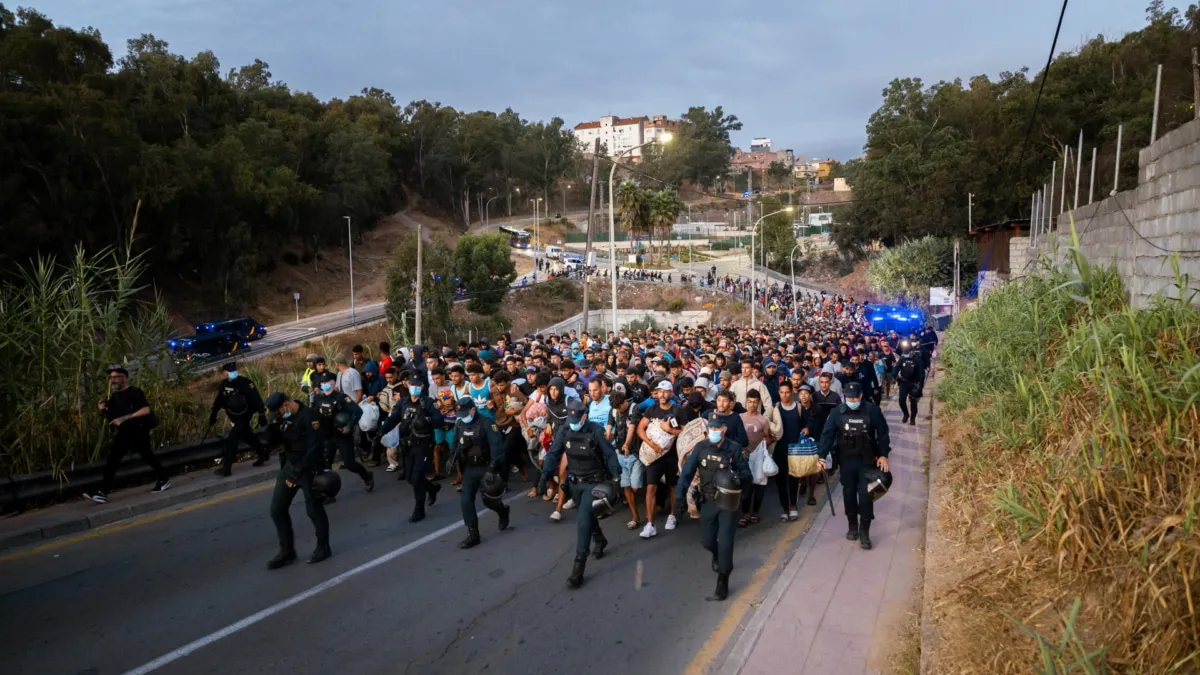

Ceuta Faces Unprecedented Migrant Surge
In a startling turn of events, over 60,000 illegal migrants reached the Spanish exclave of Ceuta since Thursday, leading to a state of emergency in the region. Many individuals braved the waters, swimming to the city and bypassing border fences, while tragically, 67 lives were lost during this perilous journey. Others managed to cross the Tarajal border checkpoint with little resistance. The situation escalated as migrants clashed with police, throwing stones and looting local shops. Recent reports suggest that this mass influx may have been intentionally facilitated by the Moroccan government.
Spanish security sources indicate that Moroccan border police withdrew from the area just before the surge began. It wasn’t until the evening that Moroccan authorities intervened with tear gas and water cannons in an attempt to control the situation. This has raised significant concerns in Madrid, where government officials acknowledge that without the Moroccan security forces' passive stance, the mass movement of migrants would likely not have materialized. However, publicly, the Spanish government has refrained from making direct accusations towards Rabat, opting instead to speak of a "model of collaboration." Behind closed doors, discussions about the true nature of this incident are reportedly ongoing.
Political Tensions and Migrant Experiences
Initially, the authorities in Ceuta were overwhelmed by the sheer number of migrants arriving in the area, with reports confirming the unfortunate deaths of 67 individuals. Adding to the complexity of the situation are testimonies from migrants themselves. Several men recounted to the "New York Times" that Moroccan police did not impede their progress; instead, they directed them towards Ceuta, with phrases like "Go that way, go that way," as recounted by 26-year-old Youssef Alaoui. Another migrant stated that officials encouraged him to cross, saying, "Come to Spain." This raises critical questions about the role of Moroccan authorities in this crisis.
The timing of this mass migration is particularly significant. Just days before the influx, Spanish Prime Minister Pedro Sánchez had improved relations with Algeria, a move that is viewed with suspicion by Morocco. Observers speculate that this incident could be linked to the long-standing territorial dispute over Western Sahara, a region Morocco claims as its own, while the Polisario Front, supported by Algeria, seeks independence. The United Nations has been calling for a resolution to this unresolved political status for decades, and the conflict strains relations between Morocco, Algeria, and Spain.
Additionally, a recent ruling by Spain's Supreme Court may have influenced the surge. The court determined that migrants reaching Ceuta by swimming or being rescued from the sea could not be immediately returned to Morocco; each case must be examined individually. This information spread through social media, leading to claims that those who reached Ceuta by swimming would not face deportation. According to the Spanish government, this rumor could be a contributing factor to the unprecedented surge of migrants.
As the situation in Ceuta appears to have stabilized, reports indicate that nearly all of the 60,000 migrants have since left the Spanish enclave. Foreign Minister José Manuel Albares stated on social media that "almost all who had arrived in Ceuta have now returned to Morocco." This incident highlights the ongoing complexities surrounding migration policies and international relations in the region.
As reported by bild.de.