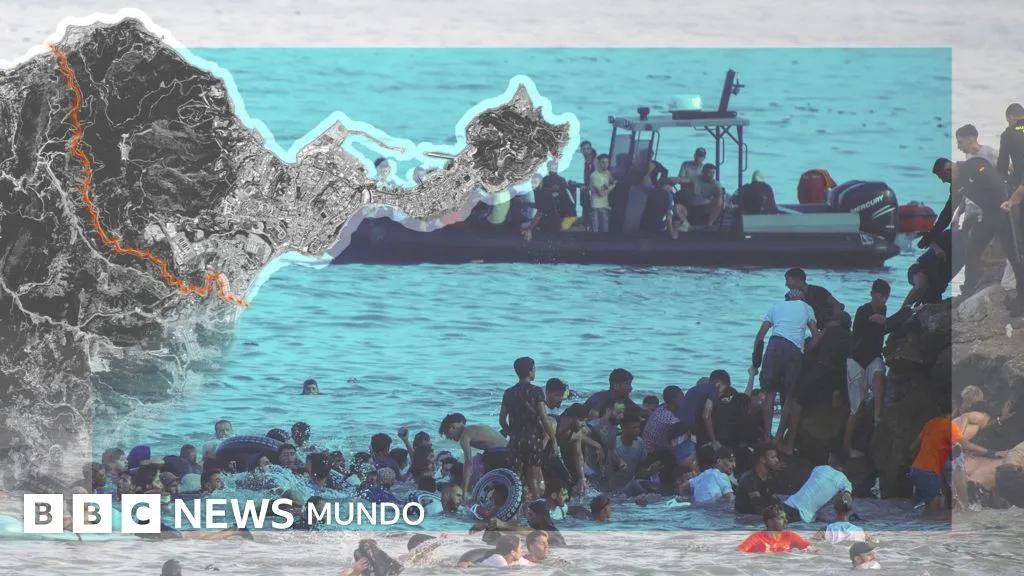

Recent Surge of Migrants in Ceuta
In a dramatic turn of events, thousands of migrants have crossed the border from Morocco into Ceuta, a Spanish enclave located in North Africa. This influx has prompted the Spanish government to deploy military forces to manage security in the region. Approximately 50,000 individuals are estimated to have breached the barriers separating Morocco from this autonomous Spanish city, marking one of the largest migratory waves Spain has witnessed in recent years. This staggering number eclipses the total of irregular migrants who have entered Ceuta and Melilla by land over the past decade. Tragically, reports indicate that at least 57 people have drowned at sea as they attempted to make the perilous crossing.
Ceuta is strategically located at the entrance of the Mediterranean Sea, right at the Gibraltar Strait, making it a critical point for migrants seeking to reach European territory. Over the past week, many have scaled border fences or attempted to swim to the shores of Ceuta from the El Tarajal border pier. The situation has sparked significant concern, with local authorities in Ceuta, led by the opposition Popular Party, urging President Pedro Sánchez to declare a national emergency to access extraordinary resources to address the crisis.
Historical Context and Ongoing Tensions
The recent surge in crossings is not an isolated incident; Ceuta has been a focal point for migration crises and diplomatic tensions between Madrid and Rabat in recent years. In May 2021, Moroccan authorities withdrew their border controls, allowing around 8,000 people from Morocco and sub-Saharan African countries to enter Ceuta within just two days. This move was largely perceived as retaliation against Spain for allowing a leader from the disputed territory of Western Sahara to receive medical treatment in a Spanish hospital. Diplomatic relations only began to improve after Spain's government reassessed its historical stance on Western Sahara and engaged in dialogue with King Mohammed VI of Morocco.
Ceuta and Melilla are unique as they represent the only land borders of the European Union with Africa and are situated merely 400 kilometers apart on the African Mediterranean coast. Under Spanish sovereignty since the 17th century, Ceuta is home to a diverse population of Christians, Muslims, Spanish residents, and Moroccans, coexisting relatively harmoniously. However, Morocco does not officially recognize Ceuta and Melilla as Spanish territory, often referring to them as occupied lands. The construction of the Ceuta Fence in 1971, a metal barrier stretching 8 kilometers and designed to prevent unauthorized entry from Morocco, has been a contentious issue. Despite criticism from human rights organizations, the Spanish government and the European Union have defended the fence's upgrades as necessary for migration control and regional security. Currently, around 3,000 military and Civil Guard personnel are stationed in Ceuta under normal circumstances, but additional troops have been deployed in response to the recent crisis, which has been described as escalating out of control.
El Tarajal beach, located at the end of the Ceuta Fence and equipped with customs and border control facilities, serves as a primary crossing point for many migrants. During both the recent emergency and the earlier crisis in 2021, this beach has been a critical transit location for individuals seeking to reach Spanish soil. According to Spanish law, irregular migrants arriving by land are assisted by the Civil Guard or the Red Cross and are taken to Temporary Attention Centers for Foreigners (CATE) or Temporary Immigrant Stay Centers (CETI). However, these facilities have struggled to cope with the massive influx observed this week. President Pedro Sánchez, during his visit to Ceuta, described the situation as a violation of Spain's territorial integrity and borders. As of the latest reports, at least 48,000 of the migrants who crossed the border have already returned to Morocco.
As reported by bbc.com.