
Widespread Demonstrations Across Spain
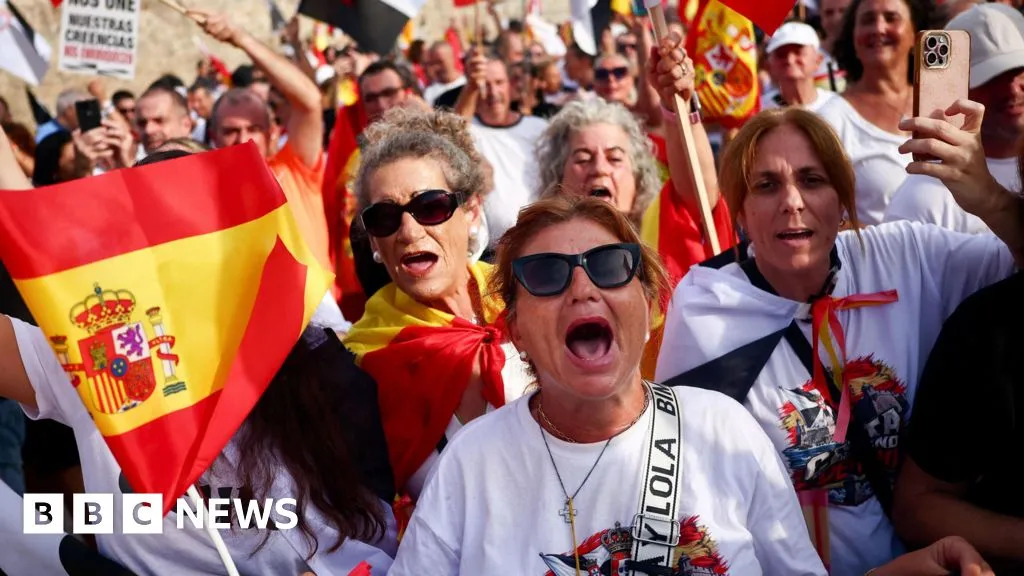
In recent days, thousands of individuals have taken to the streets in various cities across Spain, voicing their discontent regarding the government's management of a significant influx of migrants into the Spanish exclave of Ceuta, located on the North African coast. The situation has sparked a fierce political debate, with opposition parties vehemently criticizing Prime Minister Pedro Sánchez for what they perceive as a neglectful response to the crisis facing Ceuta's residents. In contrast, the government has accused right-wing factions of exploiting the ongoing situation for political gain.
On Wednesday, a police report revealed that Moroccan security forces exhibited "total permissiveness" during the unprecedented surge of migrants, contradicting Sánchez's assertion that Morocco bears no responsibility for the situation. Instead, the Prime Minister has attributed the mass crossings to human trafficking networks and misinformation disseminated online, while Morocco has firmly denied any involvement in the crisis.
Ceuta's Migrant Dilemma
The scale of the migrant influx was staggering, with at least 72,000 individuals crossing from Morocco into Ceuta on July 30 and 31. Although the vast majority have since returned, approximately 5,000 remain in makeshift camps or scattered throughout the city, including on the beach, leading to heightened tensions and unrest within this autonomous region. This situation has not only caused distress among local residents but has also intensified the political crisis for Sánchez's government.
Protests have become a near-daily occurrence, with local demonstrators demanding the immediate repatriation of migrants or their redistribution throughout Spain. The recent rallies were organized by city councils across Spain, particularly in regions governed by opposition parties such as the conservative Partido Popular (PP) and the far-right Vox party. During the significant gathering in Madrid, which attracted over 50,000 participants according to government estimates, PP leader Alberto Núñez Feijóo declared, "A Spanish city has been invaded, occupied and, unfortunately, this happened with the knowledge of the Government of Spain." Vox leader Santiago Abascal also joined the protests, accusing Sánchez of being subservient to the Moroccan regime.
In Ceuta itself, demonstrators chanted slogans emphasizing the need to defend their territory, stating, "Ceuta is not for sale, Ceuta must be defended." Many residents, like 45-year-old teacher David Hernandez, expressed frustration over the government's inadequate and delayed response, emphasizing that they cannot accept being treated as second-class citizens and insisting that their borders must be protected.
As pressure mounts on Sánchez's administration, Spanish media reports have highlighted a police document submitted to the National Court, which suggests possible complicity of Moroccan gendarmes in facilitating the migrant crossings. The report indicated that the number of Moroccan police along the border was significantly lower than usual and mentioned a "passive attitude" observed among Moroccan authorities during the incident. However, it stopped short of directly blaming Morocco for the surge.
Ceuta, along with its counterpart Melilla, has long been a contentious issue in Spanish-Moroccan relations, with Morocco asserting a historical claim over both cities. Adding to the complexity of the situation, social media platforms saw a surge of posts in August depicting the border fence as a safe and easily traversable route, despite the tragic reality that at least 100 individuals lost their lives attempting to navigate the perilous waters around the border fence, according to local officials. Prior to the influx that began on July 30, Spanish fact-checking site Maldita reported that Moroccan social media accounts were actively encouraging crossings, especially following a ruling from Spain's Supreme Court in June.
As reported by bbc.com.