
Police Insights on the Mass Influx to Ceuta
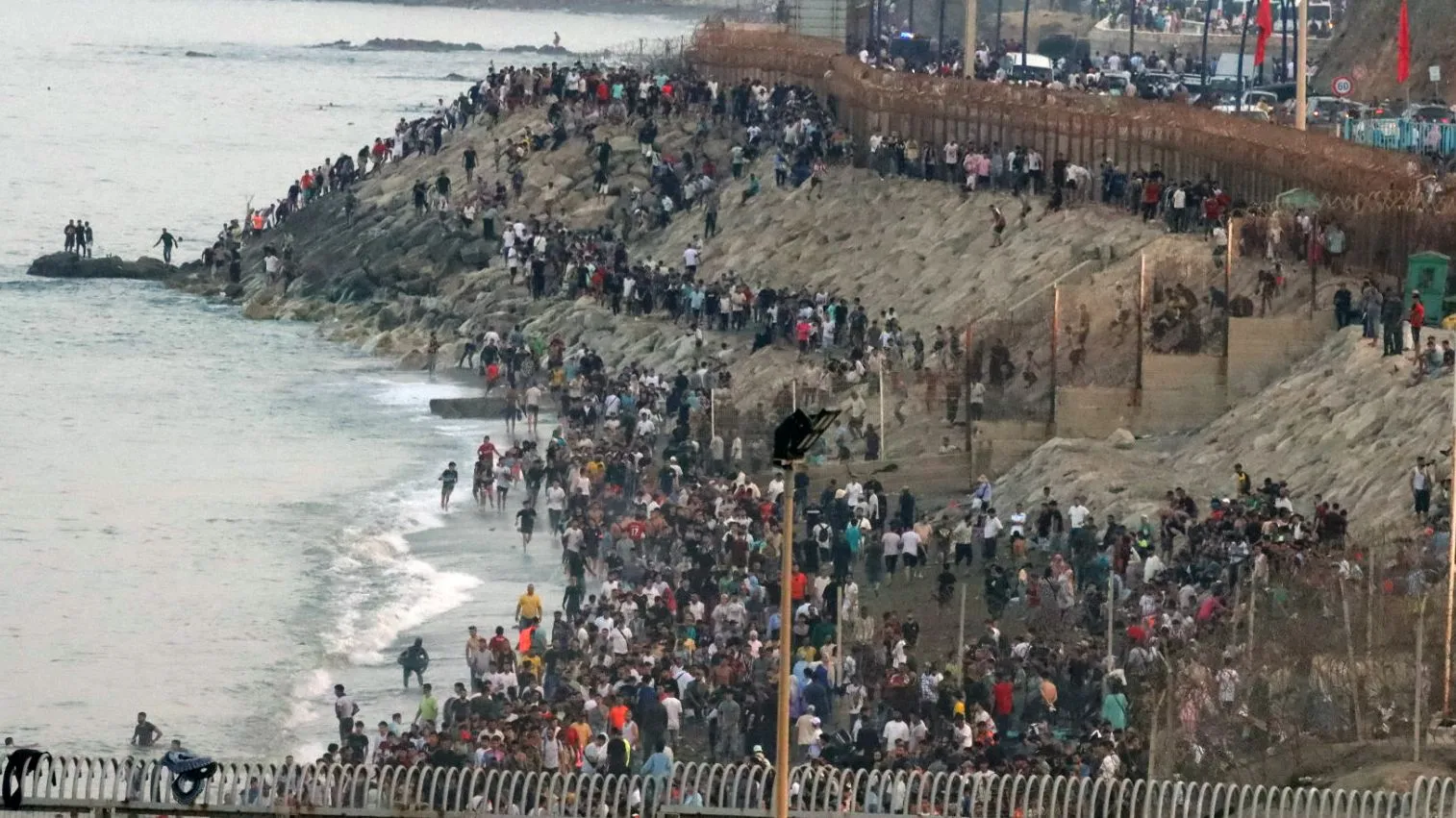
On September 2, 2026, the National Immigration and Border Center (CENIF) of the police issued a warning regarding the risk of a massive entry into Ceuta, which indeed occurred with over 72,000 individuals arriving in the autonomous city on July 30 and 31. According to a report accessed by RTVE, the police identified a troubling level of leniency among Moroccan agents, suggesting their complicity in a 'guided' assault orchestrated by the Moroccan authorities. Despite the government's firm denials of Morocco's involvement over the past month, evidence within the report points towards a coordinated effort to facilitate this unprecedented influx.
The extensive 57-page document submitted to the investigating judge meticulously details the events leading up to and following the mass entry, including video and satellite imagery that underscore what the police describe as a 'massive violation of Spain's territorial sovereignty.' This incident coincided with Morocco's Throne Day festivities, an alignment that the report deems 'neither coincidental nor innocuous.' Here, we delve into the key findings of the police report, which the government has claimed to have had no prior knowledge of until its public release.
Social Media Monitoring and Preemptive Alerts
In the days leading up to the mass entry, police were able to identify messages circulating on social media that hinted at impending events. Notably, on the day prior to the influx, the police noted a significantly reduced level of security deployment compared to the usual presence. The official celebrations in the nearby town of Rincón, which involved the Moroccan royal family, appeared to exacerbate the situation by spreading the message that the security forces were occupied, effectively leaving the border 'unprotected.'
The police's social media monitoring revealed warnings about potential attacks on Throne Day, which prompted CENIF to issue an initial alert regarding the risk of mass entry on July 29. Prior to this, agents had been tracking various online groups and forums, observing that the dissemination of such alarming messages began on Facebook and later transitioned to closed WhatsApp groups. A marked increase in activity was detected between July 24 and 28, culminating in a staggering 3,362.1% rise in messages on the day of the assault compared to the previous day. These messages were not random but followed a pre-established pattern designed to maximize impact.
On July 30, satellite images indicated a notably sparse police and military presence on the Moroccan side of the border. The police report details how the mass entry was facilitated not only by social media messages but also by instructions from Moroccan security forces, some of whom were seen guiding individuals across the water to the beach. The police characterized Morocco's response to the influx as one of 'total permissiveness,' with no serious attempts made to disperse or control the large group of individuals approaching the border.
Moreover, the report highlights the presence of individuals described as 'non-uniformed facilitators' who actively directed and monitored the flow of people during the mass entry. These individuals, who appeared integrated within the crowd, were noted for their assertive behavior and leadership qualities, often instructing uniformed personnel on-site. Such observations led investigators to conclude that the event was not spontaneous but rather part of a well-planned operation requiring significant influence over social media and connections to Moroccan security forces.
In addition to the organized nature of the event, the police identified distinct profiles among the groups that entered in three separate waves. The first wave primarily consisted of young Moroccans aged 18 to 25, aimed at overwhelming border control efforts. The second wave saw a significant representation of families with women and young children, a strategic move designed to diminish the capacity for law enforcement to respond effectively. The third wave reverted to the original profile of young males, all of whom exhibited a sense of calm and perceived impunity, suggesting a tacit understanding with Moroccan security forces.
Ultimately, the police report strongly refutes the government's narrative that criminal organizations were behind this massive entry, asserting that such groups lack the capacity to orchestrate movements of this scale. The investigators concluded that there was no evidence to suggest any criminal entities were involved in the planning or execution of this operation, countering the official stance from the beginning of the crisis.
As reported by rtve.es.