
Recent Developments in Ceuta's Migrant Crisis
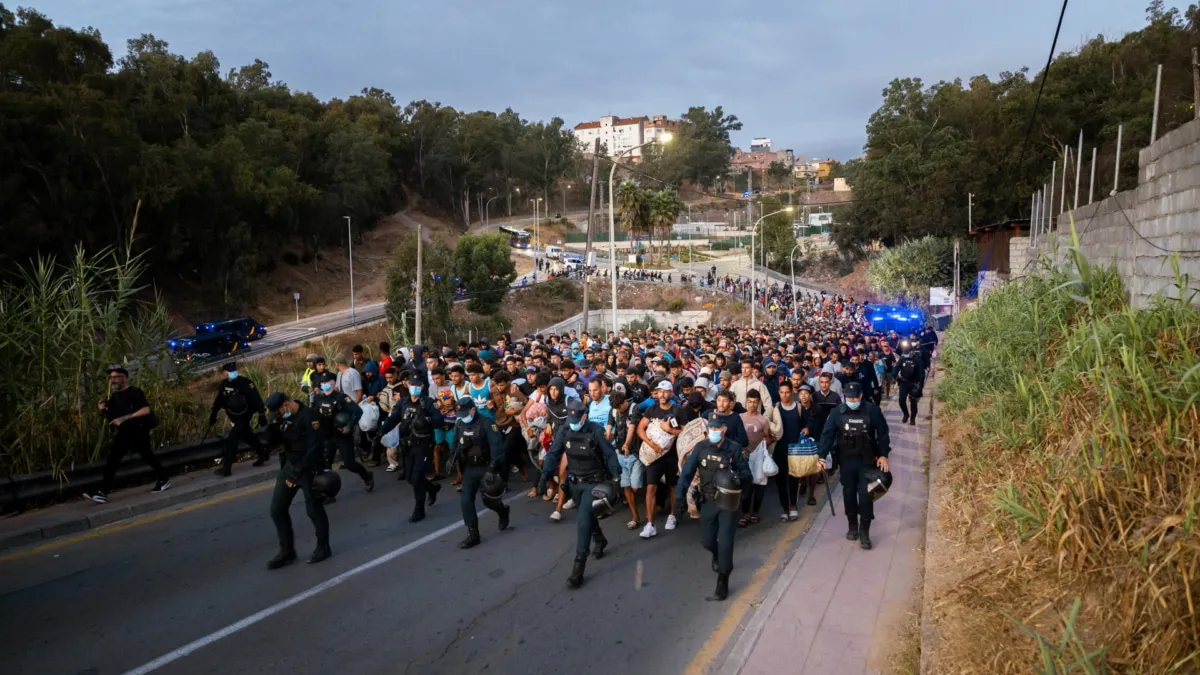
In the early hours of Friday, a significant surge of migrants attempted to cross into Ceuta, one of Spain's two enclaves located in North Africa. This situation has prompted urgent discussions among EU member state experts, as announced by a representative from the Irish presidency. EU Migration Commissioner Magnus Brunner reassured the public that no individuals had crossed over to mainland EU territory. According to Spanish Foreign Minister José Manuel Albares, nearly all of the estimated 50,000 irregular migrants who entered Ceuta have been returned to Morocco. Tragically, at least 57 individuals lost their lives while attempting to traverse the sea to reach Ceuta.
Following the arrival of tens of thousands of migrants in Ceuta, EU Parliament Vice-President Katarina Barley has called for increased support from the European Union for Spain. Barley expressed concerns that migration may be strategically used as a pressure tactic by interested parties, emphasizing the need for the EU to unite and support Spain in managing the local situation effectively.
Calls for Enhanced Border Security and EU Solidarity
As the situation in Ceuta escalates, migrants have also attempted to breach the borders of Melilla, albeit in smaller numbers, leading to clashes with police forces. Manfred Weber, a prominent European politician from the CSU, has advocated for strengthening the European border protection agency, Frontex, highlighting that Ceuta represents not just a Spanish but also a European border. Weber criticized the Spanish government's lack of engagement with European assistance, insisting that measures must be taken to prevent a repeat of such incidents.
In response to rising criticism and countermeasures from other EU nations regarding the influx of migrants, Spanish Prime Minister Pedro Sánchez has stressed the importance of adhering to European treaties. He underscored that solidarity and compassion are voluntary, whereas compliance with European agreements and data is not. Sánchez also pointed out that data from Frontex indicates that Spain is not the primary entry point for irregular migration into the EU, with significantly higher numbers reported through routes like Italy, the Western Balkan route, and Greece.
Amid these developments, the Italian government has temporarily suspended the Schengen Agreement on free movement concerning Spain, citing failures in protecting the Schengen Area's external borders. Italian Interior Minister Antonio Tajani stated that this decision was necessary to ensure the safety of citizens and to safeguard European borders. Reports from Italian news agencies confirmed the closure of maritime and air borders to Spain, which is expected to affect travelers using air and sea transport.
As the crisis unfolds, reports indicate that only around 1,700 of the original 50,000 migrants remain in Ceuta, with over 48,300 having voluntarily returned to Morocco by Friday evening, according to the Spanish Interior Ministry.
As reported by t-online.de.