
Mauritania's Political Landscape: A New Chapter Under Ould Agay's Leadership
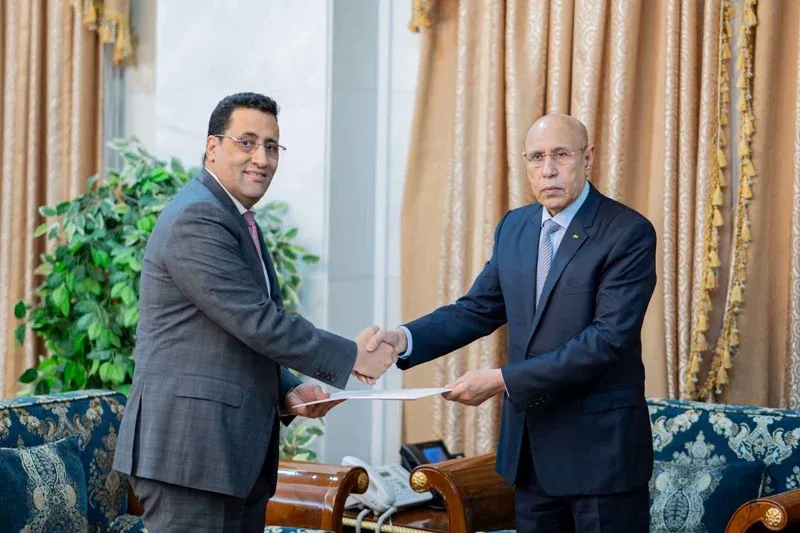
In a significant political move signaling confidence and continuity, the presidential palace of Mauritania has announced the reappointment of Mokhtar Ould Agay to form a new government. This decision comes in the wake of the resignation of his previous government, which took place last Friday, following what local media described as a controversial release of an investigation report regarding the fires at electricity stations in the capital and the widespread power outages affecting various areas around Nouakchott.
This appointment reflects President Mohamed Ould Cheikh Ghazouani’s ongoing commitment to relying on national and technocratic competencies capable of navigating the complex developmental and diplomatic challenges during a critical phase in the history of a nation facing significant developmental and economic hurdles.
Mokhtar Ould Agay's academic background is rooted in Morocco, where he attended the National Institute of Statistics and Applied Economics (INSEA) in Rabat, earning a degree in statistics and planning in 1997. He subsequently pursued further education at the University of Toulouse in France, graduating with a degree in statistics and econometrics in 2002. His professional journey began early, as he held the position of information systems manager for the employment market within the National Employment Policy project, funded by the United Nations Development Programme, from 1998 to 2003. Following this, he took on the role of monitoring and evaluation manager for an educational and training project, in addition to managing a consultancy firm specializing in statistical and economic research.
Ould Agay's initial foray into formal governmental work occurred in 2008 when he was appointed as an advisor to the Minister of Education, responsible for strategies, monitoring, and evaluation. Two years later, he became the Director General of Taxes, a role he held until early 2015 when he transitioned to the position of Minister of Finance, later overseeing the Ministry of Economy and Finance from February 2016 until August 2019.
In his latest role, the newly appointed Prime Minister has unveiled a new government composition, which sees ten previous ministers leaving their posts, including those overseeing the ministries of defense, interior, energy, Islamic affairs, culture, and economic and financial affairs. Throughout his political career within the Mauritanian government, Ould Agay has faced sharp criticism from opposition forces, extending even after his reappointment as Prime Minister. Opposition parliamentary member Biram Ould Dah Obeid has pointed out that Ould Agay bears significant political responsibility for the perceived failures in the state's performance, suggesting that keeping him in his position indicates a continuation of the same policies and a disregard for the change that Mauritanians have called for.
Just hours after his government’s resignation, President Mohamed Ould Cheikh Ghazouani reinstated Mokhtar Ould Agay as Prime Minister, while approximately 17 former ministers retained their positions in the new government lineup. Key figures such as Mohamed Salem Merzouk, Minister of Foreign Affairs, and Mohamed Ould Soueidate, Minister of Justice, have remained in their roles, while three former ministers have transitioned to other ministries. Notably, new names have appeared in this cabinet, including Ba Ousmane, who has been assigned the defense portfolio, and Mohamed Ould Abdel Fattah, who has taken on the Ministry of Energy.
As reported by hespress.com.