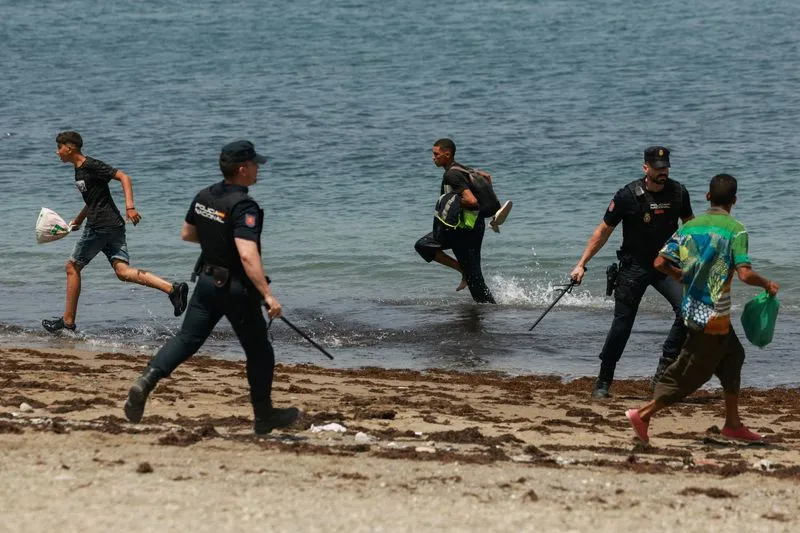

Migrants who recently attempted to enter Spain's African enclave of Ceuta via swimming or scaling fences faced a harsh reality upon arrival, which ultimately led many to return to their homes. Reports from FNIDEQ, Morocco, indicate that on Saturday, these individuals, who had initially been lured by viral social media posts and messages from friends, expressed feelings of hunger, exhaustion, and hostility from local residents, all of which shattered their aspirations for a new life in Europe.
Among those who returned was Brahim, a bakery worker from Fez, who had left his job behind after witnessing videos of thousands of others successfully crossing the border. He voiced his disillusionment, stating, "We came to make progress, not to be fooled." Brahim's experience in Ceuta was far from the hopeful vision he had imagined; he struggled to find food, surviving solely on water for three days due to inflated prices, remarking incredulously on the cost of a simple tuna sandwich, which was priced at 100 dirhams (approximately $10.75).
The atmosphere in Fnideq, the Moroccan city adjacent to Ceuta, was markedly different from the bustling scenes of earlier in the week. The streets were nearly deserted, a stark contrast to the throngs that had gathered just days prior. Many young men could be seen departing the border area, either walking along the highway or waiting for taxis, with local businesses shuttered for several days. The returnees reported a lack of basic necessities, as supermarkets and shops remained closed, leaving them to search for food and water while their wet clothes dried in the sun.
One individual, who worked at Morocco’s Tanger Med port, described Ceuta as feeling like a prison with no opportunities, stating, "Everything was closed." There were also concerning reports of local hostility; some migrants claimed they were attacked or forced out by residents of El Principe, a predominantly Moroccan neighborhood within Ceuta. While these accounts were not independently verified, they added to the grim narrative of their experiences. Yassine Ichou, a Moroccan waiter, recounted his own harrowing experience of being chased away, saying, "They imposed a siege to force us to leave Ceuta by ourselves … They succeeded in their plan."
In the wake of these events, Spain’s Interior Ministry reported two minor injuries from separate knife attacks, leading to the arrest of one assailant, but confirmed that no fatalities had occurred since Thursday. Meanwhile, in Fnideq, local businesses were feeling the impact of the migrant influx; Rachid, a hotel worker, noted that all six of his kitchen staff had crossed into Ceuta and had not yet returned, leaving management scrambling to find replacements.
Despite the turmoil, some cafes in Ceuta began to reopen, with customers returning as the city slowly returned to a semblance of normality. However, many shops continued to remain closed, while police patrolled the streets, demonstrating a heightened security presence. Marina Castaño, a 24-year-old café owner, expressed the delicate balance of resuming business while prioritizing safety: "We’ve taken the initiative to open because, ultimately, life has to return to its normal rhythm, but our safety and that of our staff always comes first." Yet, tension remained palpable in some areas, especially on the outskirts of the city.
An aid worker at a migrant reception center confirmed that it was currently at capacity and unable to accommodate any additional individuals, estimating that thousands may still be stranded within the enclave. Tito, a local hardware store owner whose shop remained closed, reflected on the overwhelming nature of the situation, stating, "You feel overwhelmed and, at the same time, helpless. Those young people, they’re being completely exploited. They’re being used as bargaining chips." One particularly determined migrant, 43-year-old Sudanese Mohamed Ahmed, shared his arduous journey, having swum for four hours to reach Ceuta after being dropped off by a truck. Despite police blocking access to migration centers, he remained resolute in his determination to stay in Spain, proclaiming, "I’m not going back. I’d rather die trying here."
As reported by wtvbam.com.