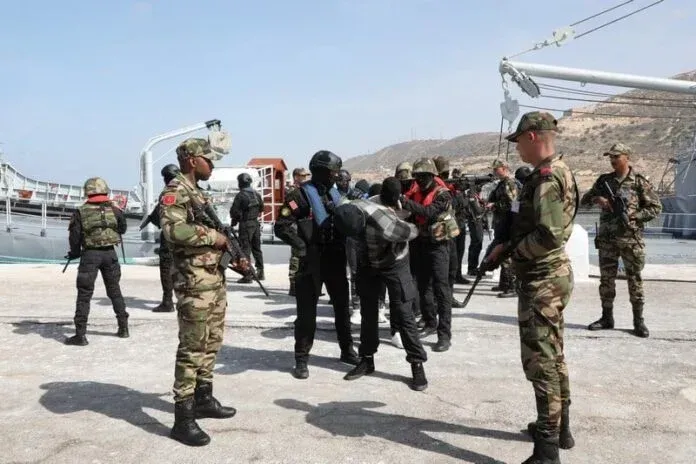

Analyzing Military Strengths: A Comparative Overview
The assessment of military capabilities reveals a complex landscape of strengths and weaknesses between Morocco and Spain, as indicated by a specialized platform that evaluates military power. While Morocco boasts a significantly higher active military personnel count of 400,000 compared to Spain's 121,802, the disparity is even more pronounced in reserve forces, with Morocco holding 250,000 reservists against Spain's 24,033. This numerical advantage is noteworthy, especially considering the population sizes, with Morocco's 37.4 million inhabitants being less than Spain's 47.3 million.
In terms of ground forces, Morocco enjoys a favorable position in several categories. Notably, the Kingdom possesses 1,346 battle tanks, vastly outnumbering Spain's 298. Furthermore, Morocco has 544 self-propelled artillery units, compared to Spain's 96. Additionally, Morocco's arsenal includes multiple rocket launchers, a capability not recorded for Spain in the Global Firepower data. However, Spain maintains a significant edge in armored vehicles, with 49,324 units compared to Morocco's 17,594.
Air and Naval Power Disparities
The advantages tilt dramatically towards Spain when examining aerial and naval capabilities. Spain fields a fleet of 440 aircraft, surpassing Morocco's 271. The contrast is especially stark in the realm of fighter jets, where Spain operates 136 compared to Morocco's 84, and in attack helicopters, with 17 Spanish units versus just 6 Moroccan ones. On the naval front, Spain's maritime power is underscored by its possession of an aircraft carrier and two submarines, assets that Morocco does not have according to the Global Firepower rankings. Furthermore, Spain's total naval fleet comprises 175 vessels, significantly greater than Morocco's 100.
Financial resources allocated to defense further illustrate the military imbalance, with Global Firepower estimating Spain’s military budget at approximately $39 billion, while Morocco’s budget stands at $16.1 billion. Spain also benefits from superior infrastructure, boasting 365 operational airports as opposed to Morocco’s 48. Additionally, the extensive development of Spain's road and rail networks plays a crucial role in the overall logistics evaluation of military capabilities.
Despite these challenges, Morocco has the advantage of a larger territory, measuring 715,550 km² compared to Spain's 505,370 km², as well as a longer land border. The data considered by Global Firepower also highlights that Morocco has a higher natural gas production than Spain.
In summary, these statistics illustrate two distinct military profiles: Morocco stands out with its significant troop numbers, reserves, and various ground capabilities, while Spain benefits from a pronounced advantage in aerial and naval sectors, alongside superior budgetary resources and infrastructural development. It is essential to interpret the Global Firepower rankings as a comparative indicator rather than an absolute measure of military strength, as the mere count of equipment does not reflect their modernity, operational availability, training levels, interoperability, or the quality of command and intelligence systems. These factors can significantly alter the actual power dynamics between the two nations.
As reported by maroc-hebdo.com.