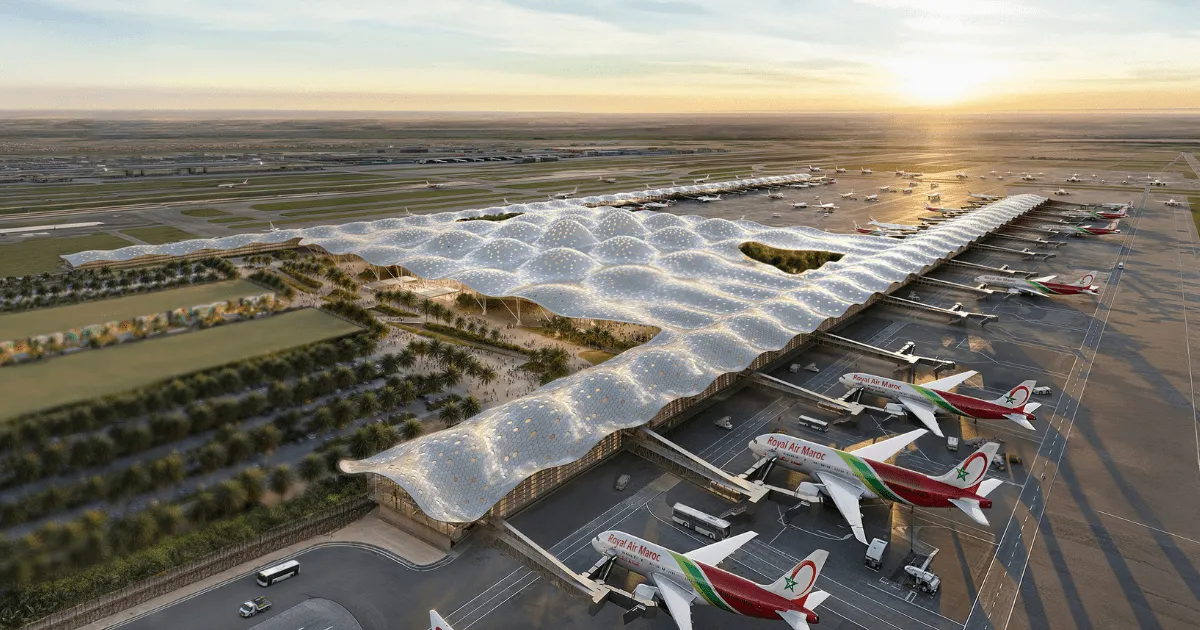

Moroccan Airports Excel in International Rankings
Recent reports reveal that both Mohammed V International Airport in Casablanca and Marrakech Menara Airport have secured their positions among the top ten busiest airports in Africa regarding passenger seating capacity for August 2026. This ranking is part of the latest assessment released by the African Airlines Association in early September 2026, highlighting the impressive growth trajectory of African aviation this summer.
As outlined in the ranking, the African aviation sector continued to thrive in 2026, bolstered by an increase in passenger traffic, the launch of new flight routes, and an expansion of fleet capabilities. Across the continent, the total passenger seating capacity rose by 8.8% in August 2026 compared to the same month in the previous year, while intra-African capacity saw a substantial increase of 10.5%. In this expanding aerial landscape, Morocco is reaffirming its pivotal role as a key link between Africa, Europe, and other global regions.
In the continental ranking prepared by the African Airlines Association for August 2026, Mohammed V Airport in Casablanca clinched the fourth position in Africa, showcasing a total capacity of 803,579 available seats during the month. This achievement solidifies Casablanca's unmatched status in North West Africa as a primary gateway to the continent, trailing only behind major aviation hubs in Cairo (1.85 million seats), Addis Ababa (1.25 million seats), and Johannesburg (1.14 million seats).
Marrakech Menara Airport, the second major airport in the kingdom, also demonstrated exceptional performance by joining the ranks of the continent's top ten, securing the tenth position with a record of 480,112 seats. This dual presence of Moroccan airports significantly contributes to North Africa's dominance, which alone accounted for 41.9% of the continent's total passenger seating capacity in August 2026.
This noteworthy achievement places North Africa well ahead of East Africa (22.7%), Southern Africa (18.3%), and Central and West Africa (17.1%). Beyond the dynamic airport infrastructure, the report highlights a significant improvement in the key performance indicators of airlines across the continent. Financially and commercially, the sector's health was reinforced with a 5.6% increase in passenger revenues recorded in July 2026.
This upward trend is sustained by a continuous growth in activity, evidenced by a 9% rise in available seat-kilometers and a 5.8% increase in passenger-kilometers transported during the same period. On intercontinental routes, African carriers have solidified their strategic position, capturing 62.4% of the total capacity operated in August.
However, this positive recovery is tempered by ongoing structural challenges, with the association noting a significant rise in aviation fuel costs on the continent, averaging $169.01 per barrel at the end of August 2026, compared to a more moderate global average of $163.87. In this context, as the International Civil Aviation Organization and the African Airlines Association intensify their efforts to realize a unified African air transport market and facilitate border procedures, Morocco emerges as a key player adeptly leveraging these developments.
As reported by achkayen.com.