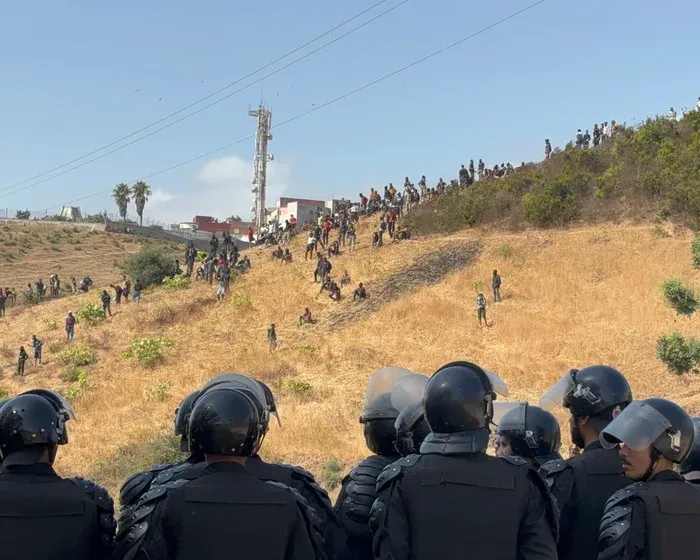

Moroccan law enforcement has recently intercepted a significant number of migrants attempting to cross into Ceuta, a Spanish exclave located in North Africa. Reports indicate that over 100 individuals were thwarted while trying to reach the border near the town of Fnideq, as confirmed by Moroccan security sources cited by various Spanish media outlets and the news agency Reuters. This interception comes just two weeks after a staggering influx of nearly 78,000 migrants arrived in Ceuta by sea within a very short period, leading to tragic consequences, including the reported deaths of around 100 individuals, as stated by the mayor of Ceuta. The majority of those who reached the exclave have since returned to Morocco.
In light of this recent surge, security measures in the region have been significantly intensified, especially following growing speculation on social media regarding a potential second mass crossing attempt. According to security reports, 111 migrants were detained in and around Fnideq, which is referred to as Castillejos in Spanish, located approximately 3 kilometers (1.8 miles) from the border. Most of these individuals hail from sub-Saharan Africa. Moroccan police, equipped with riot gear, resorted to using tear gas to disperse groups of migrants who had gathered on the hills surrounding the area.
This week, the Moroccan government indicated it was closely monitoring social media activity, particularly posts advocating for a mass crossing event scheduled for Saturday. Authorities warned that they would take legal action against both the organizers and participants of such gatherings. Meanwhile, the Spanish government has responded by deploying over 1,500 officers to patrol the border area, significantly bolstering security at the entry points. Reports from Spanish newspaper El País indicate that the level of security at the breakwater entrance was heightened to ten times that of the previous day, reflecting the urgency of the situation.
In addition to the increased police presence, Morocco has mobilized military personnel, navy speedboats, and drones to the border area, demonstrating the seriousness with which it is addressing the situation. Spain has also made preparations by installing a metal fence and a floating barrier to manage the influx of migrants more effectively. The crisis, which initially erupted in late July, has sparked diplomatic tensions among EU nations, particularly concerning the Schengen agreement of free movement. Italy has suspended this arrangement with Spain and implemented border checks on arrivals from the country, supported by Finland and Denmark, while the Czech Republic has called for a temporary suspension of Spain's Schengen membership.
In response, the Spanish government has expressed outrage, with Prime Minister Pedro Sánchez emphasizing that Ceuta is not part of the Schengen area, which means that the migrants could not travel to other European nations. Spain has urged Italy to cease its border controls, leading to reciprocal measures from Spain when Rome refused to comply, particularly in anticipation of a new influx around August 15. Italian Foreign Minister Antonio Tajani clarified that the country is not engaging in a 'battle' against Spain but is simply exercising caution in managing arrivals, suggesting that Spain should focus on the issues arising from Morocco rather than on Italy's border measures.
As reported by yahoo.com.