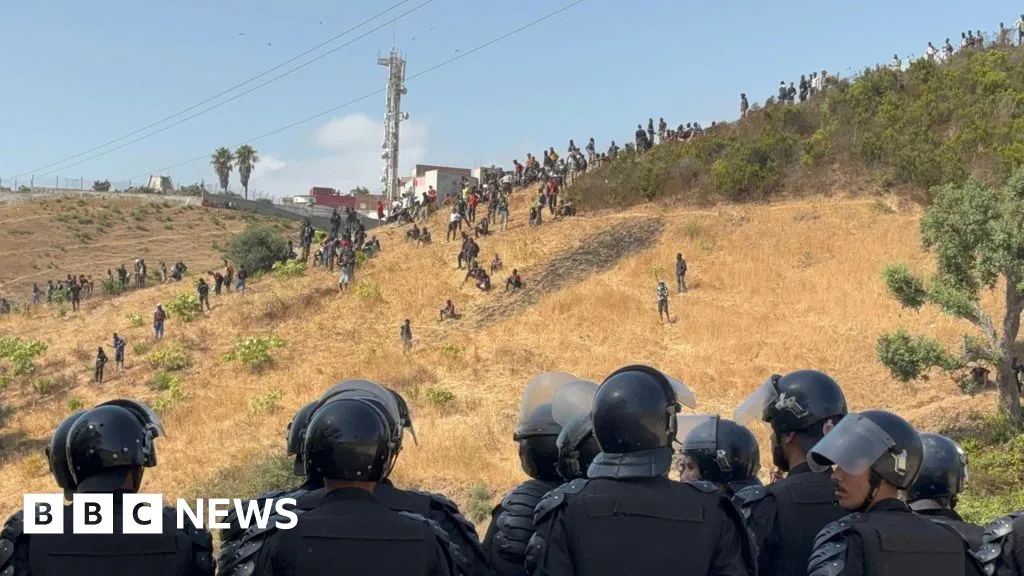

In a significant security operation on Saturday, Moroccan authorities successfully intercepted a group of over 100 migrants who were attempting to cross into the Spanish exclave of Ceuta. According to Moroccan security sources, as reported by various Spanish media outlets and the Reuters news agency, these individuals were blocked while trying to reach the border near the town of Fnideq, located approximately 3 kilometers from Ceuta.
This incident occurs just two weeks after a massive influx of approximately 78,000 migrants arrived in Ceuta by sea within a matter of hours, a situation that tragically resulted in the loss of around 100 lives, as confirmed by the city’s mayor. In response to the recent surge, both Spanish and Moroccan authorities have intensified their security measures in the region. There were concerns circulating on social media about a potential second mass crossing attempt over the weekend, prompting further reinforcement of border security.
The Moroccan security forces reported detaining 111 individuals in and around Fnideq, with the majority hailing from sub-Saharan Africa. In an effort to maintain order, Moroccan police, some of whom were equipped with riot gear, utilized tear gas to disperse groups of migrants who had gathered on nearby hillsides. Earlier in the week, the Moroccan government indicated it was closely monitoring social media posts advocating for a mass crossing, warning that anyone organizing or participating in such activities would face legal repercussions.
The security presence at the border has significantly increased, with Spanish newspaper El País noting that the security at the breakwater entrance was reported to be “ten times stronger” than the previous day. Alongside a newly installed metal fence and a floating barrier, Morocco has deployed army personnel, navy vessels, and drones to bolster border patrols. Meanwhile, Spain has contributed over 1,500 security officers to oversee the area.
While the crisis has reportedly subsided since its peak in late July, it continues to generate tensions among EU countries that maintain open borders and has led to criticism directed at the Spanish government. Notably, Italy has temporarily suspended its Schengen agreement with Spain, with support from Finland and Denmark, while the Czech Republic has called for a temporary suspension of Spain’s Schengen membership, despite Spanish Prime Minister Pedro Sánchez clarifying that Ceuta is not part of the Schengen zone.
As reported by bbc.com.