
Revolutionizing Drone Technology in Morocco
The Moroccan firm Ballistic Defense System (BDS) is making significant strides in the development of a new long-range autonomous drone that operates independently of satellite navigation signals. Based in Rabat, BDS is harnessing advanced technologies such as artificial intelligence, computer vision, and elevation maps, enabling the drone to autonomously determine its location and navigate its flight path, even in environments where GPS signals may be blocked or disrupted. This groundbreaking project is spearheaded by Fahd Laamoumi, a Moroccan aerospace engineer and CEO of BDS, who emphasizes the company’s focus on developing autonomous systems aimed at defense applications. According to Laamoumi, the latest prototype demonstrates the capability to fly with precision without relying on GPS, Glonass, or BeiDou systems, solely utilizing its onboard vision systems.
This innovative technology marks a significant advancement within Morocco's burgeoning ecosystem of unmanned aerial systems (UAS), which has seen a combination of local projects and collaborations with international companies in recent years. At the heart of BDS's project lies its advanced autonomous navigation system. Laamoumi explains that the drone employs conventional cameras and sensors to observe the terrain and compare real-time visuals against pre-stored world elevation maps. This approach eliminates the need for continuous receipt of coordinates from satellite constellations, as the onboard computer processes images and terrain data to calculate its trajectory.
Enhancing Military Operations with Autonomous Drones
The significance of this capability becomes particularly evident in military scenarios characterized by the proliferation of electronic warfare systems that can interfere with or spoof satellite navigation signals. Laamoumi asserts that the new system retains its flight capabilities even when satellite signals are unavailable. Furthermore, all necessary processing for navigation occurs onboard using a compact computer and commercial sensors. Navigation is just one aspect of the autonomous functionalities BDS is developing; Laamoumi has previously indicated that the company has been working for over a year on an intelligent drone capable of autonomously identifying, detecting, and colliding with targets. At that time, the focus was specifically on GPS-free navigation. The current design integrates multiple processing levels through artificial intelligence. According to the information released by Laamoumi, an initial system handles navigation, while subsequent algorithms manage target search and recognition, as well as the final approach phase.
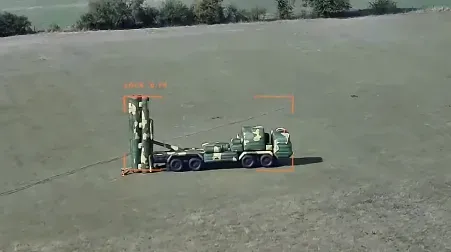
BDS claims that this architecture allows the system to perceive its environment, make autonomous decisions, and execute missions effectively. Laamoumi has described the development as a technology aimed at conducting long-range precision strikes. In recent statements, he noted that BDS has achieved the capability to reach targets located several hundred kilometers away, citing the S-400 air defense system as an example. However, this assertion originates from the manufacturer and has not been independently verified regarding its operational deployment or service entry. Some Moroccan media reports suggest that future drones from BDS could have a range of up to 2,000 kilometers, although this figure has not been officially confirmed by the manufacturer or in Laamoumi's recent statements.
Information released during the 2024 Marrakech Air Show indicated that BDS is working on a family of systems with varying ranges. Industry tracking sources have attributed a range of approximately 1,500 kilometers to the P2 model, with a payload capacity of up to 40 kilograms, while a third model, the P3, is designed for even greater distances. These details are derived from secondary sources and have not been corroborated by technical documentation published by BDS, hence the 2,000 kilometers claim should be treated with caution. What is firmly supported by the manufacturer's statements is that BDS is indeed developing a new generation of long-range autonomous drones, aiming to reduce reliance on satellite navigation technologies. Additionally, the project is presented as a technological advancement primarily driven by Moroccan engineers.
Laamoumi has stated that the BDS team consists mainly of Moroccan engineers and that the company has invested several years in developing algorithms, simulation processes, electronic integration, and autonomous control mechanisms. By late 2025, he noted that after two years of work and simulation testing, the company was entering the physical implementation phase of the system. In a subsequent publication, he mentioned that a team of Moroccan engineers had successfully developed a prototype capable of flying without GPS using artificial vision. BDS also claims that the system is designed for scalable production at a lower cost compared to comparable autonomous platforms. The development of BDS is part of a larger strategy by Morocco to enhance its industrial capabilities in the field of unmanned systems. The country has already initiated national projects, such as those developed by Aerodrive Engineering Services, the manufacturer of the Atlas Istar and the Mavrick loitering system, while also attracting international companies like Baykar, BlueBird Aero Systems, and Delair.
This growth in the industry is progressively transitioning Morocco from merely acquiring finished systems to manufacturing, integrating, and developing specific technologies domestically. For BDS, the distinctive element lies in its commitment to autonomy and artificial intelligence. While other Moroccan programs have concentrated on ISR platforms, loitering munitions, or local manufacturing of foreign systems, the Rabat-based startup aims to develop proprietary algorithms for navigation, target identification, and autonomous control. Laamoumi believes that GPS-free navigation is one of the critical areas in the evolution of autonomous systems. He argues that the ability to continue a mission when navigation signals are interfered with will differentiate future unmanned platforms.
The project is still in its developmental phase, and the final specifications of the system, including its maximum range, payload capacity, speed, autonomy, and potential operational use, have not been comprehensively published by BDS.
As reported by infodefensa.com.