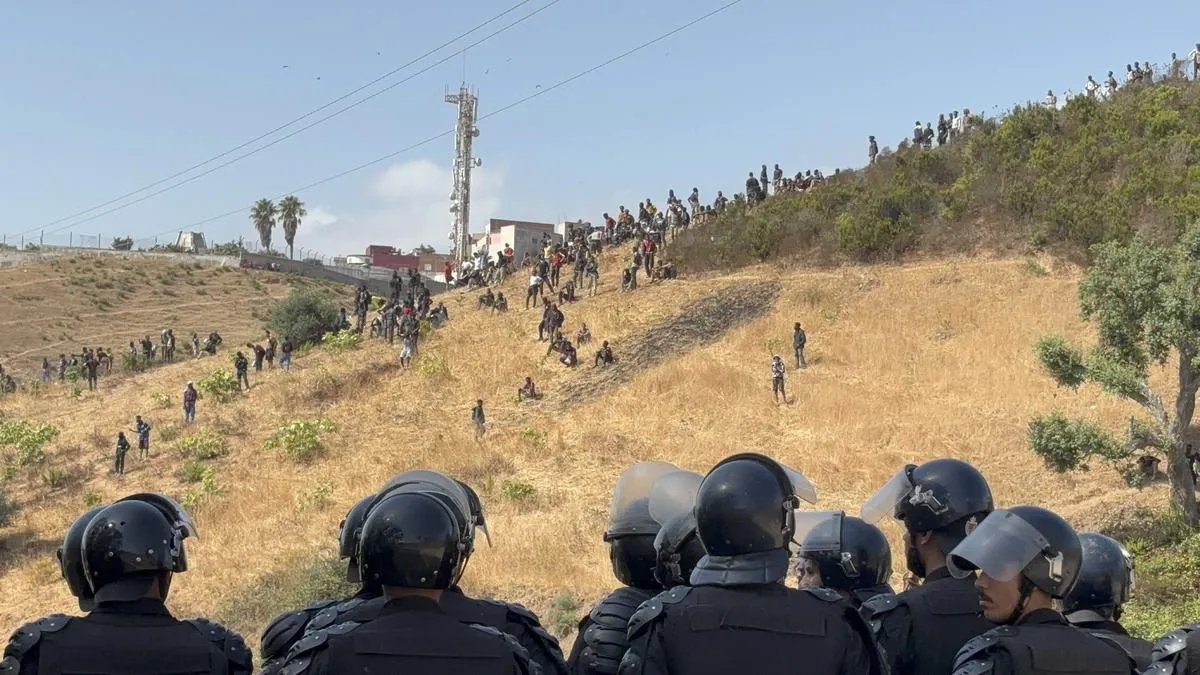

Moroccan Security Forces Intercept Migrants at Ceuta Border
On Saturday, Moroccan security forces successfully intercepted 294 migrants, predominantly from sub-Saharan Africa, who attempted to cross into Ceuta illegally from Fnideq (Castillejos). According to security sources, the intervention occurred approximately three kilometers from the Spanish border, in hilly terrain outside of Fnideq, as authorities worked diligently to prevent another mass entry into Ceuta. The operation was robust, supported by helicopters, drones, and police dogs, and included the use of tear gas to disperse the crowds.
Among those intercepted, 248 were identified as originating from sub-Saharan Africa, while 46 were Moroccan nationals. Security officials highlighted that such operations would persist in close coordination with local authorities and various security agencies. Notably, there were no reported collective infiltrations of irregular migrants into Ceuta on that day.
In addition, preventive operations conducted by the National Security Directorate in recent days resulted in the arrest of 61 individuals suspected of inciting and promoting irregular migration through social media channels.
Enhanced Security Measures Along the Border
In a bid to reinforce border security, Moroccan forces deployed six semi-rigid boats in the sea while thousands of Auxiliary Forces agents monitored the border perimeter, complemented by Gendarmerie units securing the mountainous areas. Morocco has also installed a new metal barrier approximately four meters high near the border to deter potential gatherings of individuals attempting to approach the border. This physical barrier was erected along the route connecting Fnideq to the Ceuta border crossing and aims to prevent direct access to the frontier.
The security presence is not confined to the immediate border area. Reports indicate that controls have been extended to the nearby town of Castillejos, just two kilometers from the Moroccan perimeter, where a primary security checkpoint has been established. Local sources have noted that the area is heavily monitored by military and gendarmerie forces.
Simultaneously, the Spanish side of the border has maintained a heightened security presence since the previous night. The Civil Guard's Maritime Service has been patrolling the waters, while military and National Police agents oversee the land border. This increased deployment follows a significant influx on July 30, when approximately 80,000 individuals crossed into Ceuta, as noted by Defense Minister Margarita Robles during her recent visit to the enclave.
The surge in border security has been prompted by social media calls suggesting a potential new mass crossing attempt around August 15, although information circulating online has yet to confirm any imminent large-scale arrivals. Thousands of personnel are involved in the preventive security operation organized by Rabat, aimed at thwarting mass crossings into Ceuta that were purportedly planned for Saturday.
In the backdrop of these developments, Moroccan authorities expelled journalists from Agencia Efe and TVE who were covering the situation in Fnideq, citing local instructions for immediate departure from their accommodations. A representative from the Moroccan Interior Ministry had previously requested that journalists leave the area without providing detailed explanations, merely stating compliance with orders.
The ongoing crisis has prompted criticism from political figures in Spain, including Jaime de los Santos, the Deputy Secretary for Education and Equality of the PP, who accused Prime Minister Pedro Sánchez of remaining “hidden” in his official residence on Lanzarote without addressing the ongoing migration crisis in Ceuta, which has seen over 80,000 citizens reportedly invade the enclave.
As reported by noticiasdegipuzkoa.eus.