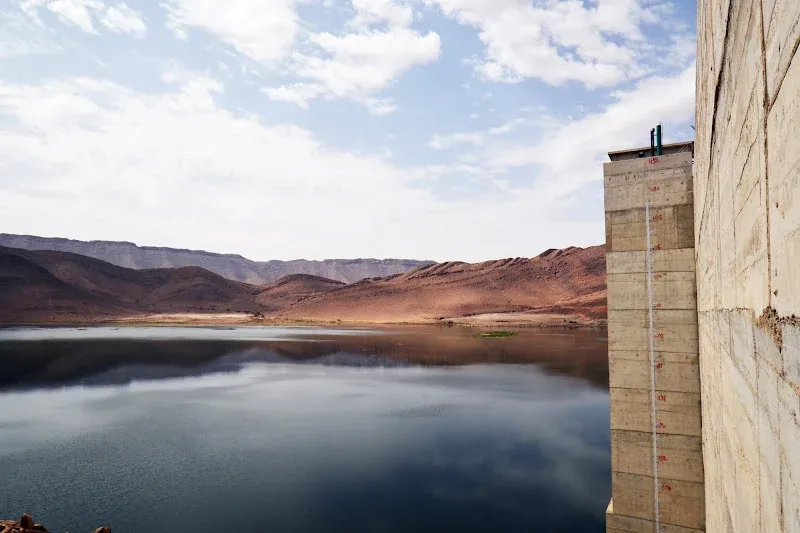

As of mid-August 2026, Moroccan reservoirs have demonstrated a remarkable resilience in their water storage capabilities, achieving a commendable 68.79% capacity despite a slight decline attributed to successive heat waves. This is a significant improvement compared to the same period last year, when the capacity stood at a mere 34.72%. According to the latest official data from the Ministry of Equipment and Water's Directorate of Research and Water Planning, this increase reflects a more than twofold enhancement in water reserves, now totaling approximately 11,713.81 million cubic meters out of an average capacity of 17,027.59 million cubic meters.
The Tansift basin leads the national rankings with a filling percentage of 83.78%, followed closely by the Sebou basin at 81.92%, the Loukkos basin at 81.72%, and the Abid Rekrak basin at 81.06%. Notably, the Amel Rabi basin has witnessed the most significant relative increase, with its main reservoir, the Al-Masira dam, rising from just 3.38% in 2025 to 40.70% this year. This remarkable jump translates to an increase in storage from approximately 90 million cubic meters to over 1 billion cubic meters.
The revival of the Al-Masira dam is particularly crucial as it serves as the second-largest water reservoir in the kingdom, playing a vital role in supplying potable water to the Casablanca-Settat region and irrigating agricultural plains in the Doukkala area.
Conversely, some basins are still lagging behind the national average, notably the Drâa-Tafilalet region at 32.82%, and the Ziz-Ghris basin, which experienced a decline from 48.63% to 41.39%. Other areas such as Sous-Massa (49.62%) and Moulouya (54.61%) also remain significantly affected by water stress, despite the overall improvement trend.
According to the government platform "Madiyalna", which focuses on water news in Morocco, several major dams have shown varying developments in their water inflows over a 24-hour period, particularly influenced by expected thunderstorms in mountainous regions. For instance, in the province of Sefrou, the "Allal El Fassi" dam topped the list with an impressive inflow of 1.2 million cubic meters, raising its capacity to 95.3%. Meanwhile, the "Ahmed El Hansali" dam in the Béni Mellal province recorded inflows of approximately 0.7 million cubic meters, increasing its capacity to 80.6%.
In contrast, the "Idris I" and "Unity" dams in the province of Taounate, both among the largest dams in the Fez-Meknes region and the Sebou basin, experienced declines in their water levels by 2.5 million cubic meters and 2.2 million cubic meters respectively, stabilizing their capacities at 78.3% and 86.3%. These fluctuations are part of the normal daily operational dynamics related to water discharge for drinking and irrigation purposes.
The data reflects a generally positive water season for most basins after years of water stress, although regional disparities warrant continuous monitoring, particularly in the southern and eastern basins that have benefitted less from recent rainfall. Overall, the observed daily activity across various dams indicates that while there are minor fluctuations related to daily discharges, the overall upward trend in the kingdom's water reserves this summer remains intact.
As reported by hespress.com.